13 Viruses, Viroids, and Prions
 Call Kai
 Learn
Learn Practice Test
 Spaced Repetition
 Match
Match Flashcards
 Knowt Play
1/36

There's no tags or description
Looks like no tags are added yet.
37 Terms
agents
Viruses, Viroids and Prions are collectively called [__]
→ not organisms/living → acellular: not composed of cells
→ lacks metabolic processes
Requires hosts in order to replicate themselves
![<p><mark data-color="yellow" style="background-color: yellow; color: inherit;">Viruses, Viroids and Prions are collectively called [__]</mark></p><p>→ not organisms/living → <strong>acellular</strong>: not composed of cells</p><p>→ lacks metabolic processes</p><p><span style="color: red;">Requires hosts in order to replicate themselves</span></p>](https://assets.knowt.com/user-attachments/bc1b8a81-e53d-418f-8c5a-10531b6658e9.png)
Viroid
Infectious RNA.
Short piece of ssRNA (single-stranded RNA) that varies in size, 246-375 nucleotides
All identified [__]s infect plants and cause plant diseases
eg.
potato spindle tuber → elongates potato’s and doesn’t make them as meaty
Chrysanthemum stunt → causes flowers to not be as big as they’d normally be
Prion
Infectious protein, i.e,
Proteinaceous infectious agents that are misfolded proteins. Also referred to as PrPSC (prion protein scrapie, in reference to scrapies in sheep where it was first found)
reproduces by ability to interact with and cause misfoldings in PrPc (prion protein, cellular), or normal proteins in our neurons
resistant to:
Proteases: enzymes that break down proteins
UV light
Standard autoclaving
transmitted by:
ingestion of contaminated food
transplantation
surgical instruments

transmissible spongiform encephalopathies
Prions causes fatal neurodegenerative diseases in their accumulation in neural tissue
→ brain tissue develops sponge-like holes
→ sponge-like appearance led to name of [__] (TSEs) » refers to all prion diseases
eg. in Animals
Scrapie in sheep
Mad cow disease in cattle
in Humans
Kuru → occurred due to cannibalism
Fatal familial insomnia → runs in families, as genotypes have proteins that are more likely to convert to abnormal form. Symptoms is being unable to sleep till death
Creutzfeldt-Jakob disease → occurs in older people. The missionary had this when Aborgines ate them, leading to Kuru
Variant Creutzfeldt-Jakob disease→ occurred from eating contaminated beef (mad cow disease)

Virion
Complete, infectious virus particle. Consists of only a nucleic acid and protein coat.
Obligate Intracellular Parasite
Viruses are [__], meaning they can only reproduce within their host cells
uses host machinery to replicate
inactive outside of host
eg. bacteriophage: a virus that infects bacteria
![<p>Viruses are [__], meaning <mark data-color="yellow" style="background-color: yellow; color: inherit;">they can only reproduce within their host cells</mark></p><ul><li><p>uses host machinery to replicate</p></li><li><p>inactive outside of host</p></li><li><p><u>eg.</u> <strong>bacteriophage</strong>: a virus that infects bacteria</p></li></ul><p></p>](https://assets.knowt.com/user-attachments/7a70bad0-115e-435f-b9ba-0f73c509f035.png)
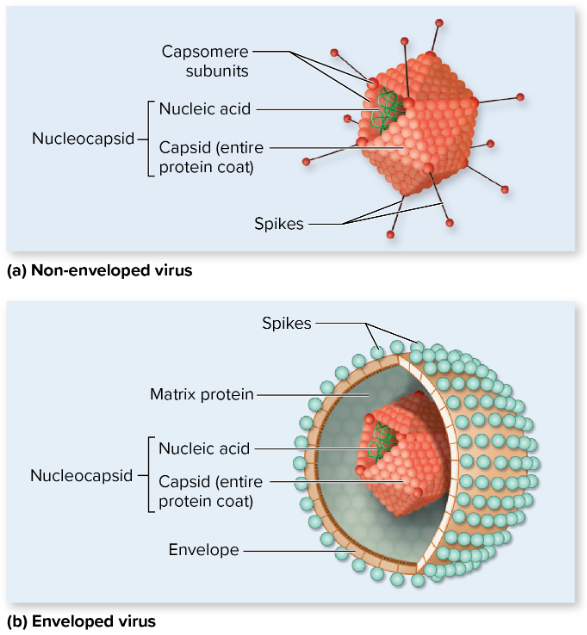
capsid
Viral structure. The protein coat of a virus. Surrounds the nucleic acid
» nucleic acid could only be either RNA or DNA (not both)
» together with the nucleic acid it surrounds, it becomes the nucleo[__]
![<p>Viral structure. <mark data-color="yellow" style="background-color: yellow; color: inherit;">The protein coat of a virus. Surrounds the nucleic acid</mark></p><p>» nucleic acid could only be either RNA or DNA (not both)</p><p>» together with the nucleic acid it surrounds, it becomes the <strong><mark data-color="purple" style="background-color: purple; color: inherit;">nucleo[__]</mark></strong></p>](https://assets.knowt.com/user-attachments/a010b7ff-d846-44a5-affb-aefbf3c0ae9f.png)
Envelope
Viral structure. Refers to the outer lipid bilayer, outside of the capsid, that some viruses have.
» naked viruses: viruses that lack an [__]
→ exit infected cells by lysing
» enveloped viruses: viruses that have a [__]
→ exit infected cells by budding
![<p>Viral structure. <mark data-color="yellow" style="background-color: yellow; color: inherit;">Refers to the outer lipid bilayer, outside of the capsid, that some viruses have.</mark></p><p>» <strong><mark data-color="purple" style="background-color: purple; color: inherit;">naked viruses</mark></strong>: viruses that lack an [__]</p><p>→ exit infected cells by <strong>lysing</strong></p><p>» <strong><mark data-color="purple" style="background-color: purple; color: inherit;">enveloped viruses</mark></strong>: viruses that have a [__]</p><p>→ exit infected cells by <strong>budding</strong></p>](https://assets.knowt.com/user-attachments/80245454-3feb-46b2-a766-3b7d1b99f8fb.png)
Spikes
Viral structure. Refers to the structures on the surface of a virus that help bind (adhere) to host cell receptors. It’s these structures that cause an immunological response by the host.
Icosahedral
1/3 of the shapes of a virus
Appears spherical when viewed with an electron microscope, but are actually 20 flat triangles arranged in a shape of a soccer ball
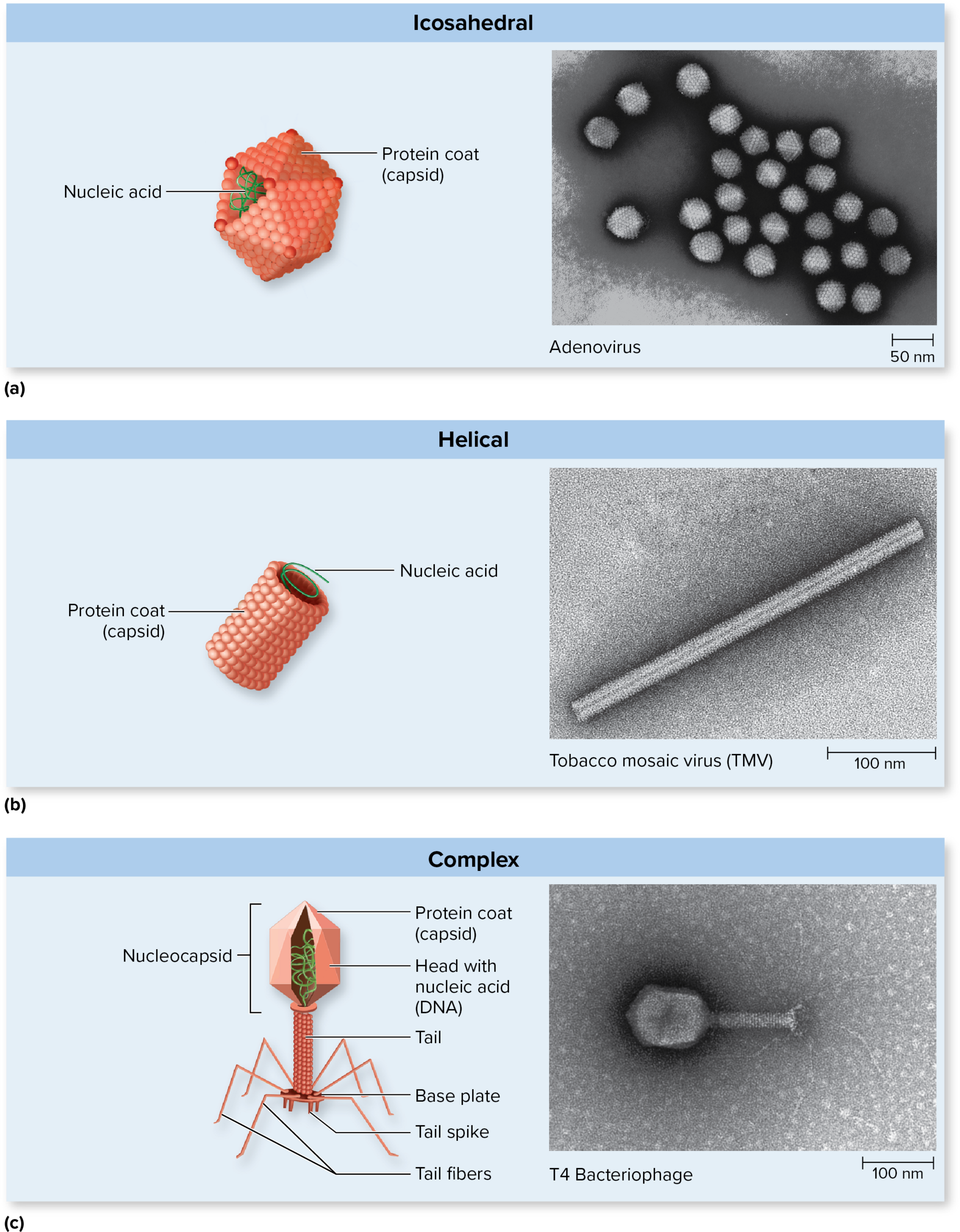
helical
2/3 of the shapes of a virus
Appear cylindrical when viewed with an electron microscope. Actually have their capsomeres arranged in a helix, similar to spiral staircase
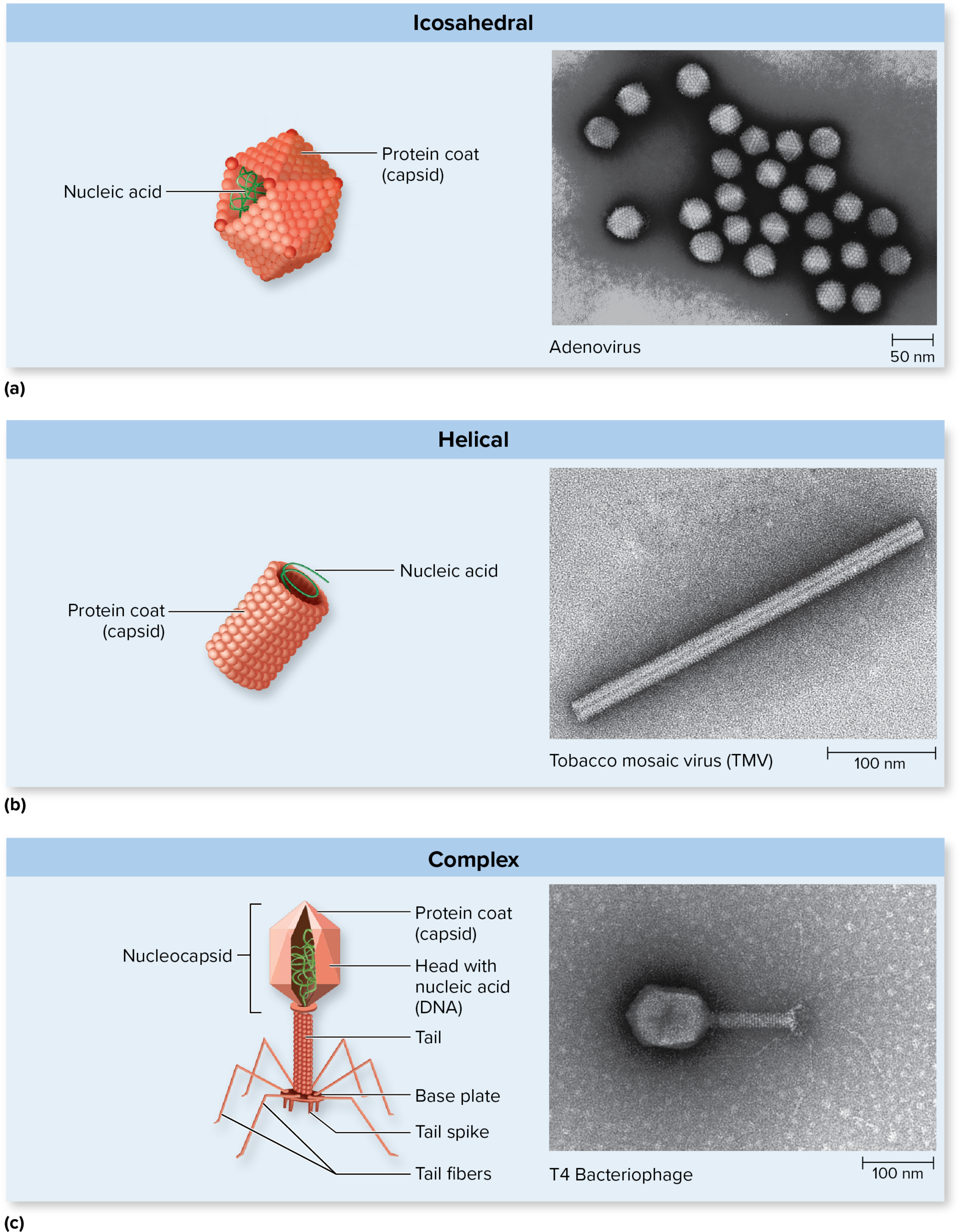
Complex
3/3 of the shapes of a virus
More complicated structures.
eg. Phages
» an icosahedral nucleocapsid head
» long helical protein tail that has other components attached to it
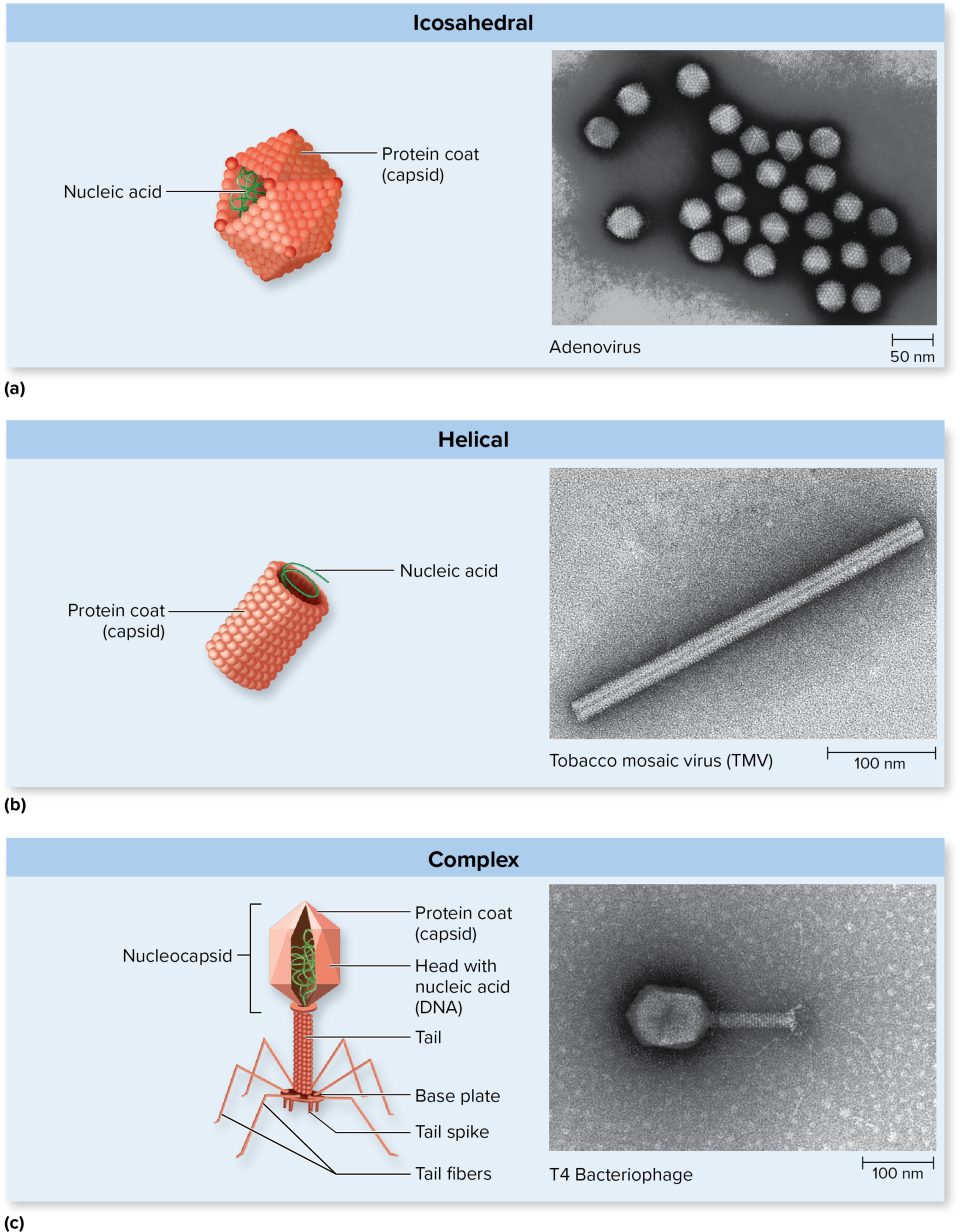
100
Viruses are notably small
10-[__]x smaller than bacteria
smallest is ~10nm (~10 genes)
largest is ~800nm

host range
Number of different hosts that a virus can infect. Usually limited to a single species for a single virus (as viruses can infect all life forms)
Further limited by:
absence of viral attachment (receptor) site on host cell surface
restriction-modification system in host cell → restriction enzymes cut up viral DNA to make sure host cell isn’t infected → something that a virus must overcome in order to infect
suitable
Viruses only multiply inside a [__] living cell, and thereby must face specific techniques and conditions in the lab to ensure their growth
plaque method
Method of growing bacteriophages in bacterial cells for lab
bacteriophages form plaques: clearings of agar from the bacteriophage causing bacterial lysing
each plaque rose from a single phage → plaque-forming units (PFU)
a single PFU represents a single infectious phage that successfully targeted and replicated in a host cell and lysed it
embryonated
Animal viruses are grown in
living animals (mice, rabbits, pigs)
[__] eggs → how flu vaccine is developed
influenza vaccine made in duck eggs
Tissue
[__] culture or cell culture grow human cells → used as host cell for viruses that can only infect humans
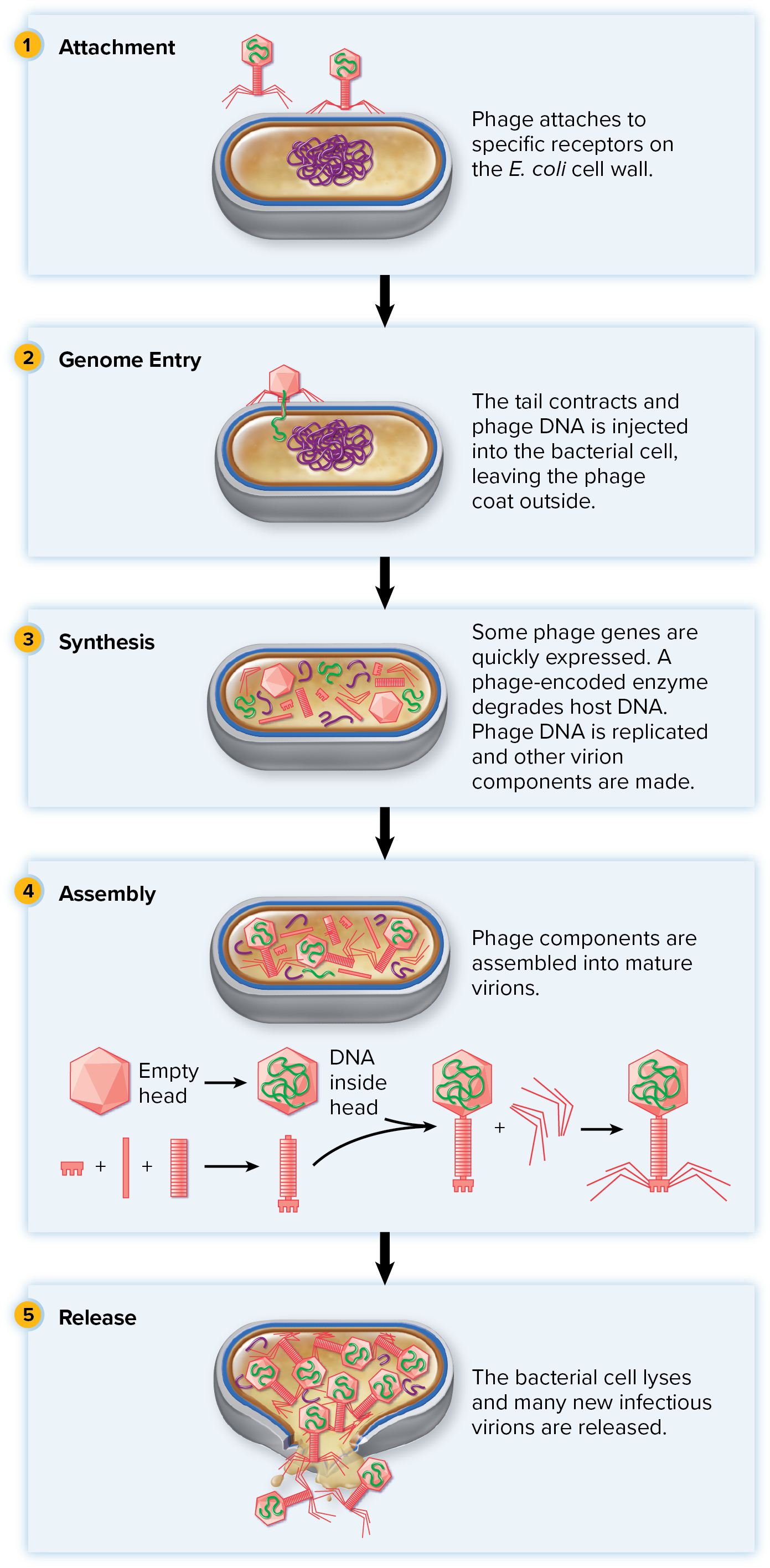
Lytic Cycle
½ Replication cycles undergone by bacteriophages to reproduce → this cycle is not exclusive to bacteriophages however
phages multiply inside a cell
phage lyses cell to release virions
5 step process:
attachment (adsorption as it removes virus from solution when attached to host cell)
penetration → DNA/RNA get injected in host cell
synthesis
→ Nucleic replication
→ Transcriptions/translation
assembly (maturation) done in a sequential manner
release
» has a burst size (number of viruses produced per bacterial cells) of T4 phage is 200 virions
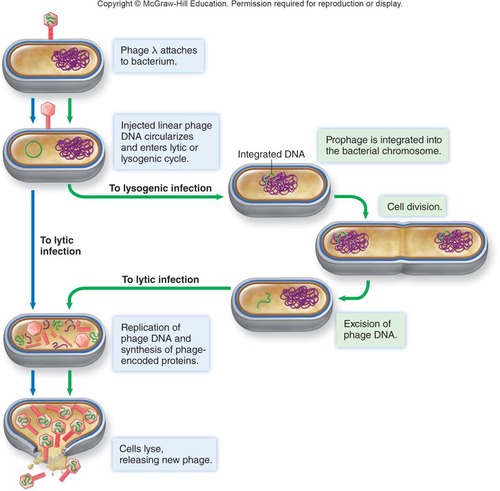
Lysogenic cycle
2/2 Replication cycles undergone by bacteriophages to reproduce → exclusive for bacteriophages
phage integrates its genome into the host genome
phage released without killing the host cell
Specifically undergone when replicating a temperate virus: a virus that can infect a host cell but does not immediately kill it (contrary to viral viruses)
→ can undergo both lytic and [__]s at different times
Steps:
Attachment
Penetration
Incorporation of viral DNA into host chromosome
» reverse transcriptase → turns viral RNA into DNA (cDNA)
» integrase: enzyme that inserts viral DNA into host genome
» prophage: what the virus is called (provirus in eukaryotes) when integrated into (doesn’t destroy) the host DNA
Viral DNA is replicated when the host cell replicates
Prophage can excise out (as it needs to be outside of the genome to replicate) and undergo lytic cycle
![<p><mark data-color="blue" style="background-color: blue; color: inherit;">2/2 Replication cycles undergone by </mark><strong><mark data-color="blue" style="background-color: blue; color: inherit;">bacteriophages</mark></strong><mark data-color="blue" style="background-color: blue; color: inherit;"> to reproduce</mark> → exclusive for bacteriophages</p><ul><li><p>phage integrates its genome into the host genome</p></li><li><p><mark data-color="yellow" style="background-color: yellow; color: inherit;">phage released without killing the host cell</mark></p></li></ul><p></p><p>Specifically undergone when replicating a <strong><mark data-color="purple" style="background-color: purple; color: inherit;">temperate virus</mark></strong>: <mark data-color="yellow" style="background-color: yellow; color: inherit;">a virus that can infect a host cell but does not immediately kill it </mark>(contrary to viral viruses)</p><p><mark data-color="yellow" style="background-color: yellow; color: inherit;">→ can undergo both lytic and [__]s at different times</mark></p><p></p><p><u>Steps</u>:</p><ol><li><p>Attachment</p></li><li><p>Penetration</p></li><li><p><u>Incorporation of viral DNA into host chromosome</u></p></li></ol><p>» <strong><mark data-color="purple" style="background-color: purple; color: inherit;">reverse transcriptase</mark></strong> → turns viral RNA into DNA (cDNA)</p><p>» <strong><mark data-color="purple" style="background-color: purple; color: inherit;">integrase</mark></strong>: enzyme that inserts viral DNA into host genome</p><p>» <strong><mark data-color="purple" style="background-color: purple; color: inherit;">prophage</mark></strong>: <mark data-color="yellow" style="background-color: yellow; color: inherit;">what the virus is called (</mark><strong><mark data-color="yellow" style="background-color: yellow; color: inherit;">provirus </mark></strong><mark data-color="yellow" style="background-color: yellow; color: inherit;">in eukaryotes) when integrated into (doesn’t destroy) the host DNA</mark></p><ol start="4"><li><p>Viral DNA is replicated when the host cell replicates</p></li></ol><ol start="5"><li><p>Prophage can excise out (as it needs to be outside of the genome to replicate) and undergo lytic cycle </p></li></ol><img src="https://assets.knowt.com/user-attachments/2937c231-c7f9-427e-9ef9-eb1928c358c2.jpg" data-width="100%" data-align="center"><p></p>](https://assets.knowt.com/user-attachments/9ddd4baa-b063-4cf7-9d3f-d0d9d1b52aba.png)
Lysogenic state
When phages do not outright kill their host cell and remains integrated in their DNA (to replicate alongside with), it is said to have entered the [__] or Lysogenic cycle.
Superinfection
1/3 effects of viral infection on host cells
Host cells are immune to [__]: infection by the same phage.
» builds up immunity
transduction
2/3 effects of viral infection on host cells
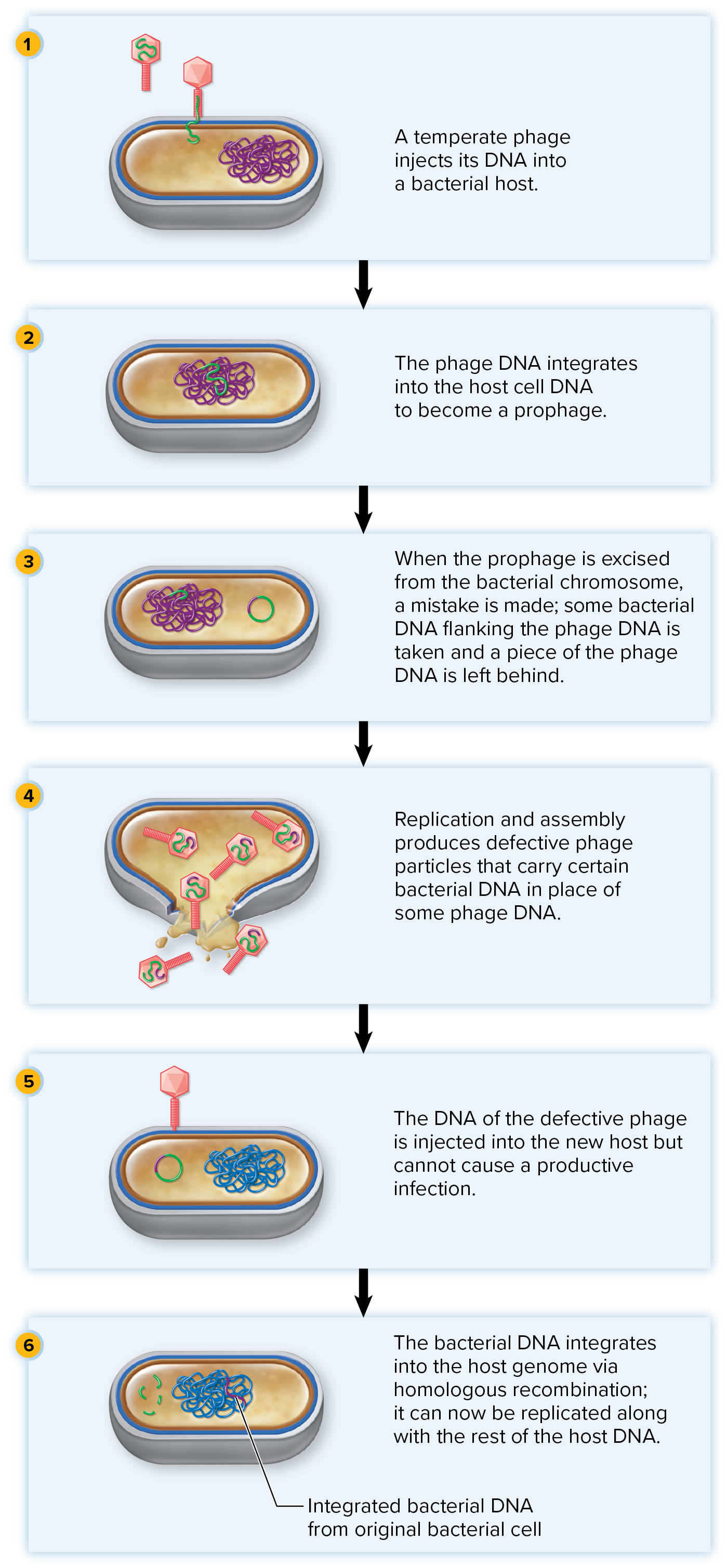
Horizontal transfer of bacterial genes
Recall: when bacterial DNA is accidentally packaged into one phage (by drifting into the phage) and transferred that way » can pack any gene
Standard [__]
Lysogenic conversion
3/3 effects of viral infection on host cells
i.e, Phage conversion » the conferring of new properties to cell as a result of a bacterial DNA being packaged into all phages replicated due to an excision error » only DNA adjacent to the integrated phage can be transferred
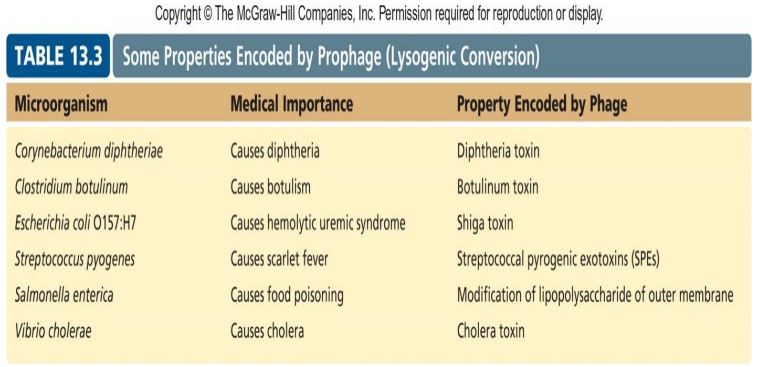
Specialized transduction.
diagnostic tests
Diagnosing viral infections are determined more by a patient’s symptoms rather than using actual tests
If utilizing tests, such [__] include:
culturing the virus
detecting virus by
molecular techniques (PCR) → most common
electron microscope
serology → injected into animals to see what antibody they’ll produce; takes antibodies to test it against different viruses and see which one it’d react with
transmission
Animal diseases are classified based on their route of [__]
Enteric Virus
Animal virus transmitted via fecal-oral route
causes gastroenteritis » inflammation of the lining of the stomach and intestines; some cause systemic disease
eg. norovirus, rotavirus
Respiratory viruses
Animal virus transmitted via infected respiratory droplets
Generally, remain localized in respiratory tract
eg. SARS-Cov-2, influenza
Zoonotic virus
Animal virus transmitted from animal to human (cross species barrier)
eg. rabies, HIV, SARs-Cov-2 as well
Sexually transmitted viruses
Animal virus transmitted by sexual activities
can cause lesions on genitalia only or systemic infections
eg. HIV, herpes, simplex virus
uncoating
Animal virus replication has 5 steps:
Attachment » done through specific spikes that adhere to receptors of host cell
→ (why only one virus can affect specific species, w/ exceptions like influenza)
Entry and [__]: fusion or endocytosis
→ enveloped viruses can do both, while unenveloped can only fuse
→ capsid discarded simultaneously with entry of virion in host cell, or if it’s nearing the synthesis site
Synthesis → nucleic acid synthesized in nucleus, while proteins in cytoplasm
Assembly » encapsidation: packaging nucleic acid into capsid occurs at nucleus → nucleocapsid
Release
→ budding: virus gets its envelope from host cell » how enveloped viruses are released
→ lysing cell » how non-enveloped viruses are released; released when the host cell dies (via virion programmed apoptosis)

defense
The outcome of infection of eukaryotic cells depends on host [__]
acute infection: rapid onset, usually short in duration, more severe.
persistent infection: continue for years or a lifetime. viruses are always present in the host
some viruses exhibit both (eg. HIV)

Acute infection
Infection that is rapid on onset but usually short in duration and more severe
Large number of viruses gets produced
disease symptoms usually due to tissue damage (cell death)
host develops immunity (either short or long lasting)
Persistent infection
Infection that continue for years or a lifetime
viruses are always present in the host
may or may not have symptoms, but still infectious regardless
Chronic infections » virus is detected at all times
Latent infections » viral genome becomes provirus (injects itself in our genome); remains silent in the host cell.
Can be distinguished by their detection during period of persistence
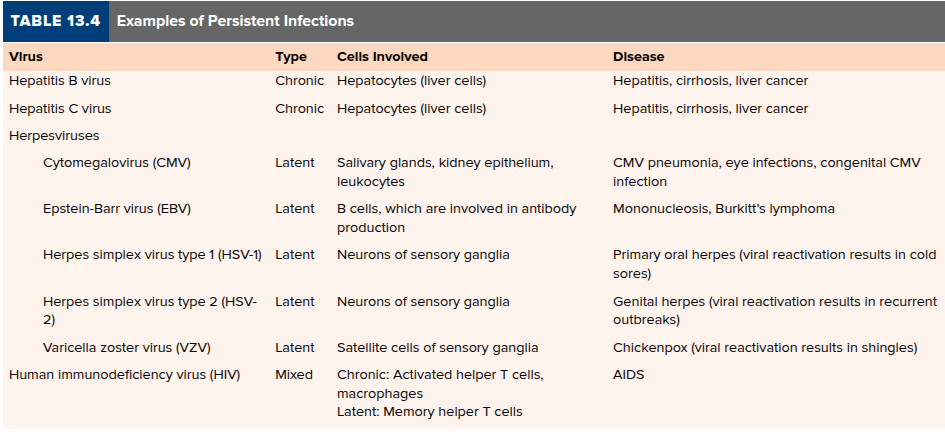
eg. Chicken pox and cold sores
Chronic infection
Persistent infection. Virus is detected at all times. Symptoms present or absent; may develop late
Latent infection
Persistent infection. Viral genome (provirus) remains silent in the host cell. Infection is followed by a symptom-less period and can reactivate. cannot be eliminated
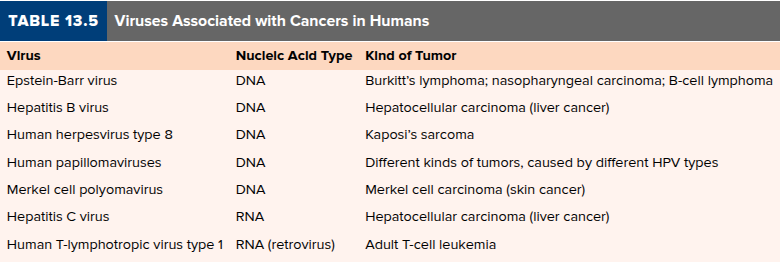
oncogenic
Some cancers are caused by
[__], or tumor-forming, viruses
integration of viral genome onto host DNA → cell transformation and viral genes expressed (lysogenic conversion)
expressed properties are uncontrolled growth → tumors