Orbital Diagrams, Noble Gas (Abbreviated) Electron Configuration, Electron Configurations
 Call Kai
 Learn
Learn Practice Test
 Spaced Repetition
 Match
Match Flashcards
1/134

There's no tags or description
Looks like no tags are added yet.
Name | Mastery | Learn | Test | Matching | Spaced | Call with Kai | Chat |
|---|
No analytics yet
Send a link to your students to track their progress
135 Terms
Mg (Magnesium)
What element is represented by this orbital diagram?
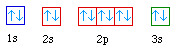
S (Sulfur)
What element is represented by this orbital diagram?

O (Oxygen)
What element is represented by this orbital diagram?
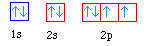
N (Nitrogen)
What element is represented by this orbital diagram?
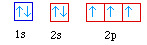
Si (Silicon)
What element is represented by this orbital diagram?

F (Fluorine)
What element is represented by this orbital diagram?
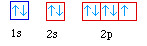
P (Phosphorus)
What element is represented by this orbital diagram?

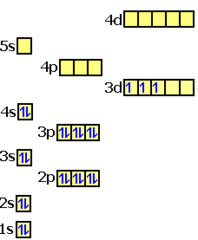
V (Vanadium)
What element is represented by this orbital diagram?
Pauli Exclusion Principle
2 electrons in the same orbital must have opposite spins
Hund's Rule
Electrons don't pair up in orbitals of equal energy until they have to, and all electrons in singly occupied orbitals have the same spin.
orbital diagram for nitrogen
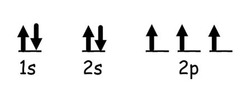
orbital diagram for fluorine
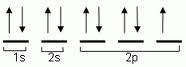
orbital diagram for carbon
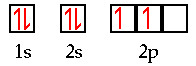
orbital diagram for lithium
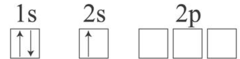
orbital diagram for sodium
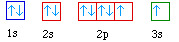
Aufbau Principle
Electrons enter orbitals with the least amount of energy first
Aufbau Principle
Fill orbital diagrams from the bottom up
Hund's Rule
Put 1 electron in each connected box before you double them up
Pauli Exclusion Principle
If you have to put 2 arrows in a box, point 1 up and 1 down
₁H
1s¹
₂He
1s²
₃Li
[He]2s¹
₄Be
[He]2s²
₅B
[He]2s²2p¹
₆C
[He]2s²2p²
₇N
[He]2s²2p³
₈O
[He]2s²2p⁴
₉F
[He]2s²2p⁵
₁₀Ne
[He]2s²2p⁶
₁₁Na
[Ne]3s¹
₁₂Mg
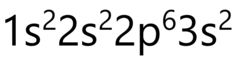
[Ne]3s²
₁₃Al
[Ne]3s²3p¹
₁₄Si
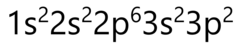
[Ne]3s²3p²
₁₅P
[Ne]3s²3p³
₁₆S
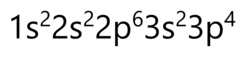
[Ne]3s²3p⁴
₁₇Cl
[Ne]3s²3p⁵
₁₈Ar
[Ne]3s²3p⁶
₁₉K
[Ar]4s¹
₂₀Ca
[Ar]4s²
The electron configuration for hydrogen (H)
1s¹
The electron configuration for bromine (Br)
1s² 2s² 2p⁶ 3s² 3p⁶ 4s² 3d¹⁰ 4p⁵
The electron configuration for aluminum (Al)
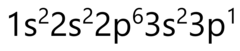
1s² 2s² 2p⁶ 3s² 3p¹
The electron configuration for silver (Ag)
1s² 2s² 2p⁶ 3s² 3p⁶ 4s² 3d¹⁰ 4p⁶ 5s² 4d⁹
The electron configuration for Ne
1s² 2s² 2p⁶
The electron configuration for lithium cation (Li 1+)
1s²
The electron configuration for sulfur anion (S 2-)
1s² 2s² 2p⁶ 3s² 3p⁶
The electron configuration for calcium cation (Ca 2+)
1s² 2s² 2p⁶ 3s² 3p⁶
The electron configuration for bromine anion (Br 1-)
1s² 2s² 2p⁶ 3s² 3p⁶ 4s² 3d¹⁰ 4p⁶
The electron configuration for nitrogen anion (N 3-)
1s² 2s² 2p⁶
How do elements determine what charge to become when they become ions?
Elements want to have the same electron configuration as noble gases.
This is because noble gases are the most stable elements.
They will lose or gain electrons (whichever is easiest) in order to have the same electron configuration as the CLOSEST noble gas.
Which noble gas does fluorine (F) want to be like?
What will it do to look like this noble gas?
What charge will it form?
Neon
Will gain 1 electron.
F = 1-
Which noble gas does potassium (K) want to be like?
What will it do to look like this noble gas?
What charge will it form?
Argon
Will lose one electron.
K = 1+
Which noble gas does aluminum (Al) want to be like?
What will it do to look like this noble gas?
What charge will it form?
Neon.
Will lose 3 electrons.
Al = 3+
Which noble gas does sulfur (S) want to be like?
What will it do to look like this noble gas?
What charge will it form?
Argon.
Will gain 2 electrons.
S = 2-
Which noble gas does astatine (At) want to be like?
What will it do to look like this noble gas?
What charge will it form?
Radon.
Will gain 1 electron.
At = 1-
Hydrogen
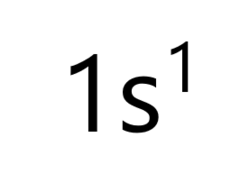
Lithium
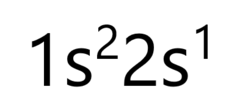
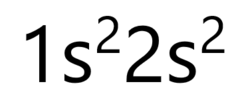
Beryllium
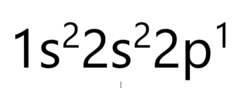
Boron
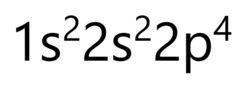
Oxygen
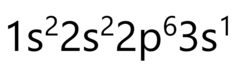
Sodium
Magnesium
Aluminum
Silicon
Sulfur
Argon
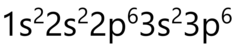
Scandium

Chromium

Iron

Cobalt

Copper

Germanium

Selenium

Bromine

Krypton

Zirconium

Hund's Rule
Every orbital is singly occupied with one electron before its doubled
names of sublevels
s, p, d, f
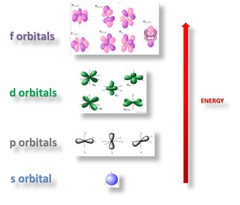
1s sublevel
sphere shape
closest to the nucleus
least amount of energy
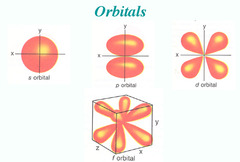
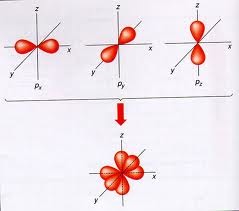
"p" sublevel shape
teardrop/ dumbell
how many electrons can each orbital hold?
2
how many orbitals are in an "s" sublevel?
1 orbital, so it can hold 2 electrons
how many orbitals are in a "p" sublevel?
3 orbitals, so it can hold 6 electrons
how many orbitals are in a "d" sublevel?
5 orbitals, so it can hold 10 electrons
how many orbitals are in a "f" sublevel?
7 orbitals, so it can hold 14 electrons
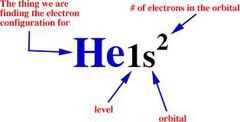
electron configuration notation
number= energy level
letter= sublevel
little number= number of electrons in the sublevel
the 4s sublevel comes BEFORE ___
the 3d sublevel
goes in order: 3s, 3p, 4s, 3d, 4p, 4d, 4f
The electron configuration for hydrogen (H)
1s¹
The electron configuration for bromine (Br)
1s² 2s² 2p⁶ 3s² 3p⁶ 4s² 3d¹⁰ 4p⁵
The electron configuration for aluminum (Al)
1s² 2s² 2p⁶ 3s² 3p¹
The electron configuration for silver (Ag)
1s² 2s² 2p⁶ 3s² 3p⁶ 4s² 3d¹⁰ 4p⁶ 5s² 4d⁹
The electron configuration for Ne
1s² 2s² 2p⁶
The electron configuration for lithium cation (Li 1+)
1s²
The electron configuration for sulfur anion (S 2-)
1s² 2s² 2p⁶ 3s² 3p⁶
The electron configuration for calcium cation (Ca 2+)
1s² 2s² 2p⁶ 3s² 3p⁶
The electron configuration for bromine anion (Br 1-)
1s² 2s² 2p⁶ 3s² 3p⁶ 4s² 3d¹⁰ 4p⁶
The electron configuration for nitrogen anion (N 3-)
1s² 2s² 2p⁶
How do elements determine what charge to become when they become ions?
Elements want to have the same electron configuration as noble gases.
This is because noble gases are the most stable elements.
They will lose or gain electrons (whichever is easiest) in order to have the same electron configuration as the CLOSEST noble gas.
Which noble gas does fluorine (F) want to be like?
What will it do to look like this noble gas?
What charge will it form?
Neon
Will gain 1 electron.
F = 1-
Which noble gas does potassium (K) want to be like?
What will it do to look like this noble gas?
What charge will it form?
Argon
Will lose one electron.
K = 1+