3.1.8 Thermodynamics
 Call Kai
 Learn
Learn Practice Test
 Spaced Repetition
 Match
Match Flashcards
 Knowt Play
1/42

There's no tags or description
Looks like no tags are added yet.
Name | Mastery | Learn | Test | Matching | Spaced | Call with Kai | Chat |
|---|
No analytics yet
Send a link to your students to track their progress
43 Terms
What is the definition of the enthalpy change of formation?
The enthalpy change when one mole of a compound is formed from its elements in their standard states under standard conditions (298K, 100kPa)

What is the definition of the enthalpy change of combustion?
The enthalpy change when one mole of a substance undergoes complete combustion in oxygen under standard conditions

What is the definition of the enthalpy change of dissociation?
The enthalpy change when all of the bonds of the same type in one mole of a gaseous molecule is broken
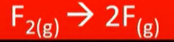
What is the definition of the first electron affinity?
The enthalpy change when one mole of a gaseous atom gains one electron per atom to become one mole of a gaseous 1- ion

What is the definition of the second electron affinity?
The enthalpy change when one mole of a gaseous 1- ion gains an electron to become one mole of a gaseous 2- ion

What is the definition of the enthalpy change of the first ionisation?
The enthalpy change when one mole of a gaseous atom loses one electron per atom to become one mole of a gaseous 1+ ion

What is the definition of the enthalpy change of the second ionisation?
The enthalpy change when one mole of a gaseous 1+ ion loses one electron to become one mole of a gaseous 2+ ion

What is the definition of the enthalpy change of atomisation?
The enthalpy change when one mole of gaseous atoms is formed from an element or compound in its standard state under standard conditions

What is the definition of the lattice enthalpy of dissociation?
The enthalpy change when one mole of a solid ionic compound is dissociated into its gaseous ions under standard conditions

What is the definition of the lattice enthalpy of formation?
The enthalpy change when one mole of a solid ionic compound is formed from its gaseous ions under standard conditions

What is the definition of the enthalpy change of hydration?
The enthalpy change when one mole of gaseous ions are fully dissolved in water to form one mole of aqueous ions

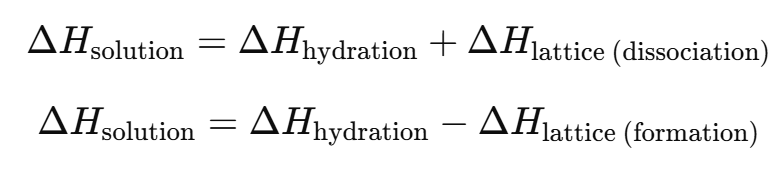
What is the definition of the enthalpy change of solution?
The enthalpy change when one mole of an ionic solid completely dissolves in water to form an infinitely dilute solution under standard conditions

What are the two equations to calculate enthalpy change of solution?
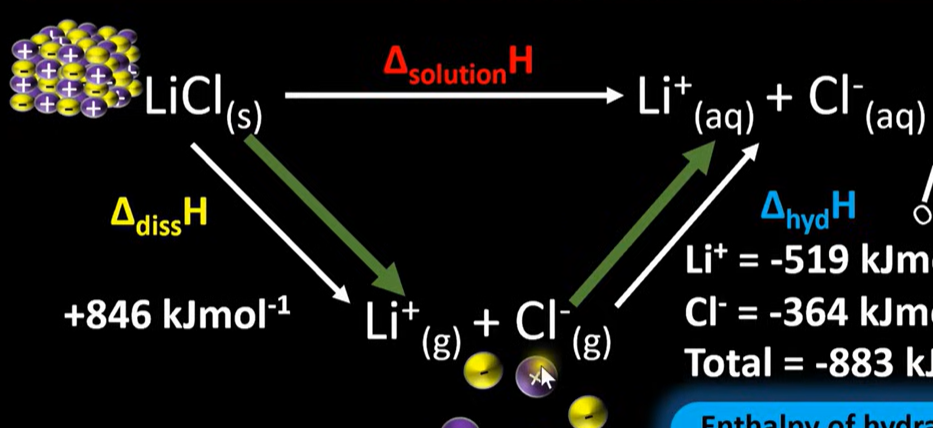
What should the Hess’ cycle look like when calculating the enthalpy change of solution?
(or could have lattice enthalpy of formation replacing dissociation arrow in the opposite direction)
What are lattice enthalpies?
A measure of how strong an ionic bond is:
the more negative the lattice enthalpy value, the stronger the ionic bond
What affects the lattice enthalpy of an ionic compound?
The charge & size of the ions:
ions with a smaller ionic radii will have a more negative lattice enthalpy → attract more strongly due to higher charge density
What is the perfect ionic model?
Assumes that ions are perfectly spherical & there is an even charge distribution (point charges)
100% polar bonds & no covalent character
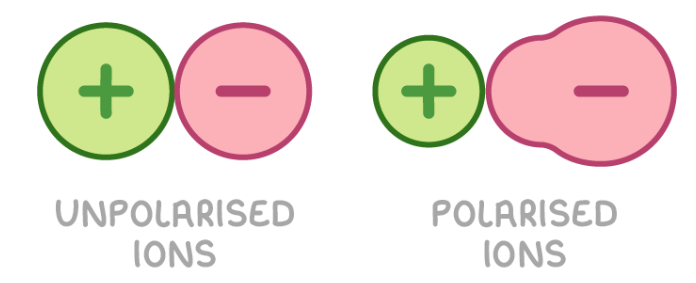
Why is the perfect ionic model often not accurate?
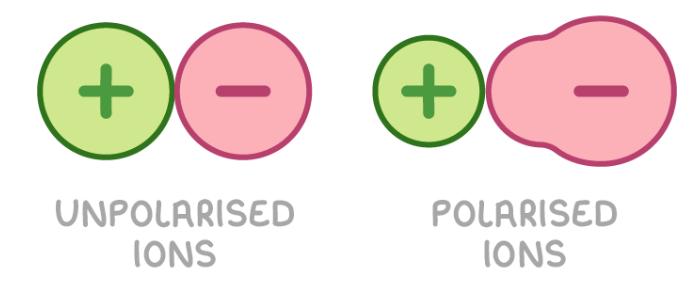
In an ionic lattice, a cation can distort the electron cloud of a nearby anion (i.e. ion polarisation) → this distortion reduces the anion's spherical shape
A cation's ability to do this is its polarising power → greater polarisation results in more covalent character
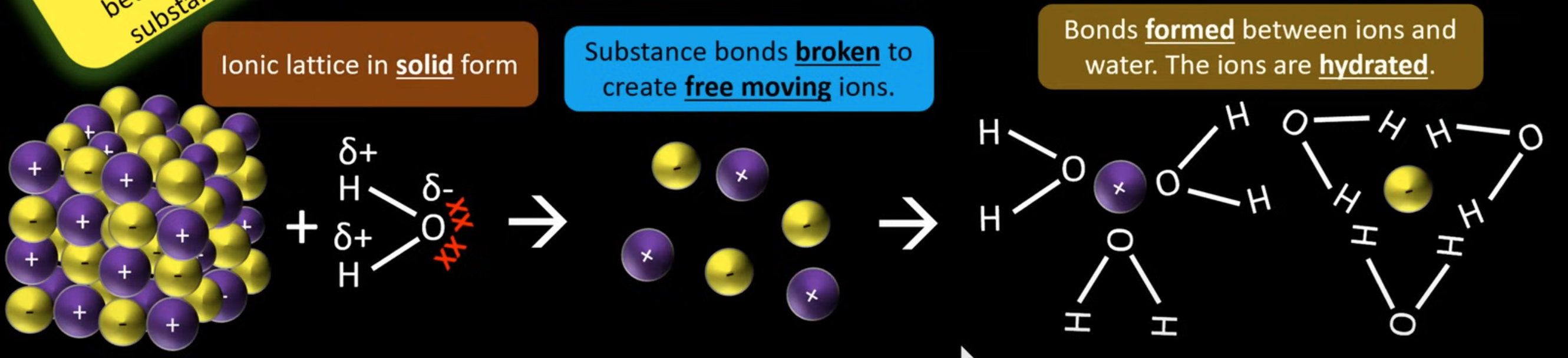
What happens when a solid is dissolved in terms of interactions of the ions with water molceules?
The lattice breaks forming gaseous ions, which are dissolved in water
The aqueous ions are surrounded by water molecules (permanent dipole due to polar O-H bond)
What three things can the enthalpy change of solution be calculated from knowing?
Lattice enthalpy of dissociation
Lattice enthalpy of formation
Enthalpy of hydration
What is entropy (ΔS) ?
The measure of disorder in a system:
the number of ways energy can be shared out between particles
higher entropy value = more disorder
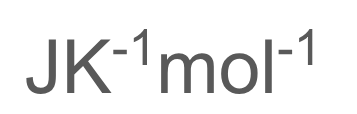
What units is entropy measured in?
Jules per kelvin per mole
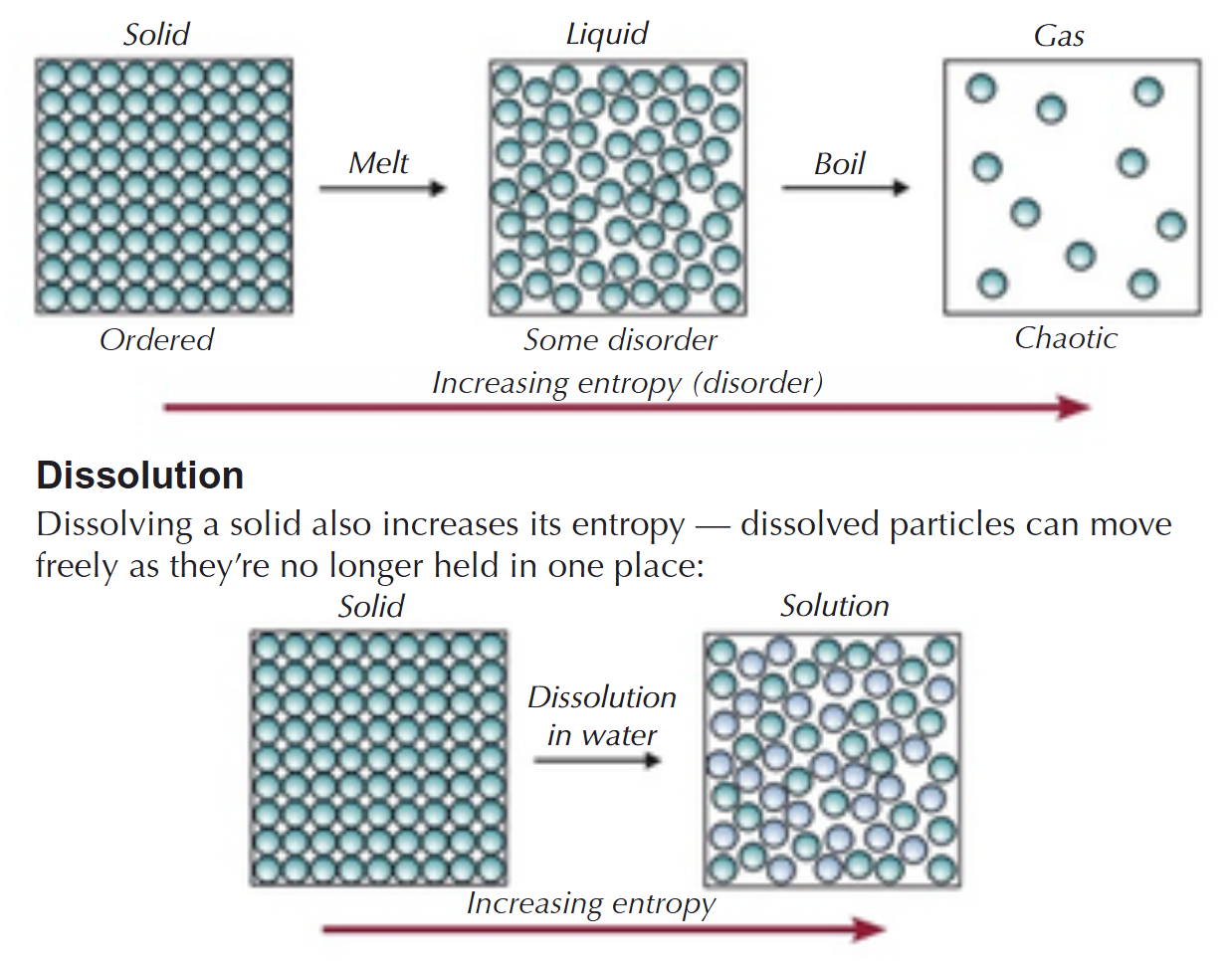
Compare the entropy for solids, liquids & gases
Solids → low entropy
atoms held firmly in place by strong bonds
particles only vibrate about a fixed point; hardly any randomness
(dissolving it increases its entropy)
Liquids → increased entropy
particles are able to move about more freely
many more ways particles & energy can be distributed
Gases → highest entropy
particles whizz around wherever
highest number of random arrangements
What is the second law of thermodynamics?
Entropy always increases (it’s more likely for molecules to be disordered than ordered)
Is a reaction with a positive or negative entropy change more likely to be spontaneous?
Positive → reactions always try to increase the amount of disorder
What is the equation to calculate the total entropy change?

What is the equation to calculate the entropy change of a system?
(per mole)

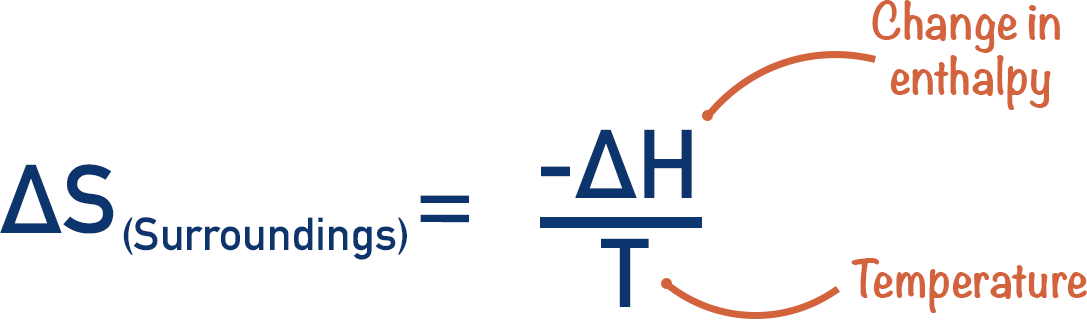
What is the equation to calculate the entropy of the surroundings?
kJ → J (x1000)
What does it mean if a reaction is spontaneous & feasible?
If a reaction is spontaneous & feasible, it will take place of its own accord/reacts naturally
Is a reaction with a positive or negative enthalpy change more likely to be spontaneous?
Negative (exothermic)
What is the equation for Gibbs free energy?
°C → K (+273)
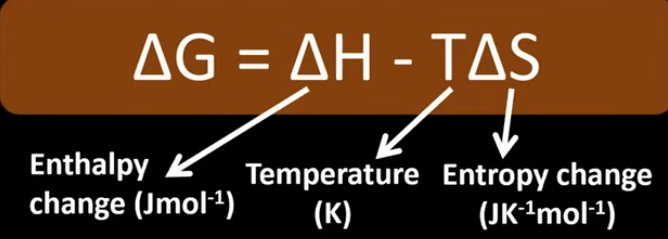
What are the units for Gibbs free energy?
kJ mol-1
What does the value for Gibbs free energy for a reaction show?
If G < 0, reaction is feasible
If G = 0, reaction is JUST feasible
If G > 0, reaction is not feasible
What is the significance of the temperature at which G = 0?
This is the temperature (in Kelvin) at which the reaction becomes feasible
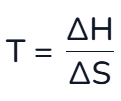
What is the equation to calculate the temperature at which a reaction becomes feasible?
(convert ΔH from kJmol-1 to Jmol-1 by x1000)
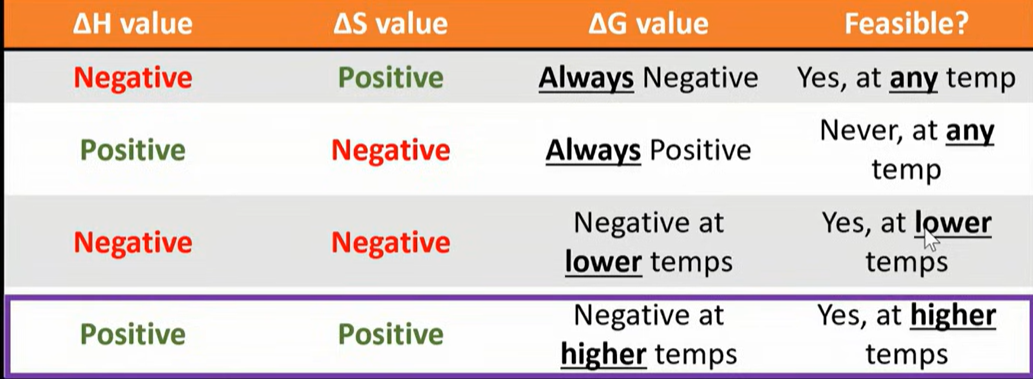
If ΔH is negative & ΔS is positive, what is the value of ΔG & is the reaction feasible?
ΔG is always negative
Reaction is feasible at any temperature
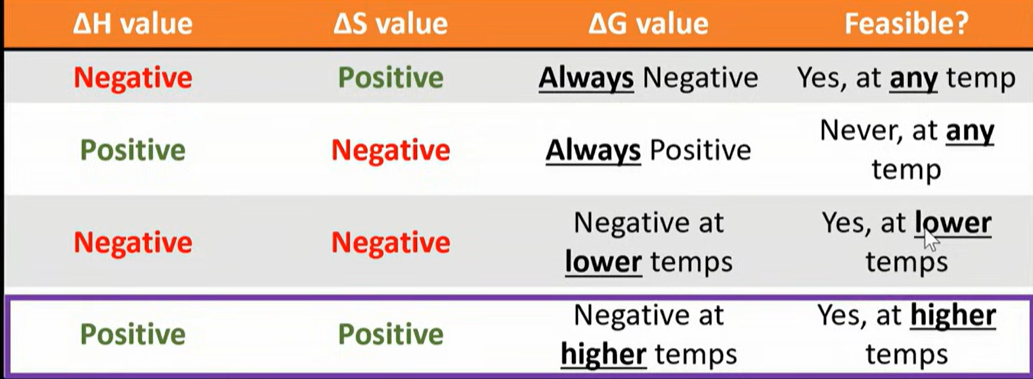
If ΔH is positive & ΔS is negative, what is the value of ΔG & is the reaction feasible?
ΔG is always positive
Reaction is not feasible at any temperature
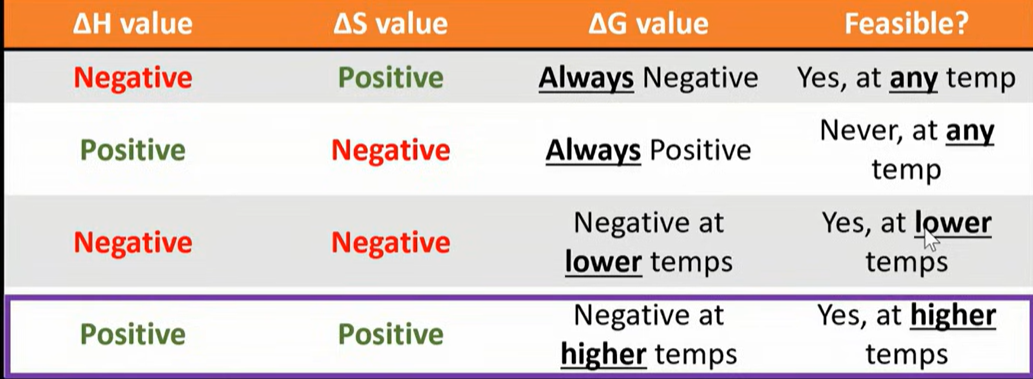
If ΔH is negative & ΔS is negative, what is the value of ΔG & is the reaction feasible?
ΔG is negative at lower temperatures
Reaction is only feasible at lower temperatures
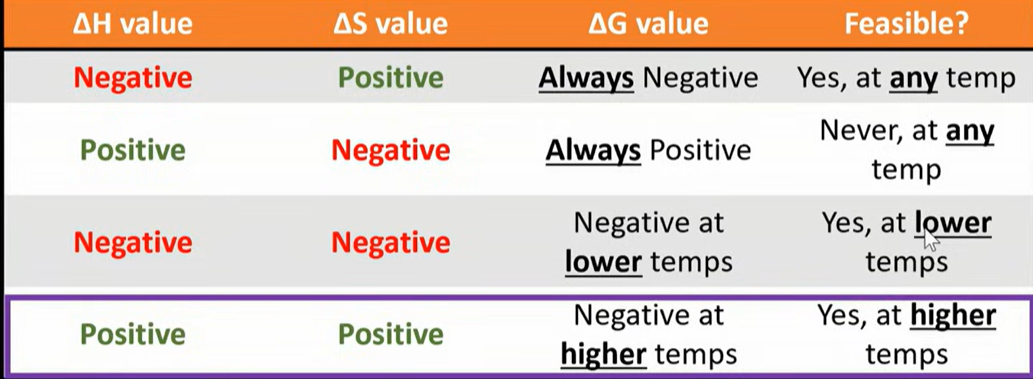
If ΔH is positive & ΔS is positive, what is the value of ΔG & is the reaction feasible?
ΔG is negative at higher temperatures
Reaction is only feasible at higher temperatures
What are the two key things to look for to decide if entropy increases, decreases or stays relatively constant?
Number of moles → more moles made = entropy increases
Going from solid to liquid/gas or liquid to gas
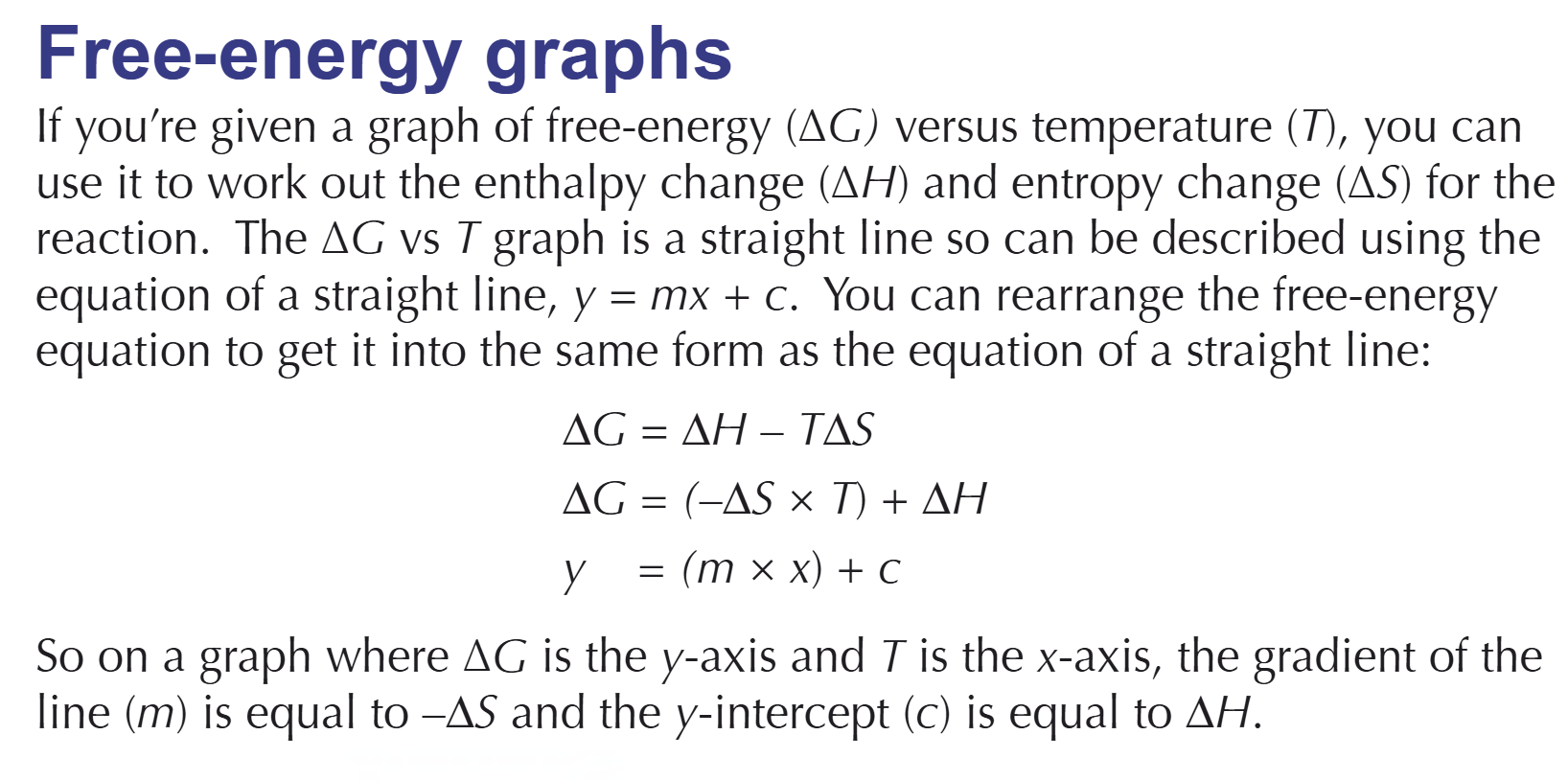
What is the equation for Gibbs free energy rearranged in the same form as the equation of a straight line (y = mx + c) ?
ΔG = (−ΔS x T) + ΔH
What is Hess’ Law?
The enthalpy change for a reaction is independent of the route taken
What is the definition of enthalpy change?
The heat energy transferred in a reaction at constant pressure