Speech and Hearing 1st Exam
 Call Kai
 Learn
Learn Practice Test
 Spaced Repetition
 Match
Match Flashcards
 Knowt Play
1/132

There's no tags or description
Looks like no tags are added yet.
Name | Mastery | Learn | Test | Matching | Spaced | Call with Kai | Chat |
|---|
No analytics yet
Send a link to your students to track their progress
133 Terms
Systems used to speak
respiratory system
the sound you are exhaling
neurological system
you telling your nerves to do this (ex. open my lips, my jaw)
muscular system
Speech sounds are determined by what we can…
produce and what we can perceive
are there speech organs?
no because these would be things that are only used for speech
but things like your mouth is also used for food
we use old parts for new purposes
aerodynamics and speech
the study of movement of air and the forces used to generate the movements
we produce air puffs
the sound traveling when talking to someone in the back of the room
kinematics
the study of motion, the positions, the velocities, and accelerations of body parts
focuses on the forces that cause the movements
the vocal folds being blown apart
acoustics/acoustic phonetics
study of sound: its production, transmission, and effects
acoustic phonetics = the study of speech sounds
contributes by studying all mechanical waves in gases, liquids, and solids including vibration, sound, ultrasound, and infrasound
psychoacoustics
looks at the relation between the physical properties of a phenomenon and perception
ultrasound
frequency is higher than you can perceive
not audible sound
infrasound
frequency is lower than you can perceive
not audible sound
components of language
phonology
how language uses sound
which sounds it uses and how it uses it
morphology
syntax
lexicon/semantics
all the words you know
articulation
what you are actually doing to create a sound/language
sub-glottal system
lungs
muscles needed for inhalation and exhalation
trachea
larynx
has the vocal folds
glottis
can open and close
vocal tract
the area from the larynx to the lips
pharynx
the throat
tongue is on the back of this
nasal cavity
oral cavity
sender
production of acoustic signal
message
acoustic signal
receiver
reception of acoustic signal
relationship of communication, language, and speech
Communication is the largest circle, then language, and then speech
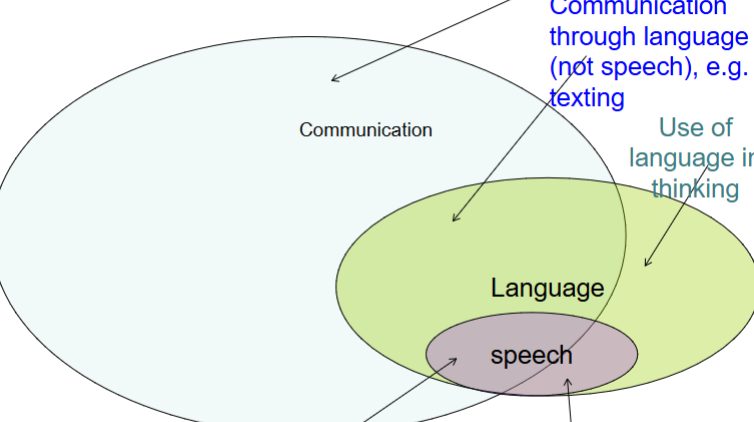
Communication through language
textingsp
speech in language
spoken communication
Just speech (in the circles of communication, language, and speech)
the vocalized form of human communication
Talking to yourself
Language
the words and rules for combing them common to a particular group of people
Start with conceptualizer, go to lexicon to find the words you need (lexicalization), then formulator to figure out the order of them (syntactic planning), and then phonological encoding (get your mouth to do it)
hardware
speech and hearing anatomy
the brain, anatomical structures
Software
how the anatomical structures are programmed and learn to function, internal language rules
can use the software to activate the hardware
speech sounds are… (planned or unplanned)
planned
where can speech problems occur?
in the production, the transmission (someone is talking over dr. loncke when he is trying to talk to sal in the back), or the reception (ex. hearing loss)
propogation
movement of sound waves in space from speaker to hearer
reception
the process of hearing
what is sound
sound is a disturbance through a medium (like air)
what does a medium have to have?
elasticity
has to have special properties that allow the sound to travel
What do we hear when we hear sound?
pressure disturbances in the air
which are made by the source
Pressure disturbances
also called waves
these are caused by the sound source
what influences the velocity (speed) of sound?
the degree of elasticity of the medium
based on the medium
what does sound travel fastest through
harder materials
like steel
what does sound travel medium speed through
liquids
what does sound travel the slowest through
gases
what is the speed of sound (sound waves) in dry air @ 68°F
340-344 m/sec
in 1 second sound travels 340 meters
1 cycle = 340 meters
elasticity
the ability of an object to spring back to its resting shape when deforming forces are removed
stiffness
the degree to which an object resists being deformed
what is required for a wave to propagate or travel
a medium
ex. water waves (the ones you see with a pebble) require water to travel, waves on a rope need the rope to travel
what is the exception to the rule that a medium is required for propagation
electromagnetic waves
transverse wave
a wave vibrating at right angles to the direction of the propagation
up and down
what relationship do frequency and wavelength hold
an inverse relationship
longitudinal waves
think slinky
push it in and then it moves all the way out
particles vibrate parallel to the direction of wave propagation
waves transport what from point A to B without actually moving the object
ENERGY
speech is composed of…
sound waves
what type of waves are sound waves?
longitudinal waves
because sound waves are propagated in the same place as particle displacement and therefore makes a longitudinal wave
what happens in air before you make a sound
particles are in random motion and are an average distance from one another
then when you make a sound the waves hit each other and keep oscillating in place
simple wave
one frequency only
a pure tone
complex wave
multiple frequencies
what displaces air molecules
a vibration
in what way is the disturbance moving from the source
away from the source
sound pressure waves (what happens in them)
particles oscillate back and forth but don’t travel beyond their own area of disturbance
only the disturbance itself travels forward
what are water waves a combination of
transverse and longitudinal waves
swing analogy: when the displacement is maximum (describe RF and I)
restoring force
it is strong and pushing the swing back downward
inertia
is at 0 as the swing stops and reverses
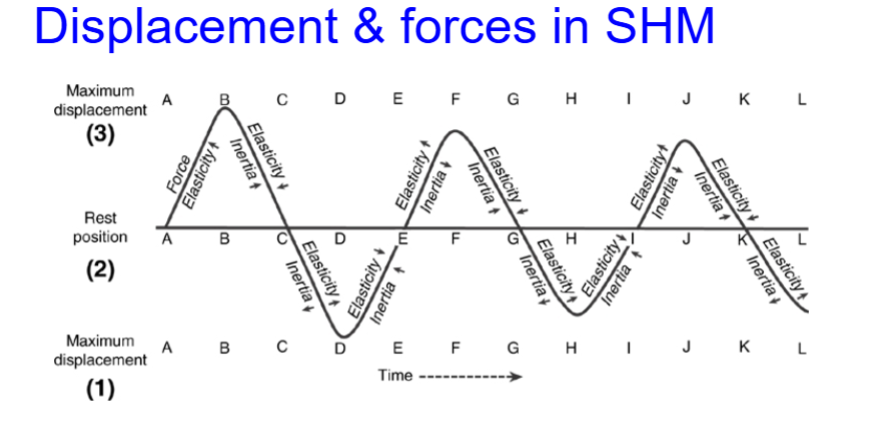
swing analogy: when the displacement is zero(describe RF and I)
inertia
strong
the fastest movement occurs as the swing passes the rest position
restoring force
0 as the swing passes through the rest position
what is a pure tone an example of
simple harmonic motion (SHM)
Why do vibrations occur? Which two forces?
inertia and elasticity
tuning fork phases (elasticity, time, inertia directions)
Time 1
at rest
Time 2
inward displacement
force and elasticity
Time 3
back to rest
Elasticity: down
Inertia: up
Time 4
outward displacement
Elasticity: up
Inertia: down
Time 5
back to rest
Elasticity: down
Inertia: up
Time 6
inward displacement
Elasticity: up
Inertia: down
Time 7
back to rest
Elasticity: down
Inertia: up
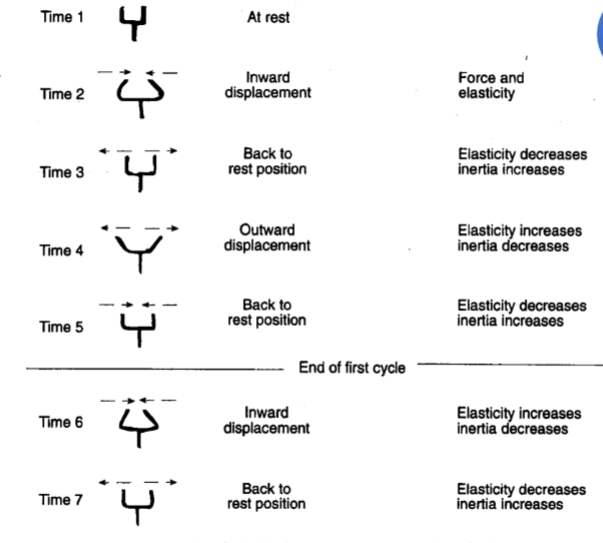
how many cycles are the tuning fork phases
1.5
Newton’s Inertia Law
all bodies remain at rest or in a state of uniform motion unless another force acts in opposition
Inertia and Mass relationship
directly proportional relationship
the magnitude of inertia is directly proportional to the mass
mass is a measure of inertia
restoring force
wants to push the object back into its rest position
inertia
this carries the tines of a tuning fork past its rest position
another word for outward displacement
overshoot
SHM in tuning fork (description in words)
elasticity allows displacement
inertia carries the tines past the rest position and a restoring force builds up in another direction
and then the fork is sent back to rest position
and then overshoots again because of inertia
Restoring force and inertia relationship
inverse
when restoring force is strong, inertia is weak (max displacement)
when restoring force is weak, inertia is strong (at rest position)
inertia wants to keep doing what its doing and elasticity wants to go back to its OG form
what sets the frequency?
the source
what results from SHM
pure tones
characteristics of SHM
the pattern of vibration repeats itself
it is periodic
each cycle takes the same amount of time
each period is consistent
the frequency is constant
it is a sine wave
compression
condensation
where the density of the air mass is increased
high pressure
peak/crest
rarefaction
thining
when the air mass density decreases
low pressure
trough
why do particles move about positions of equilibrium
because of the opposing forces of inertia and elasticity that are keeping one from overpowering the other
what are waves carried by
a medium
Characteristics of a low frequency
sounds are slow
low pitch
frequency
cycles of the waves
how many times it moves in 1 sec
characteristics of a medium
elasticity
how easily you can disturb it
how easy it is to speak through the air/medium
when we speak we put pressure into the air and disturb the medium
temperature and sound
air particles move faster in higher temps and that means sound moves faster
speech = sounds waves = mechanic waves = longitudinal waves
waves only…
transfer energy from place to place
DON’T move the matter
wavelength
length of one cycle
oscillation
moving/rocking back and forth
what gets a wave started
the source of the disturbance
what is the velocity at the rest position
max
because you fly by that point
what will more force do to oscillation
it will be wider oscillation
if Dr. Loncke pushes Katherine harder she would make wider oscillations
what are waves composed of
vibrations that move
ex. the rope example and the faster you move it up and down the more vibrations and the shorter the waves
what can’t sound travel through
a vacuum
displacement equals?
the amplitude
abduction
vocal folds are open
rest position
so you can breathe
what is amplitude of displacement is proportional to?
force applied
what are two forces opposing each other consistent with?
Newton’s third law of motion (there is an opposite and equal reaction for everything)
elasticity allows displacement but also generates a restoring force that stops the movement
Child on a swing
the farther the child moves away the stronger the restoring force
the child stops because of friction
by creating a force in our vocal folds the pressure can put the sound out
what is moving and not the actual particles?
THE WAVES
Resonance Characteristics of the vibrating object
if you push harder the swing will go further
but if you want to see who will go faster they are going at the SAME SPEED