CHEM 2202 FINAl - theory from all chapters
 Call Kai
 Learn
Learn Practice Test
 Spaced Repetition
 Match
Match Flashcards
 Knowt Play
1/58

There's no tags or description
Looks like no tags are added yet.
Name | Mastery | Learn | Test | Matching | Spaced | Call with Kai | Chat |
|---|
No analytics yet
Send a link to your students to track their progress
59 Terms
Constitutional isomers
Compounds with same molecular formula but different structures
What forces keep the bond at optimal length
attractive forces between positively charged nuclei and negatively charged electrons
Repulsive forces between 2 positive charged nuclei
Repulsive forces between 2 negatively charged electrons
Electronegativity difference between the three types of bonds
Covalent - less than 0.5
Polar covalent - betweeen 0.5 and 1.7
Ionic bond - more than 1.7
The greater difference in electronegativity, what happens to polarity
Greater difference in electronegativity the more polar the bond
What orbital are electrons most stable
1s orbital (lowest in energy)
3 rules for the placement of electrons (know how to apply them when making electron configuration)
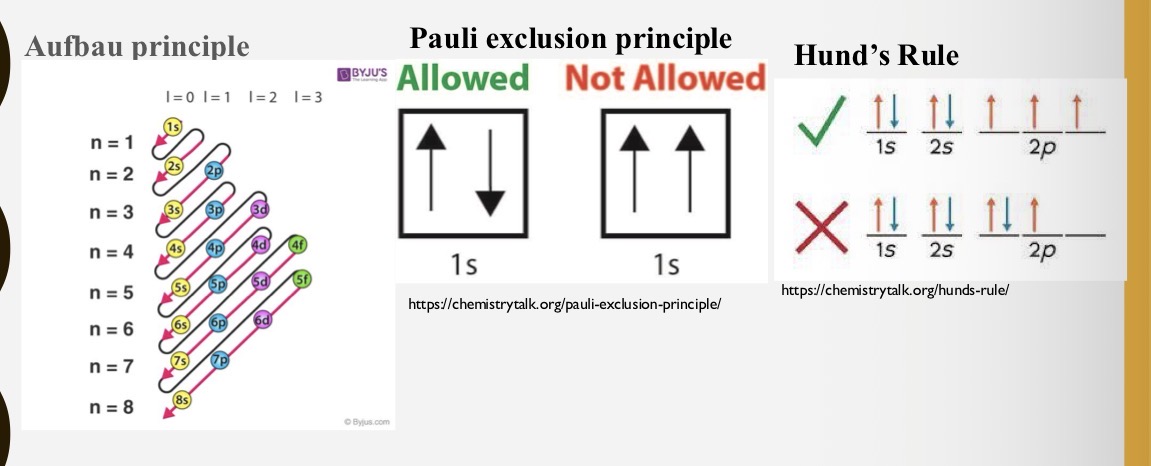
2 types of molecular orbitals
HOMO - highest occupied molecular orbitals
LUMO - lowest unoccupied orbital
Sp3 hybrid orbital
single bonds (sigma)
Overlap of 4, 1s
25% s character and 75% p character
Sp2 hybrid orbital
1 sigma 1 pi bond
3 equal energy sp2 orbitals and one unhybridized p orbital
33% s character and 67% p character
Sp atomic orbitals
1 sigma bond 2 pi bond
Overlap head on to form sigma bonds while unhybridized P orbitals overlap side by side to form pi bonds
50% s character , 50% p character
What is stronger, a pi or sigma bond and why
Sigma is stronger as it takes almost twice the bond energy of a pi bond to break it
Order the hybrid orbitals from longest to shortest
Sp3 > sp2 > sp
What steric numbers associate with each hybridization
Steric number:
4 -sp3
3 - sp2
2 - sp
3 types of intermolecular forces (know how to idetnfiy them)
Dipole dipole interactions
Hydrogen bonding
Dispersion forces
Hydrogen bonding
strong type of dipole attraction
Is the attractive force between an H bonded to an electronegative atom and a lone pair on another electronegative atom
Attractive forces and their effects on MP and BP
less dipole = lower polarity = lower boiling point
More branching = less surface area = lower boiling point
More hydrogen bonding = greater boiling point
Greater London dispersion = greater mass = greater boiling point
Oxygen bonding patterns
-ve charge - 3 lone pairs, 1 bond
Neutral - 2 bonds, 2 lone
+ve- 3 bonds, 1 lone pair
Nitrogen bonding patterns
-ve - 2 bonds, 2 lone pairs
Neutral - 3 bonds, 1 lone pair
+ve - 4 bonds, no lone pairs
Carbon bonding patterns
-ve - 3 bonds , 1 lone pair
Neutral - 4 bonds
+ve - 1-3 bonds, no lone pairs
When does resonance occur
Only in overlapping p orbitals (thus cant occur in single bonds)
2 types of carbons next to a double bond
Vinylic - direct carbons
Allylic - indirect carbons
What electrons allow for electrons to take place
Delocalized electrons
Bronsted Lowry definition of acid and bases
Acid - proton donor
Base - proton acceptor
In a bronsted Lowry acid base reaction, where does the flow of electron density always originate
From an electron rich site on the base like a low pair or pi bond
In an acid base reaction what does equilibrium favour
Weaker acid
How to compare how much larger a pKa is (how much more prod to reactant or reactant to prod)
Larger pKa - smaller pKa
take that number and put it as a base 10
Ex. Acid has pKa 14, conj acid has pKa 50, thus 50-14 =36
Conj acid is 10^ 36 x more product formation than the acid
Lower the pKa…
Greater the acidity, greater the stability
Lewis acid definition of acid and base
Acid - accepts pair of electrons
Base - donates pair of electrons
Saturated hydrocarbons are also known as
Alkanes
What makes a compound more stable
Has to be lowest energy thus
more branching
More acidic
Staggered
Largest groups are ANTI to one another in a Newman projection
Chair conformation
Largest molecule is equatorial and trans
Stereoisomer
Same molecular formula and collectivity but different spatial arrangement of atoms
Enantiomers
2 molecular that are mirror images but are not superimposable (opposite R and S configurations)
only a chiral compound can have an enantiomer
Extremely similar physical properties
Diastereomers
Can be chiral or achiral
some chiral centers are inverted but not all
NOT mirror images
Different physical properties
Optical active
Only chiral compounds are optically active, and can rotate plane polarized light in a positive or negative direction
+ = dextrorotatory
- = levrorotatory
Maximum number of possible stereoisomers can be calculated as
2^N
N is the number of chiral centers
Meso compounds
Compound with chiral centers but is achiral due to symmetry
Racemic mixture
50/50 mixture of 2 enantiomers with a 0 degree rotation
Distillation
Seperates compounds with different boiling points
Recrystallization
Seperates compounds with different solubility’s
Successful seperation of enantiomers
resolution of enantiomers using race mix mixture
Chiral resolving agent
Affinity chromatography
Atropisomer
Stereoisomers that would be interchangeable through the rotation of a sigma bond but because the bond is unable to rotate, the conformations are stuck and interchangeable
Alllenes
Compounds that possess adjacent carbon double bonds that may or may not be chiral depending on the substituent
Enthalpy vs entropy
enthalpy - Is the heat energy exchange between the reaction and its surroundings
Entropy - molecular disorder
Conditions for spontaneous and non spontaneous reactions
Spon - +ve entropy (S), -ve free energy (G), exergonic favoured and favours products
Non spontaneous - -ve entropy (S), +ve free energy (G), endergonic favours reactants
5 factors that affect reaction rate
Reactant concentration
Activation energy
Temperature
Geometry and sterics
Catalysts
Rate law for first, second and third order
1) K(A)
2) K(A)(B)
3) K(A)²(B)
Transition state
high energy
Fleeting and cant be observed
Energy maxima
Intermediate
low energy
Energy minima
Observable
Nucleophile
Electron rich that can donate electrons
Lewis bases
Are stronger when more polar
Electrophile
Electron deficient and can accept pair of electrons
Lewis acids
Carbocations and partially positive atoms
When can a reaction be reversible
If the attacking nuclephile is also a good leaving group (ex. H2O)
Loss of a leaving group
Proton transfers (unless pKa difference is greater than 10 units)
everything else is typically irreversible including rearrangement
2 main reasons why alkyl halides undergo substitution and elimination reactions
Halogen is electron withdrawing, creates a partial positive charge on the adjacent carbon making it susceptible to nuclephilic attacks
Presence of good leaving groups
SN2 rate law
K(alkyl halide)(nuclephile)
E2 elimination rate law
Follows second order
K(alkyl halide)(base)
What’s the rate determining step in SN1
Formation of carbocation because its the highest energy transition state (thus has highest Ea)
SN1 rate law
Follows first order reaction
K(substrate)
Which solvents are best for SN1 and SN2 reactions
SN1 - Protic solvents bc it stabilizes the carbocation intermediate → lowers Ea and causes faster reaction
SN2 - aprotic solvent bc it raises energy of the Nu → lowers Ea and causes faster reaction
nucleophiles are more reactive in aprotic solvents
At what temps are enthalpy and entropy dominated
Low temps → enthalpy dominates and addition reactions are favoured
High temps→ entropy dominates and elimination reactions are favoured
What 2 factors increase entropy
more Mols products
Acyclic