6 - Nutritional Support
 Call Kai
 Learn
Learn Practice Test
 Spaced Repetition
 Match
Match Flashcards
 Knowt Play
1/55

Earn XP
Description and Tags
Proverbs 16:3
Name | Mastery | Learn | Test | Matching | Spaced | Call with Kai | Chat |
|---|
No analytics yet
Send a link to your students to track their progress
56 Terms
a. Malnutrition
A deficiency, excess, or imbalance of energy, protein, and other nutrients that causes measurable adverse effects on body tissue, size, shape, composition, function and clinical outcome
a. Malnutrition
b. Overnutrition
c. Undernutrition
d. Cachexia
TRUE
TRUE OR FALSE
Nutrients can be introduced in the body in different routes
Kwashiorkor
Identify:
a. Marasmus
b. Kwashiorkor

Marasmus
Identify:
a. Marasmus
b. Kwashiorkor

Kwashiorkor
It develops in children whose diets are deficient of protein
a. Marasmus
b. Kwashiorkor
Marasmus
It is due to deficiency of proteins and calories.
a. Marasmus
b. Kwashiorkor
Kwashiorkor
It occurs in children between 6 months and 3 years of age.
a. Marasmus
b. Kwashiorkor
Marasmus
It is common in infants under 1 year of age.
a. Marasmus
b. Kwashiorkor
Kwashiorkor
Subcutaneous fat is preserved.
a. Marasmus
b. Kwashiorkor
Marasmus
Subcutaneous fat is not preserved.
a. Marasmus
b. Kwashiorkor
Kwashiorkor
Oedema is present
a. Marasmus
b. Kwashiorkor
Marasmus
Oedema is absent
a. Marasmus
b. Kwashiorkor
Kwashiorkor
Enlarged fatty liver.
a. Marasmus
b. Kwashiorkor
Marasmus
No fatty liver.
a. Marasmus
b. Kwashiorkor
Kwashiorkor
Ribs are not very prominent.
a. Marasmus
b. Kwashiorkor
Marasmus
Ribs become very prominent.
a. Marasmus
b. Kwashiorkor
Kwashiorkor
Lethargic
a. Marasmus
b. Kwashiorkor
Marasmus
Alert and irritable.
a. Marasmus
b. Kwashiorkor
Kwashiorkor
Muscle wasting mild or absent.
a. Marasmus
b. Kwashiorkor
Marasmus
Severe muscle wasting
a. Marasmus
b. Kwashiorkor
Kwashiorkor
Poor appetite.
a. Marasmus
b. Kwashiorkor
Marasmus
Voracious feeder.
a. Marasmus
b. Kwashiorkor
Kwashiorkor
The person suffering from this needs adequate amounts of proteins.
a. Marasmus
b. Kwashiorkor
Marasmus
The person suffering from this needs adequate amount of protein, fats and carbohydrates.
a. Marasmus
b. Kwashiorkor
Kwashiorkor
Protuberant belly
a. Marasmus
b. Kwashiorkor
Marasmus
Prominent bones
a. Marasmus
b. Kwashiorkor
Kwashiorkor
Xerosis
a. Marasmus
b. Kwashiorkor
Marasmus
Loose skin
a. Marasmus
b. Kwashiorkor
Kwashiorkor
Poor wound healing
a. Marasmus
b. Kwashiorkor
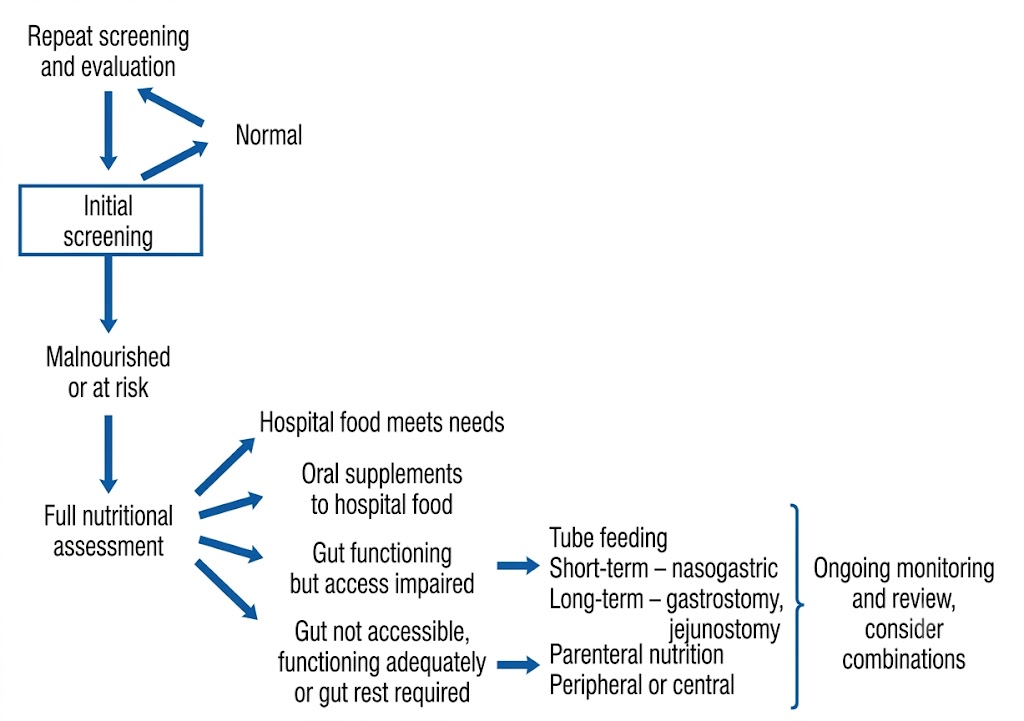
[MALNUTIRTION]
Steps in clinical approach to nutritional screening and support:
a. True
Nutrients can be introduced in the body by different routes such as enteral and parenteral routes.
a. True
b. False
a. True
Combinations of oral diet, enteral feeding and parenteral nutrition, either peripherally or centrally, may be appropriate
a. True
b. False
a. Enteral Nutrition
A method of providing nutritional support via tubes inserted into the stomach or small intestine
a. Enteral Nutrition
b. Parenteral Nutrition
c. Oral Nutrition
d. Specialized Nutritional Support
b. Parenteral Nutrition
A nutritionally balanced aseptically prepared or sterile physiochemically stable solution or emulsion for IV administration
a. Enteral Nutrition
b. Parenteral Nutrition
c. Oral Nutrition
d. Specialized Nutritional Support
b. Parenteral Nutrition
Indicated whenever the GI tract is inaccessible or nonfunctional or when enteral nutrition is inadequate or unsafe
a. Enteral Nutrition
b. Parenteral Nutrition
c. Oral Nutrition
d. Specialized Nutritional Support
Solution should be compounded in a pharmacy using a laminar flow
Solution must be infused or discarded within 24hours after hanging
Vitamins are only stable at room temperature for 24hours so they are added to the PN solution at the time of infusion
[NUTRITION]
Key practice points for parenteral nutrition [3]
a. Laminar flow hood
[Key Practice Points for Parenteral Nutrition]
Parenteral Nutrition should be compounded using a ______
a. Laminar flow hood
b. Biological safety cabinet
c. Fume hood
d. Clean bench
b. Vitamins
[Key Practice Points for Parenteral Nutrition]
______ in parenteral nutrition are only stable at room temperature for 24 hours. Therefore, they are added to the PN solution at the time of infusion
a. Electrolytes
b. Vitamins
c. Trace elements
d. Amino acids
b. Room temperature
[Key Practice Points for Parenteral Nutrition]
Vitamins in parenteral nutrition are only stable at ____ temperature for 24 hours. Therefore, they are added to the PN solution at the time of infusion
a. Refrigerated
b. Room temperature
c. Body temperature
d. Freezing
Peripheral / Partial Parenteral Nutrition (PPN)
[PPN or TPN]
_______-
A nutritional support that supplies only part of daily nutritional requirement
Oral intake in a peripheral vein for short term nutritional support (<14 days)
Total Parenteral Nutrition (TPN)
[PPN or TPN]
_______-
Supplies all daily nutritional requirements
Indicated for long term use (>30 days)
May be administered continuously over a 24-hour period
Peripheral / Partial Parenteral Nutrition (PPN)
[PPN or TPN]
Contains <10% final concentration of dextrose
Total Parenteral Nutrition (TPN)
[PPN or TPN]
Used for patients who cannot get their nutrition through eating
Total Parenteral Nutrition (TPN)
[PPN or TPN]
10% of dextrose and 5% protein
Peripheral / Partial Parenteral Nutrition (PPN)
[PPN or TPN]
Solution tonicity: <500 mOsm/L
Total Parenteral Nutrition (TPN)
[PPN or TPN]
Solution tonicity: 500 mOsm/L
Peripheral / Partial Parenteral Nutrition (PPN)
[PPN or TPN]
May be administered through a larger peripheral vein
Total Parenteral Nutrition (TPN)
[PPN or TPN]
Central line
Total Parenteral Nutrition (TPN)
[PPN or TPN]
Designed to totally replace enteral intake
When specialized nutritional support is required, enteral nutrition should be used in preference to parenteral nutrition.
Parenteral nutrition should be used when GI tract is not functional or cannot be adequately nourished by oral diet or enteral nutrition.
Specialized nutrition support should be initiated in patients with inadequate oral intake for 7 to 10 days or in those patients in whom inadequate oral intake is expected over a 7- to 14-day period.
ASPEN Guidelines [3]
TRUE
[NUTRITIONAL SUPPORT]
TRUE OR FALSE:
When specialized nutritional support is required, enteral nutrition should be used in preference to parenteral nutrition.
TRUE
[NUTRITIONAL SUPPORT]
TRUE OR FALSE:
Parenteral nutrition should be used when GI tract is not functional or cannot be adequately nourished by oral diet or enteral nutrition.
b. 7 to 10 days
[NUTRITIONAL SUPPORT]
Specialized nutrition support should be initiated in patients with inadequate oral intake for _____ days or in those patients in whom inadequate oral intake is expected over a 7- to 14-day period.
a. 5 to 7 days
b. 7 to 10 days
c. 3 to 5 days
d. 10 to 14 days
b. 7- to 14-day
[NUTRITIONAL SUPPORT]
Specialized nutrition support should be initiated in patients with inadequate oral intake for 7 to 10 days or in those patients in whom inadequate oral intake is expected over a ______ period.
a. 5- to 10-day
b. 7- to 14-day
c. 10- to 15-day
d. 14- to 21-day
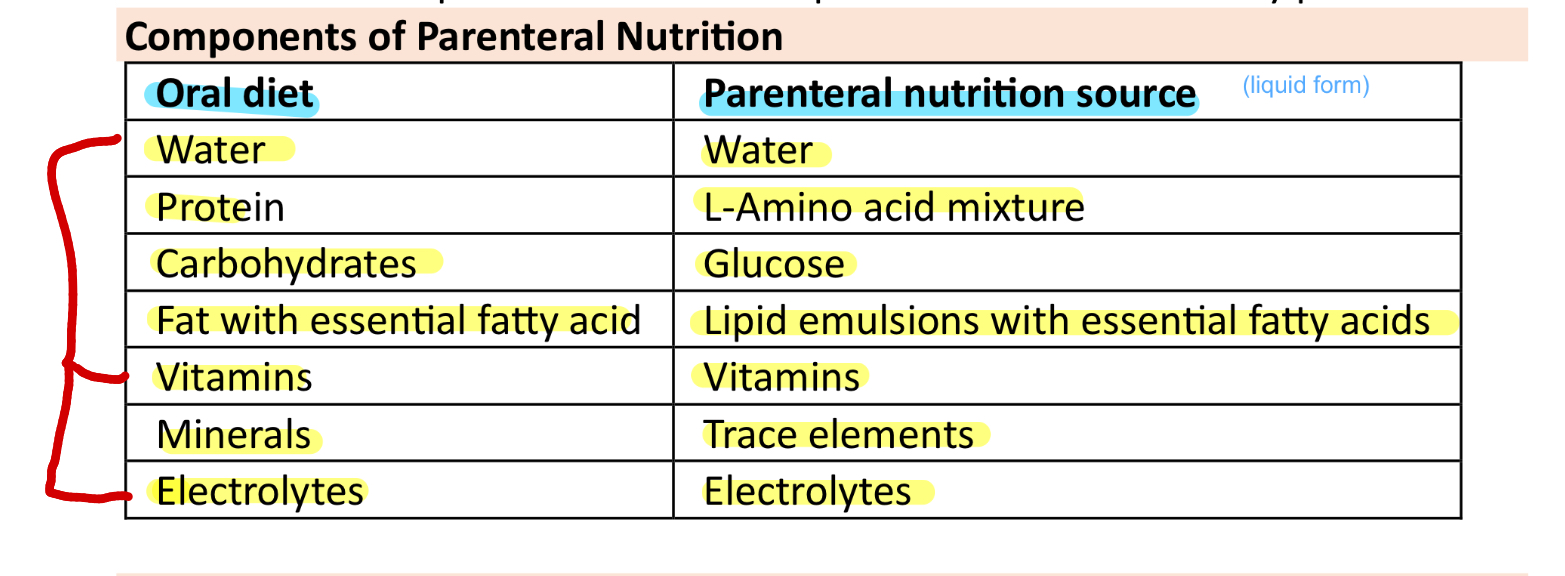
Components of Parenteral Nutrition
Oral diet vs. Parenteral nutrition
Glucose to amino acids: Press the upper left chamber (glucose) to mix with the lower chamber (amino acids).
Add electrolytes and trace elements in port.
Lipid emulsions: Press the upper right chamber (liquid) to mix with lower chamber.
Add vitamins.
Mix thoroughly then hang it on the drip stand for 24 hrs
Steps in mixing TPN components [5]