12. Meat
 Call Kai
 Learn
Learn Practice Test
 Spaced Repetition
 Match
Match Flashcards
 Knowt Play
1/17

There's no tags or description
Looks like no tags are added yet.
Name | Mastery | Learn | Test | Matching | Spaced | Call with Kai | Chat |
|---|
No analytics yet
Send a link to your students to track their progress
18 Terms
Definition of red meat
Meat that is red when you buy it
Unprocessed mammalian muscle meat: beef, veal, pork, lamb, mutton, horse and goat
Definition processed mea
Meats transformed through salting, curing, fermentation, smoking or other processes to enhance flavor or improve preservation
What is the relative risk increase for colorectal cancer per 100 grams of red meat consumption per day?
17% increased risk
What is the relative risk increase for colorectal cancer per 50 grams of processed meat consumption per day?
18% - in otherword 1 out of 20 individuals in UK/NL gets colorectal cancer
Group 1 carcinogens
Causes cancer
Processed meats
Alcohol
Cigarette smoking
Risk of cancer in smoking vs processed and red meat
Smoking is a significantly larger problem

two studies with same RR but different interpretations on red meat

Cancer risk among vegetarians vs non-vegetarians
Showed that risk was lower
However, VERY confounding as these are very different groups of people: different BMI, different lifestyles, different education, more often women are vegetarian.
Difficult to compare.
Why is it not perse advised to be vegetarian/vegan?
Because meat also has good nutrients
Vitamin B3
Vitamin B12
Vitamin B6
Iron
Zinc
Selenium
Are meat replacements always healthy?
No, often contain high salt.
Dietary recommendations all over the world

Possible mechanism (overall unhealthy diet)
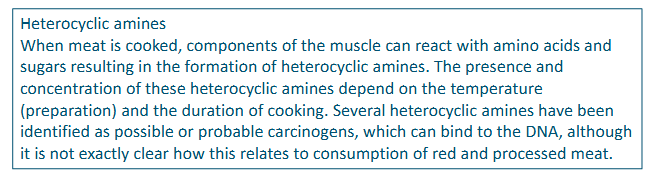
Due to heterocyclic amines that are formed when cooking or heating meat
Potent carcinogens in rodents (animal studies)
Also present in poultry
Possible mechanism II (PAH)
Polycyclic aromatic hydrocarbons
Formed when fat drips on fire
Smoke contains PAHs
Also found in cigarette smoke

Possible mechanism III (N-nitrosocompounds)
N-nitrosocompounds (NOC’s) => preservatives
Nitrite and Nitrate => nitric oxides
Endogenously formed (caricongenic)
Exact structure and role in color poorly understood

Possible mechanism IV (dietary heme)
Heme-iron is colouring pigments of red meat
Poorly absorbed in small intestine
Toxic metabolite during digestion
Experiment with mice and dietary heme
Two groups of mice, one was given additional heme equivalent to 160g of red meat a day.
Colon was tested, by testing cytotoxicity
Overtime, the mice who consumed additional heme had greater cytotoxocitiy
Group with additional heme also had more proliferation

Gene expression and dietary heme
Feedback mechanisms for proliferation inhibited
Tumor supressor gene TP53 was expressed less
= less apoptosis
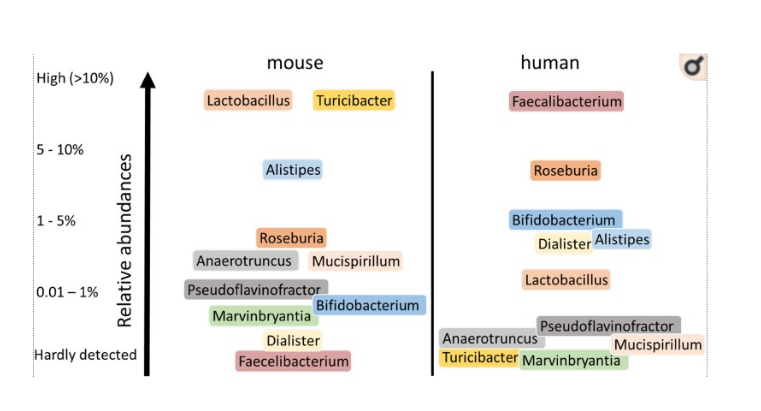
Mice vs humans (stomach bacteria)