ch 4 - nucleic acids + RNA
 Call Kai
 Learn
Learn Practice Test
 Spaced Repetition
 Match
Match Flashcards
 Knowt Play
1/17

There's no tags or description
Looks like no tags are added yet.
Name | Mastery | Learn | Test | Matching | Spaced | Call with Kai | Chat |
|---|
No analytics yet
Send a link to your students to track their progress
18 Terms
nucleotides
The *monomers of nucleic acids*; consist of a 5-carbon sugar (pentose), phosphate group, and nitrogenous base
Two types:
- Deoxyribonucleotides in DNA
- Ribonucleotides in RNA
Question: What type of nucleotide is represented in the picture? How do you know? (hint: look at sugar)

DNA
Nucleic acid made of deoxyribonucleotides (*deoxyribose* sugars and adenine, *thymine*, cytosine, guanine bases)
- Made of *two strands* that form a *double helix*
- Both strands have a hydrophilic sugar-phosphate backbone
- Stores information for its own *semi-conservative* replication and for the creation of proteins and RNA molecules

RNA
Nucleic acid made of *ribonucleotides* (*ribose* sugars and adenine, *uracil*, cytosine, guanine bases)
- *Single stranded!*
- Has wider variety in function; involved with catalysis (rRNA, snRNA, ribozymes), protein creation (mRNA, tRNA, rRNA, miRNA, snRNA), and more

deoxyribose
The 5-carbon sugar inside deoxyribonucleotides (that form DNA)
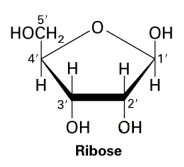
Compared to ribose, deoxyribose lacks the additional hydroxyl group on the 2' carbon

ribose
The 5-carbon sugar inside ribonucleotides (that form RNA)
Compared to deoxyribose, ribose has an additional hydroxyl group on its 2' carbon that makes RNA more reactive
pyrimidines
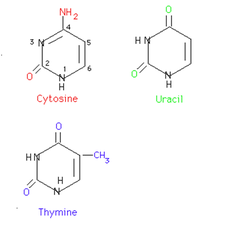
*Single-ringed* nitrogenous bases; refer to cytosine, uracil (in RNA), and thymine (in DNA)
Helpful memorization tool: CUT (cytosine, uracil, thymine) the Pyramid
purines
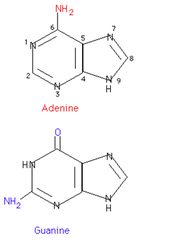
*Double-ringed* nitrogenous bases; refer to adenine and guanine
Helpful memorization tool: Pure As (adenine) Gold (guanine)
Phosphodiester bond
Bonds formed between the 3' *hydroxyl group* of a nucleotide and the 5' *phosphate group* of another nucleotide through dehydration synthesis
Nucleotides are linked together by phosphodiester bonds to create nucleic acids.

Nucleic acid polymerization
An input of energy is required to polymerize nucleic acids; this energy is obtained from the hydrolysis of phosphate groups from activated nucleotides (triphosphates)

Nucleic acid directionality
Nucleic acids are read, replicated, and created in a *5' → 3' direction*
In reference to sugar-phosphate backbone: 5' free phosphate group → 3' free hydroxyl group ... new nucleotides can only be added to a 3' free hydroxyl group

complementary base pairing
In a *double-stranded DNA molecule*, the amount of adenine = the amount of thymine (A = T) and the amount of cytosine = the amount of guanine (C = G)
These nitrogenous bases are linked together by hydrogen bonds across strands

DNA and RNA primary structure
The same for both DNA (uses thymine) and RNA (uses uracil); refers to the *5' → 3' order of nucleotide bases*

DNA secondary structure
An *antiparallel double helix*, stabilized by complementary base pairing (hydrogen bonding) and base stacking (hydrophobic and van der Waals interactions)

DNA tertiary structure
*Supercoiling and clumping* around positively charged histone proteins (nucleosomes)

RNA secondary structure
*Stem-and-loop configuration* stabilized by hydrogen bonding on the *same single strand* of RNA

RNA tertiary structure
*Pseudoknot* stabilized by hydrogen bonding between *distant* nitrogenous bases on the *same single strand* of RNA

DNA and RNA quaternary structure
Do DNA and/or RNA have a quaternary structure? That is up to you to decide...BUT we recommend recalling proteins' quaternary structure (the aggregation of multiple polypeptide subunits). Are there examples where multiple DNA and/or RNA subunits aggregate to form a new functional unit?
Gel electrophoresis
Experimental technique used to separate molecules based on size and charge
Usable with both DNA (- charge) and proteins (- charge given through SDS denaturant); both will therefore migrate toward the positive electrode
Smaller molecules will travel farther distances on the gel
Darker bands = more DNA / protein is present in that sample
