1 173 Lec PRINCIPLES AND METHODS OF PCOE
 Call Kai
 Learn
Learn Practice Test
 Spaced Repetition
 Match
Match Flashcards
 Knowt Play
1/103

There's no tags or description
Looks like no tags are added yet.
Name | Mastery | Learn | Test | Matching | Spaced | Call with Kai | Chat |
|---|
No analytics yet
Send a link to your students to track their progress
104 Terms
EPIDEMIOLOGY ETYMOLOGY
Etymology (Greek)
○ “epi” - upon
○ “demos” - people
○ “logos” – study of
● Study of people / populations
● Scientific discipline of public health
● Basic science of preventive & social medicine
EPIDEMIOLOGY
Study of distribution and determinants of health-related states or events in specified populations, and the application of this study to the control of health problems.
is concerned with (who, what, when, where)
Epidemiology
Surveillance, observation, experiments, hypothesis testing, analytic research
● Epidemiology is a scientific discipline;
● Research-oriented because it involves systematic collection of data and analysis
Study
Analysis of: persons, times, places and classes of people affected
Distribution of disease and health states
Looking at the pattern of occurence
Time: Frequency (how often? Is it seasonal, weekly, or daily?)
Place: Locality (e.g., barangay level, city level, school, nationwide, global setting )
Class of people affected: children, pregnant women, males, females, senior citizens , etc.
Distribution
are the ones being studied by epidemiologists
Determinants / Risk factors
Factors that influence health: biological, chemical, physical, social, cultural, economic, genetic & behavioral
● Because disease does not happen randomly in the population
● Ex. No. 1 risk factor/determinant for breast cancer is genetics/family history (strongest)
Determinants
Diseases, causes of death, behaviors (use of cigarettes), positive health states, reactions to preventive regimens, provision & use of health services
● Does not always focus on disease, it can be other types of outcomes like mortality or behaviors.
● Includes both positive and negative health states
Health-related states and events
“Community” - where the individual lives; constitutes his or her immediate EXTERNAL ENVIRONMENT
● Population = group of people with defined characteristics
● The external environment will characterize the living conditions and affect the health of the community
● E.g. living conditions; physical and social characteristics of the community
Specified populations
Aims of public health – to promote, protect & restore health
Application to prevention & control
Explain this:
A. MAIN DETERMINANTS OF HEALTH
● Onion illustration; Determinants have layers
● Viewed from the innermost to the outermost layer
○ Individual interacts with its family that interacts with the community and so on
○ There are several factors that can affect the social and community network as well as the individual living in the community, such as housing, work environment, and so on
B. EXAMPLE OF HEALTH DETERMINANTS
INDIVIDUAL
Physical
Socio-economic Status (SES)
Behavior
B. EXAMPLE OF HEALTH DETERMINANTS
ii. COMMUNITY
Water & sanitation
Food supply
Housing
B. EXAMPLE OF HEALTH DETERMINANTS
INDIVIDUAL
● genetic susceptibility to cancer ● immunity against specific diseases ● low level of physical fitness (prone to back injury)
Physical
B. EXAMPLE OF HEALTH DETERMINANTS
INDIVIDUAL
● poverty ● lack of economic resources ↔ inadequate nutrition
Socio-economic Status (SES)
B. EXAMPLE OF HEALTH DETERMINANTS
INDIVIDUAL
● behaviors with negative impact on health
○ e.g. smoking, eating habits, alcohol, addiction
● behaviors with positive impact on health
○ e.g. regular exercise, drinking enough water, sleeping, balanced diet
Behavior
B. EXAMPLE OF HEALTH DETERMINANTS
ii. COMMUNITY
● Diseases from contaminated water but preventable: typhoid, hepatitis, cholera
Water & sanitation
B. EXAMPLE OF HEALTH DETERMINANTS
ii. COMMUNITY
● Food supply malnutrition due to inadequate amount of food ● Over-nutrition/obesity/overweig ht due to accessible inexpensive caloric foods
Food supply
B. EXAMPLE OF HEALTH DETERMINANTS
ii. COMMUNITY
● Presence of pests (rats, mice, cockroaches) due to structural defects ● Overcrowded (airborne diseases, e.g., TB, meningitis, etc.)
Housing
C. ULTIMATE GOAL OF EPIDEMIOLOGY
● To eliminate or reduce the health problems of community/populations
● To promote the health and well-being of the society as a whole
● The application of epidemiological principles and methods to the study of drug effects in human populations
● The study of the use of and effects of drugs in large number of people
● Employs principles of epidemiology in quantifying adverse drug events, patterns of drug use, and efficacy in a large population
● Provides useful information about the beneficial and harmful effects of any drug for a clinician to better assess the patient for their particular condition
PHARMACOEPIDEMIOLOGY
PHARMACOEPIDEMIOLOGY
Pertinent questions relevant to the study:
○ What specific drug is used?
○ How is the drug being used?
■ Gives us information regarding patterns of use, including how much, where, when, & by whom?
○ Why is the drug being used? (Reasons for drug-taking behavior/compliance)
○ Study of drugs in humans ○ Pharmacoepidemiology derives its content Clinical Pharmacology ○ Covers everything about drugs ■ Pharmacokinetic properties ■ Pharmacodynamics ○ Helps us to understand how drugs work and guide their administration
Clinical Pharmacology
Central Principle of Clinical Pharmacology
Individualization of Therapy
Therapy should be tailored to fit the patient through the determination of the Risk-Benefit Ratio of the drug for a patient
Individualization of Therapy
T/F As a clinician, they should also be aware of the harmful effects of the drug, not just the clinical and beneficial effects
T
Different aspects of pharmacoepidemiology that can be studied
CP + PE ovverlap
○ Drug interactions
○ Global trends in prescribing
○ Generic vs reference utilization
○ Management of ADRs
○ Screening studies
○ Lifestyle effects on drug therapy
○ Special population drug therapy
○ Equivalence testing
○ Spontaneous reporting of safety
DRUG EFFECTS
The unwanted effects of drugs that could not be predicted based on their preclinical pharmacologic profile or the results of the premarketing clinical studies.
Unanticipated Harmful Effect:
○ Corresponds to Type B Adverse Drug Reaction
○ Ex. Rosiglitazone had an unanticipated cardiovascular problem
Unanticipated Harmful Effect:
Unwanted effects of drugs that could have been predicted based on preclinical and premarketing studies
Anticipated Harmful Effect:
○ Corresponds to Type A Adverse Drug Reaction ○ Ex. Chlorpheniramine causes sedation; every drug has its side effects and anticipated harmful effect
Anticipated Harmful Effect:
Desirable effects of drugs that were seen or not anticipated at the time of drug marketing
Ex. Sambong as a possible diuretic, which was meant for cardiovascular use
Unanticipated Beneficial Effect:
Desirable effects of the drug that are known to be caused by the drug
Anticipated Beneficial Effect:
Anticipated Beneficial Effect
A study of whether a drug can bring about its intended effect under ideal conditions
Efficacy
Anticipated Beneficial Effect
A study of whether in real-world conditions, a drug achieves its desired effect
Effectiveness:
Anticipated Beneficial Effect
A study of whether a drug can bring about a desired effect at the acceptable cost.
Efficiency
Study of the distribution and determinants of disease in population
Epidemiology:
Epidemiology Questions
○ How is the disease distributed in the population? (e.g. who has the disease? Sex, Age)
○ Where the disease occurred?
○ What causes the disease? (What is the effect of specified risk factors on disease: is lung cancer caused by cigarettes? Is brain tumor caused by cellphones?)
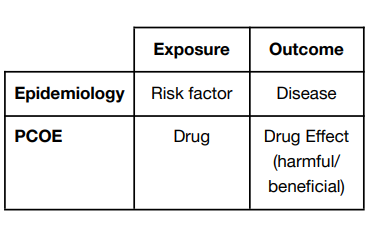
○ Risk factors (Exposure) -> Disease (Outcome)
■ Risk factors are mainly the determinants ■ Outcomes are not necessarily disease, it can be death, injury, toxicity, etc.
Epidemiology
Study of the use and effects of drugs in large populations
Pharmacoepidemiology:
Pharmacoepidemiology Questions
○ How is the drug being used?
○ Whether this is an effect of the drug?
○ Drug (Exposure) -> Drug Effects (Outcome)
■ Exposure is only the drug, unlike in Epidemiology where the exposure can be any sort of outcome.
■ Outcome should also be drug-related, more on the effects of the drug (anticipated/unanticipated beneficial/harmful effect).
Pharmacoepidemiology
○ Risk factors (Exposure) → Disease (Outcome) ○ Question
■ Is coffee drinking (risk factor) associated with the occurrence of the outcome of stroke (outcome)?
■ Is using a cell phone (risk factor) associated with the occurrence of brain tumor (outcome)?
■ These hypotheses can be answered by epidemiological studies
○ Looks at the distribution of disease/pattern of disease in the population
■ Ex. Prevalence of CHD, 80% of the CHD were male with DM
Epidemiology
○ Drug (Exposure) → Drug Effects (Outcome) ○ Question
■ Do COX-2 (risk factor) Inhibitors lead to MI (outcome)?
○ Looks at the Distribution of drug/drug use/drug effect in the population
■ Ex. Prevalence of statin use, 40% is inappropriate use
Pharmacoepidemiology
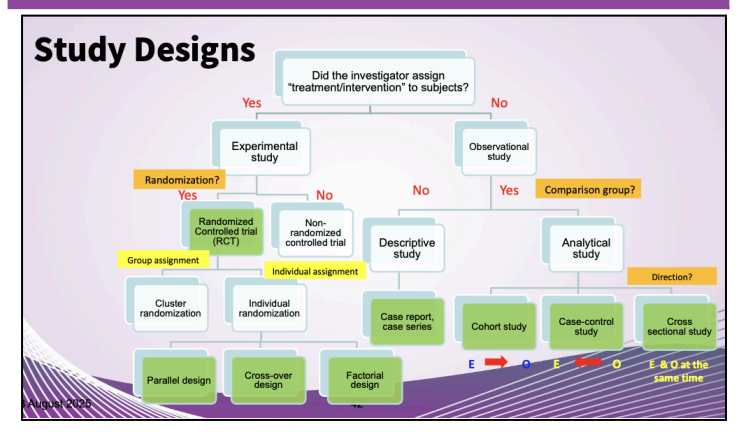
Study Designs
○ Can be employed to prove the relationships
○ Observational studies
○ Case report/series
○ Cross-sectional
○ Case-control
○ Cohot
○ Experimental study: RCT
NOTE TABLE
WAW
C. RATIONALE FOR PCOE
i. THALIDOMIDE
● 1961: Classical example: THALIDOMIDE disaster
○ Thalidomide was withdrawn from the market as it was proven to be associated with phocomelia.
○ Was given to pregnant mothers for morning sickness. It was not known to be teratogenic until epidemiological studies proved it to be associated with phocomelia when used during pregnancy.
○ Rate birth defect = phocomelia
○ Epidemiological studies = in utero exposure to thalidomide
THALIDOMIDE INCIDENT INFLUENCE
● Gave rise to different legal policies on the inclusion of some more requirements before a drug is approved to the market.
● WHO collated information from national monitoring organizations ○ 1962: Kefauver-Harris Amendments ■ pcol & toxical pre-clinical testing
● IND before clinical ■ Proof of drug efficacy before marketing (RCT)
● Publication of drug utilization studies ○ How physicians use/prescribe drugs → determinant of poor prescribing ○ Described how there are a certain number of physicians who do not consult CPGs or are not updated with the current practices, resulting in poor prescribing practices/drug utilization.
● Drug withdrawals from the market: ○ Ex. cisapride → rofecoxib → valdecoxib → sibutramine → propoxyphene
● Patient safety movement ○ Looks at medication errors ○ Speak on behalf of patients ■ Philippine Alliance of Patient Organizations (PAPO) ■ There are other organizations of patients that represent specific diseases (e.g., psoriasis, stroke, lupus)
● Many challenges that prevent optimal use of drug products – risks involved
Read more on other drugs/vaccines involved & their adverse effects
Mini segue
- Patient organizations are becoming more active and want their voices to be heard.
- Before, sa HTAC, the citizen’s representative was a nurse and not a patient. Complaints were made, but it was already constituted by the DOH. Instead, patient organizations were invited during stakeholder consultations for certain health conditions.
- Starting 2023, HTAC was reconstituted and considered including patients in the council.
Many challenges that prevent optimal use of drug products - risks involved ○ Some of these risks are discovered only after the drug is circulating in the market.
● After a drug is withdrawn from the market, challenges are faced by the Industry and manufacturer who would lose money and regulatory bodies/policy makers who would have to implement changes to their policy/regulations. ○ With the growing industry, there is also a growing demand for post-authorization safety studies (PASS) or post-marketing surveillance
RATIONALE FOR PCOE
iii. RISK MANAGEMENT
○ Iterative process that involves the identification, characterization, evaluation, and minimization of risks associated with medicinal products. ■ Iterative, as it covers the whole product life cycle.
○ GOAL: maximize efficiency & minimize risk (effectiveness)
Risk Management (Therapeutic)
● EU regulatory guidance definition (European Medicines Agency (EMA) & Heads of Medicines Agency (HMA), 2012)
○ A risk of management system is a set of pharmacovigilance activities and interventions designed to identify, characterize, prevent or minimise risks relating to medicinal products, including the assessment of the effectiveness of those activities and interventions
III. THERAPEUTIC RISK MANAGEMENT
EU
● US regulatory guidance definition by the Food and Drug Administration (FDA, 2005)
○ Specifically, risk management is an iterative process of: 1. Assessing a product’s benefit-risk balance 2. Developing and implementing tools to minimise its risks while preserving its benefits 3. Evaluating tool effectiveness and reassessing the benefit-risk balance, and 4. Making adjustments, as appropriate to the risk minimisation tools to further improve the benefit-risk balance
III. THERAPEUTIC RISK MANAGEMENT
US
PCOE CYCLE
● Compromises an of ongoing cycle of:
○ Risk Detection
○ Risk Assessment
○ Risk Characterization
○ Risk minimization (mitigation)
○ Effectiveness evaluation
○ Improvement
PCOE CYCLE
Identifying new risks from monitoring of the product
Risk Detection
PCOE CYCLE
Analyzing risks based on currently available data to evaluate their importance and gaps in knowledge, considering factors such as the likelihood of occurrence, severity, and the product's benefits.
Risk assessment:
PCOE CYCLE
Planning and implementing activities to gather more information about the risks of the product, such as further studies.
Risk characterization:
PCOE CYCLE
Planning and implementing measures to prevent or reduce risks, such as an educational plan.
Risk minimization (mitigation):
PCOE CYCLE
Assessing whether these activities sufficiently address the risks of the product.
Effectiveness evaluation:
PCOE CYCLE
Modifying, replacing or removing the activities, if appropriate; changes may be triggered by new information about the medicine, deficiencies identified during evaluation of existing activities, or external developments such as new regulatory requirements.
Improvement:
T/F Therapeutic risk management is a linear process
F. Therapeutic risk management is an iterative process or cycle
Reflects the difference between efficacy and effectiveness
○ Efficacy: arises from the benefits of the drug observed during clinical trials
○ Effectiveness: describes the real world use of the drug
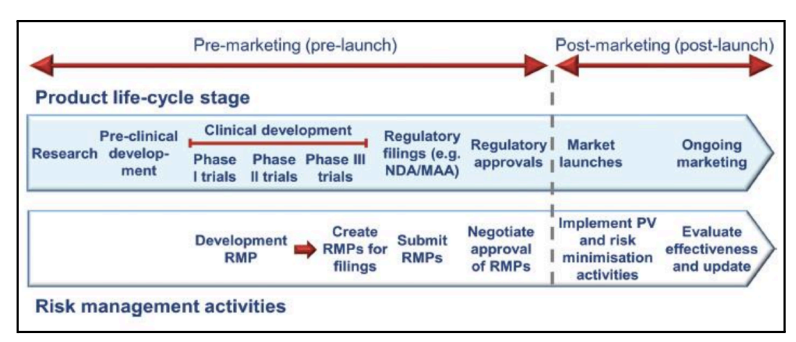
EXPLAIN THIS IMAGE
Key risk management activities during the product life-cycle
(NAA, Marketing Authorization Application, NDA, New Drug application, PV, Pharmacovigilance, RMP, risk management plan)
This table describes the application of risk management throughout the life cycle of a medicinal product or drug therapy; this is just a review of the drug development process.
What is NOT solely a regulatory requirement, but actually a strategic approach for ensuring patient safety, which should be performed throughout the product’s life-cycle.
Risk management
○ Risk management plans are now included in the product portfolio when submitted to the regulatory authorities.
○ Updates will be required when the product is released to the market to gather possible new safety information that was not discovered beforehand.
USES/CONTRIBUTIONS OF PCOE
GENERAL:
1. Reassurance about drug safety
2. Fulfillment of ethical and legal obligations
>> Important in drug development
● Importance of Pharmacoepidemiology in Drug
Development (Drug Approval Process)
USES/CONTRIBUTIONS OF PCOE
PHARMACY PRACTICE
1. Supplements the information from pre-marketing ○ Provide more precise incidence of known adverse and beneficial effects, and ○ In patients not studied prior to marketing
2. Provides new information not available from pre-marketing studies ○ Discovery of previously undetected adverse and beneficial effects (uncommon and delayed effects) ○ Patterns of drug consumption/utilization ○ Effects of drug overdoses ○ Economic implications of drug use (pharmacoeconomics) ○ For making rational drug therapy decisions (evidence-based)
CASE STUDY: Adverse Event Reports Lead to Further Studies
The U.S. FDA received a higher than expected number of reports through their Adverse Event Reporting System of amyotrophic lateral sclerosis (ALS i.e., Lou Gehrig's disease) in patients taking statins. Through this reporting system, the FDA decided to evaluate this signal of a possible causal association between the two. In an article published in Pharmacoepidemiology and Drug Safety in 2008, they reported reviewing 41 controlled clinical trials. The results indicated that about 9 of 64,000 patients treated with a statin and 10 of about 56,000 patients treated with placebo were diagnosed with ALS. The FDA concluded that the use of statins does not increase the incidence of ALS. The FDA continues to evaluate the issue. Case-control studies and other epidemiologic studies evaluating the incidence of ALS and statin use are being conducted.
● Summary:
CASE STUDY: Adverse Event Reports Lead to Further Studies
○ Report says that ALS was linked to patients taking statins;
○ Based on the report, only 9 out of 64,000 patients had received statins and 10 out 56,000 received placebo
○ Because of these small numbers, the U.S. FDA did not associate ALS to use of statins
● This case actually led to further studies:
○ Now, there are more publications about this AE and the use of statins. In fact, it was found that statins protect patients from ALS.
○ Don’t just jump into conclusion because you have seen initial reports about a potential link of an AE and the use of a drug
REVIEW TABLE
STUDY DESIGNS
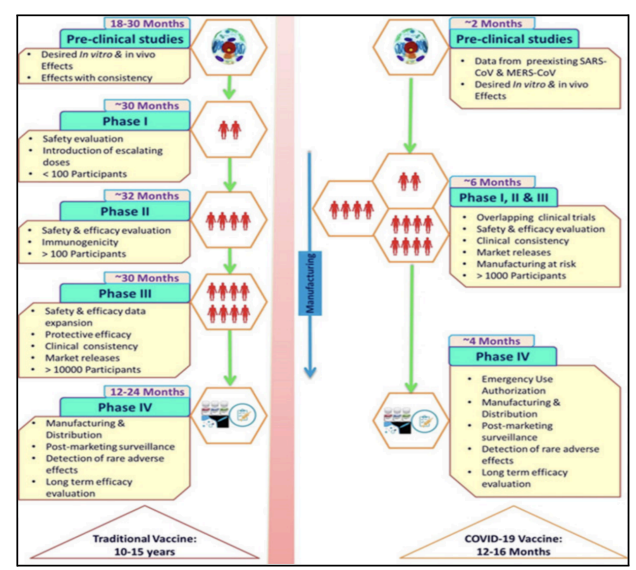
This figure differentiates the preclinical phases from the clinical phases of typical vaccine vs. traditional ones
● A traditional vaccine would take around 10-15 years of development; however, during the pandemic, COVID-19 vaccines only took about a year (12-16 months) to finish the preclinical and clinical phases.
● The first set of vaccines were approved via the Emergency Use Authorization (EUA) pathway.
● They started with hundreds of vaccine candidates, and later during clinical development, there were only about less than 10 that were approved under EUA in different countries (UK, USA, Canada, Russia, China, and India).
● The process is better called accelerated (expedited, acc. sa HTA) and not a shortcut.
○ This gave rise to vaccine hesitancy among several people.
○ If you recall, some HCPs have even advocated the use of, not vaccines, but drugs like Ivermectin to protect patients from COVID-19.
○ The process is only expedited because we were in an emergency crisis at that time, but hesitancy arose from data limitation and questions that are left unanswered.
○ As more safety data becomes available and results become more robust, hopefully more people become confident to undergo vaccination.
VI. REASONS FOR PERFORMING PCOE STUDIES
● When should one perform PCOE studies?
A. REGULATORY
1. Required
○ During clinical trials, the data needs to be submitted as part of the product dossier/profile
2. To obtain earlier approval for marketing
3. As a response to question by regulatory agency
○ Who should be at the forefront in answering these questions? Pharmacists, specifically regulatory pharmacists are the experts who coordinate and communicate with the agency. They should have a strong background in pharmacoepidemiology.
4. To assist application for approval for marketing elsewhere
VI. REASONS FOR PERFORMING PCOE STUDIES
● When should one perform PCOE studies?
B. MARKETING
● For marketing purposes, these studies would become evidences to prove the safe use of drug products
1. To penetrate the market by documenting drug safety
2. To increase name recognition
3. To reposition the drug
○ Different outcomes (quality of life; economic)
○ Different types of patients (elderly, etc)
○ New indication
○ Less restrictive labeling
VI. REASONS FOR PERFORMING PCOE STUDIES
● When should one perform PCOE studies?
C. LEGAL
1. To anticipate future product litigation
○ PCOE studies can serve as evidences in the court to answer complaints
VI. REASONS FOR PERFORMING PCOE STUDIES
● When should one perform PCOE studies?
D. CLINICAL RESEARCH
1. To generate hypothesis:
○ New Chemical Entity
○ Safety profile of the class
○ Relative safety of the drug within its class
○ Formulation
○ Disease to be treated: Duration, Severity, Prevalence, Presence of Alternative Therapies
2. To test hypothesis: problem on drug structure;
problem on pre-clinical or pre-marketing human data;
problem based on spontaneous reports; need to
quantify frequency of adverse reactions
● Patterns of Use
○ What are the patterns of drug utilization?; How are
drugs used in clinical practice?
○ How are drugs used in specific patient populations,
such as women, children, the elderly?
○ How long do people take this drug? Do certain
patient groups stop taking this drug? What are the
medication and persistence rates for this drug?
● Safety
○ Are there drug-drug interactions with this drug
product that were not previously identified? How
frequently do drug-drug interactions occur in the
population?
○ Do certain risk factors predispose patients to
ADRs?
● Effectiveness
○ Is drug A more effective than drug B?
○ What is the effect of using the drug over time?
● Economic Evaluations
○ Is drug A more cost-effective than drug B?
○ What are the economic consequences of using the
therapy?