3.3 - E in mitochondria + chloroplasts
 Call Kai
 Learn
Learn Practice Test
 Spaced Repetition
 Match
Match Flashcards
 Knowt Play
1/25

There's no tags or description
Looks like no tags are added yet.
Name | Mastery | Learn | Test | Matching | Spaced | Call with Kai | Chat |
|---|
No analytics yet
Send a link to your students to track their progress
26 Terms
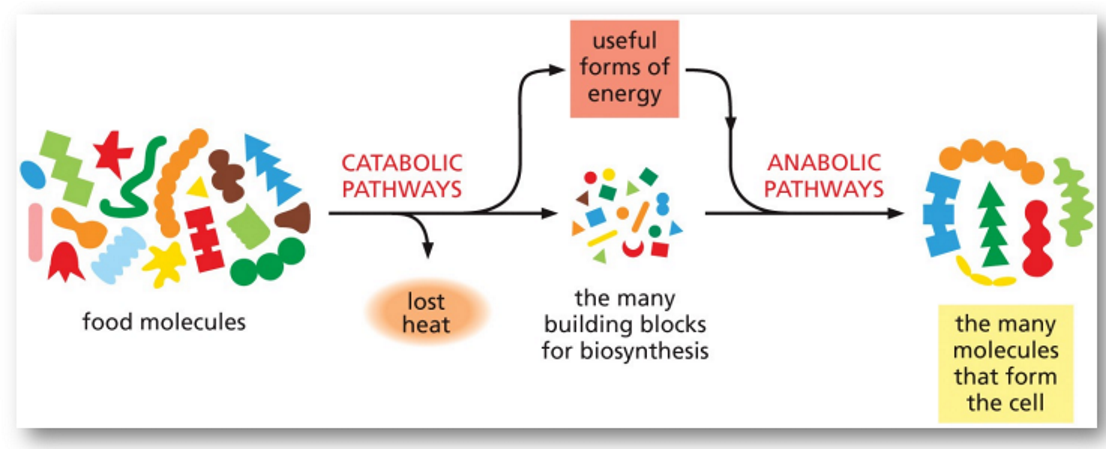
catabolism
a major portion of the energy stored in the chemical bonds of food molecules is dissipated as heat
some E used to drive new molecule synthesis in anabolic pathways!
what maintains biological order?
the 2nd law of thermodynamics
human intervention will release enough heat to bring back order
biological order steps
molecules of cell + env are relatively disordered
cell takes E from food → carries out order rxn → releases heat into env
heat incr. disorder in surroundings
different forms of energy are interconvertible but the total amount of energy must be ………………
conserved
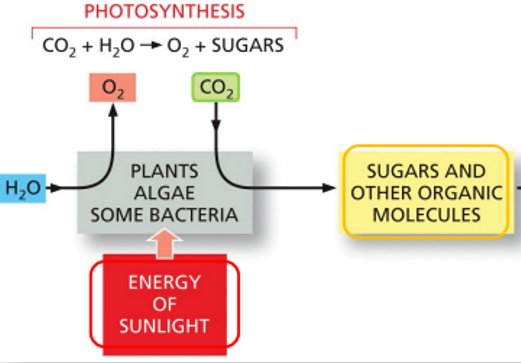
trapped by plants and some microorganisms through photosynthesis ………… is the ultimate source of all energy for humans and other animals
sunlight
2 stages of photosynthesis
stage 1
activated carriers are generated in the first stage, ATP and NADPH
2 stages of photosynthesis
stage 2
chemical-bond energy can be formed and stored via photosynthesis
photosynthesis general process
sun E → H2O + CO2 → O2 + sugar
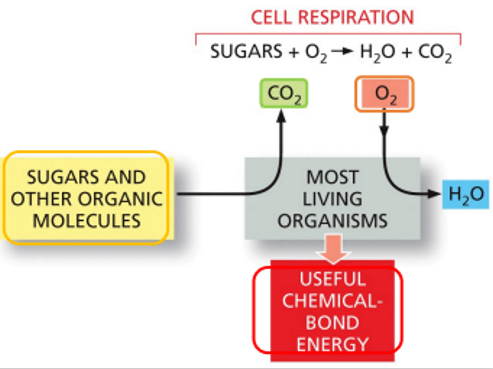
cell respiration
O2 + sugar → CO2 + H2O
membrane-based mechanisms definition
use the energy provided by food or sunlight to generate ATP
this is how cells obtain most E
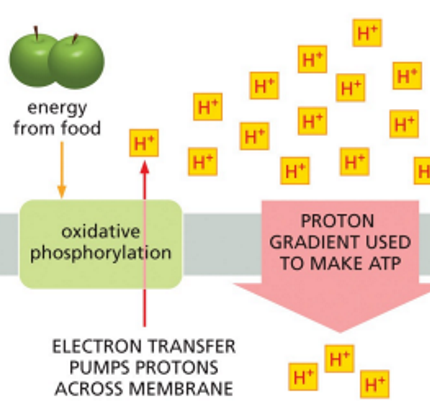
oxidative phosphorylation
membrane-based mechanism
in mitochondria
electron-transport system uses energy from oxidation of food to generate a proton (H+) gradient across a membrane
photosynthesis
membrane-based mechanism
ur so smart babie!
in chloroplasts
electron-transport system uses energy derived from the sun to generate a proton gradient across a membrane
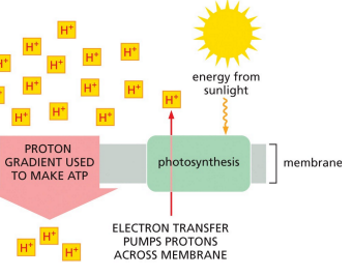
if a battery’s terminals are directly connected………, the energy released by electron transfer is all converted into heat
to eachother
wow babie ur so smart i love you
if a battery is connected …………., much of the energy released by electron transfer can be harnessed to do work
to a pump
membrane-based mechanisms
step 1
proton pump harnesses E of electron transfer to pump protons (H+) across a membrane
creates proton gradient
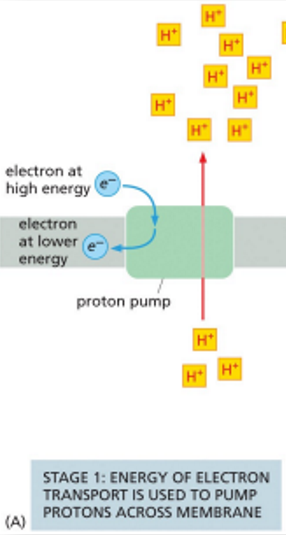
membrane-based mechanisms
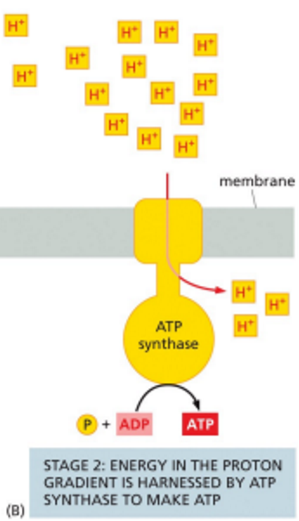
step 2
proton gradient serves as E source that can be used to drive many E-requiring reactions
in mitochondria, chloroplasts and prokaryotes
SYNTHESIS OF ATP BY SYNTHASE
a ………. can divide like a bacterium
mitochondria
similarities between mitochondria and chloroplasts
have their own DNA-based genomes + replication machinery
inner compartments have DNA + ribosomes
membranes contain protein complexes involved in ATP production
where is the mitochondria in a cardiac muscle cell
close to the contractile apparatus, where ATP hydrolysis provides the energy for contraction
where is the mitochondria in sperm
in the tail, wrapped around a protion of the motile flagellum that requires ATP for movement
role of mitochondria in nodes of Ranvier
stationary at the node and serve as energy sources to support Na+/K+ ATPases
4 comparments of mitochondria
matrix
inner membrane
outer membrane
intermembrane space
mitochondrial matrix
contains highly concentrated mixture of enzymes
required for oxidation of pyruvate + fatty acids and citric acid cycle
mitochondrial inner membrane
contains proteins that carry out oxidative phosphorylation
electron transport chain
ATP synthase
transport proteins that move selected molecules in + out of matrix
mitochondria outer membrane
contains large, channel-forming proteins
permeable to all molecules of 5000 daltons/less
mitochondria intermembrane space
contains several enzymes that use ATP passing out of matrix to phosphorylate other nucleotides