Environmental Farm Management Exam #2
 Studied by 2 people
 Call Kai
 Learn
Learn Practice Test
 Spaced Repetition
 Match
Match Flashcards
 Knowt Play
1/56

There's no tags or description
Looks like no tags are added yet.
Name | Mastery | Learn | Test | Matching | Spaced |
|---|
No study sessions yet.
57 Terms
Disease
Physical/mental condition where a normal function is harmed
Illness
subjective sensation of experiencing a disease rate
Sickness
the state of being ill
Health
absence of illness/injury
Why animal Healthy Matters
health is a key part of animal welfare but not sole determinant
Animal Health =
studies focus on disease itself
welfare perspective focus on how animal experiences the consequences of disease
Inflammation
a defense mechanism to infection & tissue injury
Chronic Inflammation
due to persistent & unresolved acute inflammation or chronic process
characterized by simultaneous destruction & healing of tissue
can spread to other parts of body & cause inflammation
Sickness Behavior
fever
depression
lethargy
inappetence
thirst
Sickness Behavior - Isolation
could benefit due to reducing spread of disease
Care of Sick/Injured Animals
require additional care & resources
Immunity & Vaccinations
pathogens enters body causes
inflammation
activation of cell medicated immunity
antigen in pathogens → B-lymphocytes produce antibodies
Vaccines is to avoid animal suffering through prevention
Lameness
impaired movement or deviation from normal gait
welfare concern across all species
can increase sensitivity to pain & reduce feed intake
Experimental vs Commercial Setting
great focus on developing measures for experimental setting
Key Differences
animals kept in larger groups
minimal or no direct contact w/ animals
limited time for observation
Resource-Based Indicators
describe environment & management protocols
easy to assess
identify risk factors that can threaten welfare
“think structure”
Animal-Based Indicators
describes state of animal
measures how the animal is actually fairing in environment
difficult to incorporate on-farm assessments
look at animal itself
behaviors can be used as an animal based indicator
What should we “Measure”
use both indicators to assess welfare state of animal
Assessment Strategies MUST meet →
Valid
accurate
Reliable
precise
Robust
applicable to different situations
Practical
time/labor adequate
Applying New Measures
Measure
Analyze Risk Factors
Inform
Support Management decisions to create improvements in welfare
Housing of Farm Animals - General Purpose
Protection + Confinement
Regulation of Temperature + Air
Access to Feed + Water
Stocking Density
# of animals per area
total space / # of individuals = Stocking Density
Protection + Confinement
limit access to space
Regulation of Temp + Air
Ventilation
movement of air
measured by cubic feet per minute
C → F
C = F - 32 / 1.8
Access to Feed + Water
balanced diet
water
Feed Conversion Ratio
measures efficiency convert feed into body mass
FCR = feed consumption (lbs or kg) / weight gain (lbs or kg)
Lower FCR = more efficient
Higher FCR = less efficient
Mortality
% mortality = percent of animals that died or were euthanized
% mortality = (# of animals dead&euthanized / total start # animals) * 100
Environmental Enrichment
improve or enhance the environment of the animals
Goals of Environment Enrichments
increase behavioral diversity
decrease frequency of abnormal behaviors
increase range of # of normal behavior patters
increase utilization of environment
increase ability to cope w/ challenges
increase biological functioning
Stressor
external/internal factor that disrupts animals homeostasis & elicit stress response
Stress
biological response of an animal when exposed to a stressor
Strain
magnitude of physiological behavioral effect that stressor caused
Homeostasis response to stressor
fight or flight : response
involves nervous system & endocrine system
Autonomic Nervous System (involuntary)
sympathetic nervous system (SNS)
releases norepinephrine (noradrenaline)
end goal: increase blood flow to organs + muscles needed for response
Endocrine System
HPA (Hypothalamic - Pituitary - Adrenal) Axis
Stressor Detected
Secrets CRH (Corticotropin - releasing hormone)
CRH stimulates anterior pituitary gland to release ATCH (adrenocorticotropic hormone)
ATCH travels to adrenal gland
Adrenal cortex releases glucocorticoid
Cortisol acts on body functions
Visual Representation
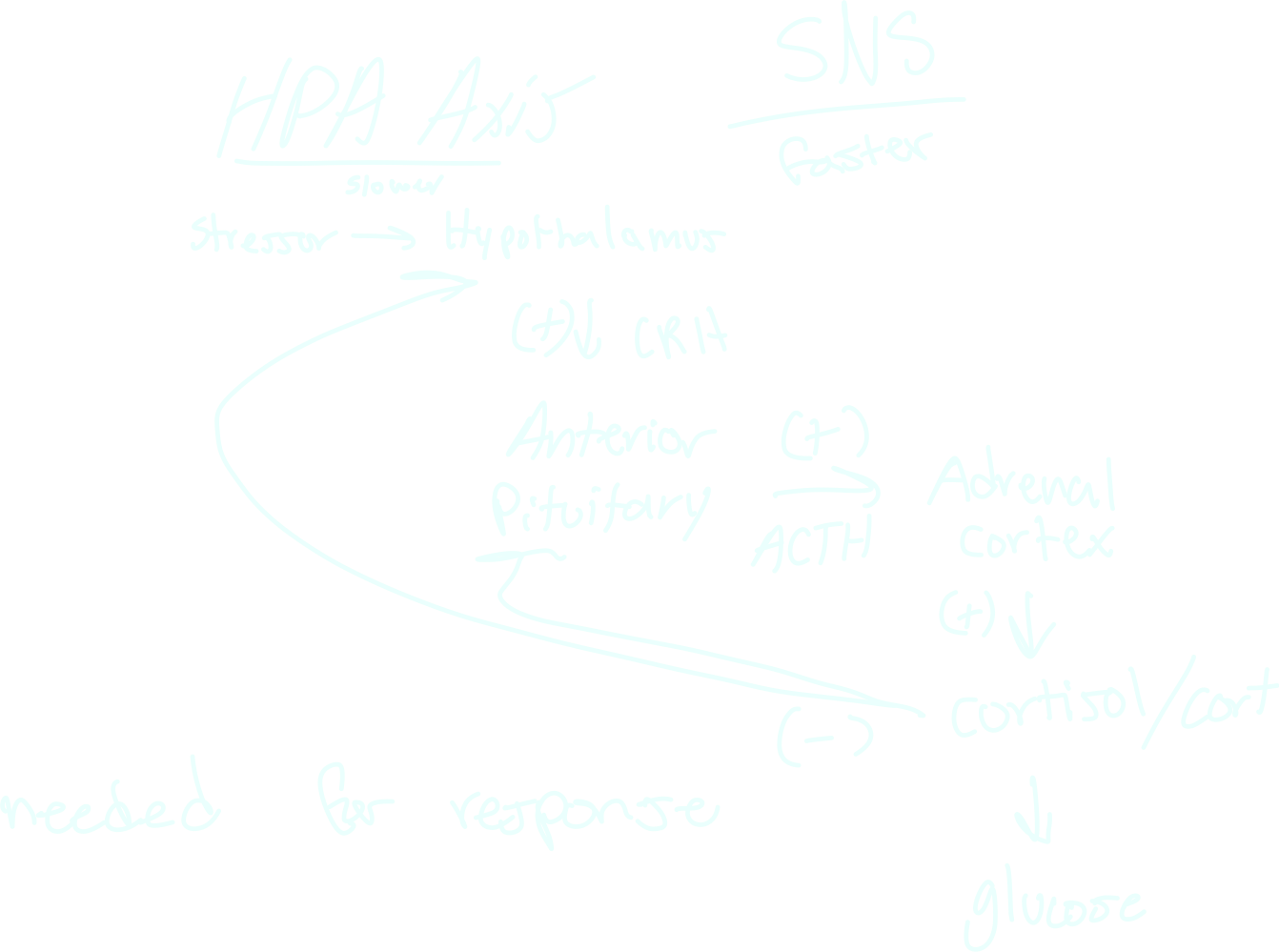
Consequences of Chronic Stress
development + growth
immune
digestive
reproductive
Atypical Behavior
behavior that are exaggerated in frequency and/or intensity of normal eliciting stimuli
Causes of Atypical Behavior
environmental deprivation
social isolation or over crowding
forced exposure to humans
nutritional deficiencies
hormonal imbalance
early weaning or brain damage
Treatment & Management Approaches
environmental enrichment
behavioral modification
Behavioral Modification
systematic methods used to reduce or eliminate atypical behavior
focuses on changing associations, reinforcement patterns or responses to stimuli
Behavior Modification Techniques
punishment
counterconditioning
flooding
progressive desensitization
pharmacological
Livestock Climate Impact Truth
livestock methane part of carbon cycle
CO2 form fossil fuels is bigger threat
livestock & agriculture can reduce emissions w/ technology
incentive - based climate policy is effective + scalable
farmers are essential to climate progress
Composting Livestock Waste
composting is a managed biological oxidation process that converts heterogenous organic matter into homogenous homus like material
Key Elements
carbon - energy
Nitrogen - protein
water - function of microbes
oxygen - aerobic decomposition
Process of Composting Livestock Waste
Windrow Management
manure placed in long piles
particles should be < 2in
Temperature
heat up above 120F
between 131-170F for 15 days
Oxygen & Turning
must remain aerobic CO2 >5% in
Moisture
60% moisture
C/N Ratio
20 C : 1 N
too low → excess N causes ammonia odor
too high → excess C causes slow decomposition
Finished Compost Characteristics
dark brown to black color
Homogenous appearance
Economic / Environmental Perspective
manure should be viewed as a viable resource
Metrics for Stock Density
ft2 = ft ft ; in2 = in in
1ft = 12in
1 m = 100 cm
1 m = 3.28 ft
Conversion for FCR
1 kg = 2.20
1 kg = 1000g
homeostasis
maintain balanced internal environment despite external changes
5 criteria to assessing animal welfare
nutrition
environment
health
behavioral interactions (social
mental state
sympathetic nervous system
fast
increases heart rate
dilate blood vessels
Isabelle abnormal behaviors
tongue rolling
non nutritive oral manipulation
Jerseys perform more because
more time spent chewing while grazing
more feed per unit of body weight
genetic influence
benefits to composting
reduces weight
substitute to fertilizer
greenhouse gas with highest potency
methane
greenhouse gas get destroyed by
methane
feed additives to reduce methane
bovaer
rumen modifiers (less impact)