Chemistry 105 Exam 1
 Call Kai
 Learn
Learn Practice Test
 Spaced Repetition
 Match
Match Flashcards
 Knowt Play
1/78

There's no tags or description
Looks like no tags are added yet.
Name | Mastery | Learn | Test | Matching | Spaced | Call with Kai | Chat |
|---|
No analytics yet
Send a link to your students to track their progress
79 Terms
chemistry
the study of matter by studying behavior of atoms and molecules
atoms
submicroscopic particles; building blocks of ordinary matter
molecules
groups of 2 or more atoms in geometric shape; at least 2 atoms in a definite arrangement held together by chemical force (not all molecules are compounds)- H2=molecule; CO=molecule and compound
classifications of matter
state or composition
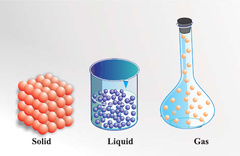
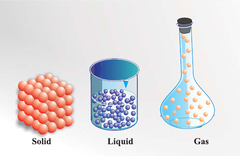
state- solid
atoms super close together; definite shape and volume; amorphous (atoms do not have long range pattern of arrangement) or crystalline (atoms have long term pattern of arrangement); condensed
state- liquid
atoms close but can move freely; definite volume, not shape (fluid); condensed
state- gas
atoms far apart; no definite shape or volume; atoms move freely; compressible

composition- pure substance
non variable compound; made up of only one compound (can't separate=element or can separate=compound)
element
can't be broken down
compound
2 or more substances (elements) in fixed ratio; pure substance; different properties than component elements
composition- mixture
variable compound; two or more components in proportion that can vary
homogeneous
uniform (tea and sugar)
heterogeneous
non-uniform (wet sand)
physical means
used to separate mixture into pure components
chemical means
used to separate compound into pure components
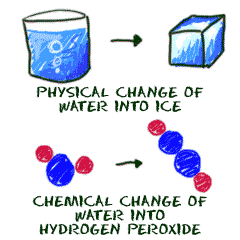
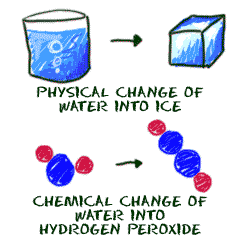
physical change
no alteration of composition or identity (ice melting, sugar dissolving, etc.)

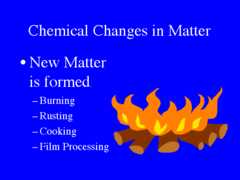
chemical change
alters composition or identity of substance (hydrogen gas burns in oxygen to make H2O, rust, etc.)
physical property
color, odor, boiling point, density
chemical property
acidity, toxicity, flammability
extensive property
depends on amount of matter (mass, volume, length)
intensive property
independent of amount (density, temperature, color)
phase change
does not change composition; solid to liquid to gas
energy
capacity to do work
work
directed energy
kinetic energy
energy produced by moving object Total E= ke+pe
potential energy
energy available due to position Total E= ke+pe
thermal energy
energy associated with random motion of atoms and molecules (type of kinetic energy)
Law of Conservation of Energy
total quantity of energy in the universe is constant; all energy can be converted to other forms, but never created or destroyed
mass
measure of quantity of matter; does not change with gravity
weight
force that gravity exerts on object
volume
1cm^3=1mL
density
mass/volume- kg/m^3, g/L, g/mL
1g/cm^3=1g/mL=1000kg/m^3
K, F, C (temperature)
K=C+273.15
F=1.8(C)+32
C=(F-32)/1.8
precision
measurements close to each other
accuracy
measurement close to actual value
Law of Conservation of Mass
in a chemical reaction, matter is neither created nor destroyed; mass of reactants=mass of products
Law of Definite Properties
all samples of a particular compound will have the same proportions of constituent elements ex: H2O-2:1
Law of Multiple Proportions
when 2 elements (A and B) from 2 different compounds, the masses of B that combine with 1 g of A can be expressed as a ratio of small whole numbers ex. NO- 14:16, NO2- 14:32, N2O- 28:16
Dalton's Atomic Theory
explains above laws; beginning of modern chemistry
1. elements are composed of tiny, indestructible parts called atoms
2. all atoms of a given element are identical
3. atoms combine in simple whole number ratios to form compounds
4. atoms of one element can't change into atoms of another element (chemical reaction is separation, combination, or rearrangement rather than creation or destruction)
cathode ray
Thompson's experiment; beam of particles in cathode ray tube travel from negative charged end (cathode) to positive charged end (anode); cathode ray has negative electrical charge; discovered electron (smaller than atom); discovered charge to mass ratio of electron
oil drop
Millikan's experiment; oil drops acquired electrons (negative charge) as they fell; lower plate had electrical strength to halt the fall of the drops; charge to be -1.6x10^.19 C and found mass of electrons to be 9.1x10^-28 g
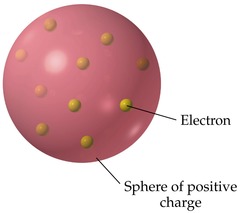
Thompson's plum pudding model
electrons stuck in positively charged background (blueberries and muffin)
Rutherford's gold foil experiment
positively charged alpha particles pass through gold foil, but some deflect off at different angles- charges not spread out evenly across atom; positive charges held in dense core (nucleus); disproved plum pudding model
Chadwick
discovered neutrons
atomic number
number of protons in nucleus of each atom of an element (fixed number); determines identity; neutral atom: atomic number=# of neutrons
mass number
# of protons + # of neutrons
isotopes
atoms which have the same atomic number, but different atomic masses
atomic mass
mass of he atom in atomic mass unit; atomic mass unit= 1/12 of the mass of a Carbon12 atom
atomic mass=sum(abundance of isotope n)x(mass of isotope n)
ions
atom or group of atoms with a + (cation) or - (anion) charge; charge= loss or gain of electrons
monatomic ions
ions which consist of only one atom: Na^+, Cl^-, Mg^2+, O^2-
polyatomic ions
ions which consist of more than one atom: OH^-, SO4^2-, NH4^+, CO3^2-
ionic compound
compound formed from 2 or more ions: LiCl, MgF2 (metal and nonmetal; cation and anion)
Periodic Law
when arranged in order of increasing atomic mass, certain sets of properties recur periodically
Mendeleev's periodic table
periods: horizontal rows
families or groups: vertical columns (elements have similar properties)
used periodic law to predict properties or undiscovered elements
regions
metals, metalloids, nonmetals
metals
solid at room temperature; reflective surface; conduct heat and electricity; malleable and ductile; lose electrons and form cations in reactions; 75% of elements; lower left of table
non-metals
found as solids, liquids, and gases; poor conductors of electricity and heat; solids are brittle; gain electrons and form anions in reactions; upper right of table
metalloids
some properties of metals and some of non-metals; semi-conductors
Important group- H
non-metal; colorless, diatomic gas, low melting point and density; reacts with nonmetals to form molecular compounds- HCl and H2O; H reacts with metals to form hydrides- metal hydrides react with H2O to form H2; H+(halogen) dissolves in water to form acids
Important group- Alkali metals
1A; soft, low melting point and density; flame tests: Li=red, Na=yellow, K=violet; very reactive, never find uncombined in nature; tend to form water soluble compounds; colorless solutions; react with water to form basic (alkaline) solutions and H2 (releases lots of heat)
2Na+2H2O-->2NaOH+H2
Important group- Alkali earth metals
2A; harder, higher melting point and density; flame tests: Ca=red, Sr=red, Ba=green; reactive (less than above); form stable, insoluble oxides form which they are extracted; oxides=basic=alkaline earth metal; reactivity with water to form H2: Be=none, Mg=steam, Ca,Sr,Ba=cold water
Halogens
7A; nonmetals and diatomic; F2 and Cl2-gases, Br2-liquid, I2-solid; very reactive; react with metals to form ionic compounds; H(halogen)=acid;
HF(weak acid)
Noble gases
8A; very unreactive (hard to become gain or lose electrons); gas at room temperature; low melting and boiling point
mole (mol)
# of atoms in exactly 12.000g of C12- 6.022x10^23
molar mass
mass of one mole of units of a substance in grams (atomic mass)
elements and compounds
elements can combine to make limitless compounds; properties of compounds different than those of its component elements
chemical bonds
forces that hold atoms together in a compound
ionic bond
transfer of electrons form metals to nonmetals results in cations and anions held together by electrostatic force
covalent bond (molecular bond)
sharing of electrons (-) between two nonmetal nuclei (+); results in a molecule
chemical formula
give elements in compound with relative number of each element as a subscript: H2O, AlPO4, C4H8
molecular formula
C2H6 (actual)
empirical formula
CH3 (lowest number whole ratio)
atomic elements
elements whose particles are single atoms
molecular elements
elements whose particles are multi-atom molecules
molecular compounds
compounds whose particles are molecules of only nonmetals
ionic compounds
compounds whose particles are cations and anions
diatomic elements
H2, N2, O2, Cl2, Br2, I2
diatomic molecules
CI2, HF, NO
polyatomic molecules
CO2, HCN, CH3OH