Electric Fields
 Call Kai
 Learn
Learn Practice Test
 Spaced Repetition
 Match
Match Flashcards
 Knowt Play
1/23

There's no tags or description
Looks like no tags are added yet.
Name | Mastery | Learn | Test | Matching | Spaced | Call with Kai | Chat |
|---|
No analytics yet
Send a link to your students to track their progress
24 Terms
What are atoms charges defined by?
The net sum of +ve (protons) and -ve (electrons) in the atom
When the net charge of a particle ≠ 0
It has a charge imbalance
Define Static Charges (+alternative name)
The lack of overall movement of charge in an object is static charge (electrostatics)
Define ESF
Repulsive + Attractive force polarities
Equal magnitude of force in opposite direction:
Repulsive = +ve
Attractive = -ve
What are the 2 components of Coulomb’s law?
Force between 2 charges are proportional to the product of the 2 charges (F∝Qq)
Force is inversely proportional to the square of the distance between the point charges
What is the equation for Coulomb’s law?
F= kQq/r²
What type of quantity is Electric field strength?
Vector quantity (shows the force the point charge experiences in the Electric field)
Define Electric field strength
The force per unit charge a small +ve would experience at that point in an electric field
Give the formula for Electric field strength (+ unit)
E= F/q
Unit= NC-1
What type of particles are used to measure Electric Field strength (+ why)
Small charged Point Mass’:
Their Electric field is virtually 0, so we can accurately calculate the E.F strength of the greater charge
What is the formula for Electric field strength?
F=kQ/r²
k = 1/4πε₀
ε₀ = Permittivity in a vacuum
Give the axes + shape for the E.Field strength to distance graph
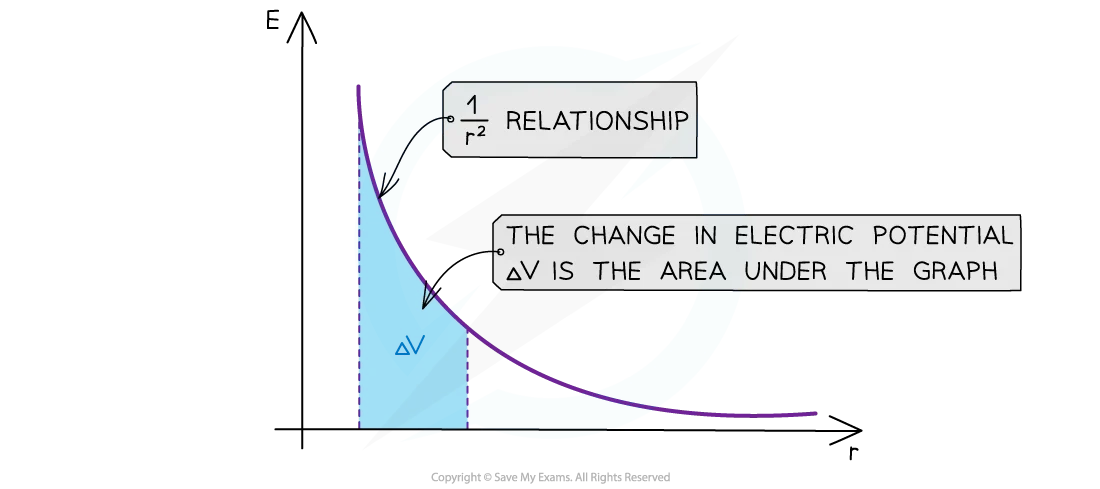
Describe the field lines of a +ve and -ve field
What do the frequency of field lines show?
More lines = Stronger E.Field = Higher charge

What is the formula for the Resultant Electric field strength for a particle in multiple fields?
How do you find the force components?
ETotal = sqrt((E1x + E2x + E3x)² + (E1y + E2y + E3y)²) :
E1x = E1 * cos(theta1)E1y = E1 * sin(theta1)
Electric Potential + Potential energy
Electric Potential + Potential energy
How is Work done in an Electric Field?
Work is done when a point charge is moved in an electric field
How do we know what polarity Work Done is in an electric field?
What about EPJ
WD is -ve when a point charge is moved in the same direction as the field lines:
-ve when it moves in the same direction as the field lines
Define EPJ
Work done to move a point charge from infinity to its position in an E-Field
Define Electric Potential
The WD per unit +ve to move a charged particle from infinity to a position in the field
Give the formula for Electric Potential
Potential= EPJ/q
q is the point charges’ charge
Describe the E-Potential graph
Axes
Shape
Gradient
Area
x-axis= Distance
y-axis= Electric Potential
Gradient = V/m → E.Field Strength
Area = Change in Potential ΔV
+ve = Top half
-ve = Bottom half

Give the formula for work done by a point charge in an E-Field:
Derive the change in Potential formula
WD=qΔV
1. WD=FxD
2. F=Eq
3. WD= EqD
4. WD= qΔV
5. qΔV=EqD
6. ΔV=ED
What are Equipotentials?
A set of points in an Electric Field which have the same electric potential
Capacitors
Capacitors