PHLT 331 EXAM 1 PART 1
 Call Kai
 Learn
Learn Practice Test
 Spaced Repetition
 Match
Match Flashcards
 Knowt Play
1/82

There's no tags or description
Looks like no tags are added yet.
Name | Mastery | Learn | Test | Matching | Spaced | Call with Kai | Chat |
|---|
No analytics yet
Send a link to your students to track their progress
83 Terms
Absorbed Dose
Describes the amount of energy deposited per unit mass in an object or person. The units for absorbed dose are gray (Gy, international unit) and rad (rad, U.S. unit).
Exposure Dose
An exposure dose is an estimate of the amount of a chemical that enters a person’s body when the person comes in contact with the chemical.
Confounding
The distortion of a measure of the effect of an exposure on an outcome due to the association of the exposure with other factors that influence the occurrence of the outcome
Epidemiologic Triangle
A model that describes disease transmission through the relationships between hosts, agents, and the environment.
Healthy Worker Effect
The observation that employed populations tend to have a lower mortality experience than the general population
Incidence
The number of instances of illnesses commencing, or of persons falling ill, during a given period in a specified population
Prevelance
The number of affected persons present in the population at a specific time divided by the number of persons in the population at that time—that is, what proportion of the population is affected by the disease at that time.
LD50
(lethal dose 50) The dosage (mg/kg body weight) causing death in 50% of exposed animals
Odds Ratio
The measure of association between exposure and outcome used in case-control studies
PEL
Permissible exposure limits (PELs) OSHA standards that are subject specific and that provide supporting documentation for promulgation and enforcement of occupational health regulations. They denote an allowable exposure level in the workplace air that is averaged over an eight-hour shift.
TLV
Threshold limit value (TLV) Airborne concentrations of substances that represent conditions under which it is believed that nearly all workers may be unaffected
SMR
Standardized mortality ratio (SMR): The ratio of the observed mortality in a population to the expected mortality.
SMR = (observed deaths)/(expected deaths)
Toxin
A toxic substance made by living organisms, including reptiles, insects, plants, and microorganisms
Toxicant
A poison that is made by humans or that is put into the environment by human activities. Many pesticides are toxicants.
Epidemiology
the study of the occurrence and distribution of health-related states or events in specified populations, including the study of the determinants influencing such states, and the application of this knowledge to control the problems
What does occupational health do?
Identify high-risk groups
Guide research efforts for further investigation and mitigation
What is toxicology
concerns the chemical and physical properties of poisons, their respective physiological or behavioral effects on living organisms
What does an occupational toxicologist do?
establishes exposure thresholds and reduces risk
ecological study
the units of analysis are populations or groups of people rather than individuals
case control study
Subjects who participate in the study are defined on the basis of the presence or absence of an outcome of interest. They already have it (or not) exposure is not determined for them
Experimental study
experimenter randomizes sample, controls who is exposed to a certain intervention
What kind of study is a gold standard
experimental study
What is used in cohort studies
relative risk
relative risk (formula)
risk of disease in exposed vs non-exposed

Odds ratio (formula)
odds of exposure in diseased vs. non-diseased (AD/BC)

Standardized mortality ratio (formula)
observed/ expected x100
Incidence rate (formula)
new cases/ total population at risk x multiplier

Prevalence (formula)
proportion with disease at that time
What is used in a case-control and cross sectional study
odds ratio
WHAT Hill’s criteria MUST be present everytime
temporality must be
Strength (hill’s criteria)
a strong association between exposure and outcome (ex: high odds ratio)
consistency (hill’s criteria)
association that has been observed repeatedly by different persons in different places, circumstances, and times
specificity (hill’s criteria)
association of certain outcome from a specific exposure and not from other types of exposures
Temporality (hill’s criteria)
the exposure must be observed before the outcome, and the time between exposure and outcome makes sense
Biological gradient (hill’s criteria)
existence of dose-response relationship (ex: change in dose corresponds to change in outcome)
biological plausibility (hill’s criteria)
association makes sense from the standpoint of contemporary biological knowledge
BEI (biological exposure indices)
A measure of the amount of chemical absorbed into the body. The level of exposure that the typical worker can experience without adverse health effects
coherence (hill’s criteria)
association does not seriously conflict with generally known facts of natural history and disease biology
dose
described as exposure dose, absorbed dose, administered dose, total dose
dose-response
correlative relationship between exposure and effect
threshold
lowest dose at which particular response occurs
latency
time period between initial exposure and measurable outcome
effects of mixtures
additive, antagonistic, synergistic effects can occur when exposures are combined
advantage of ecological studies
they make use of data (e.g., mortality data and census data) that have been collected routinely
disadvantages of ecological study
the difficulty of assessing the impacts of unmeasured exposures that may be related to the study outcome
ecological fallacy
a logical error in statistics and research where you wrongly assume that what is true for a group as a whole is also true for an individual member of that group
disadvantage of experimental studies
but in many instances they are difficult and expensive to perform in the work environment
prevalence (math)
#of ill/ total # at a point in time
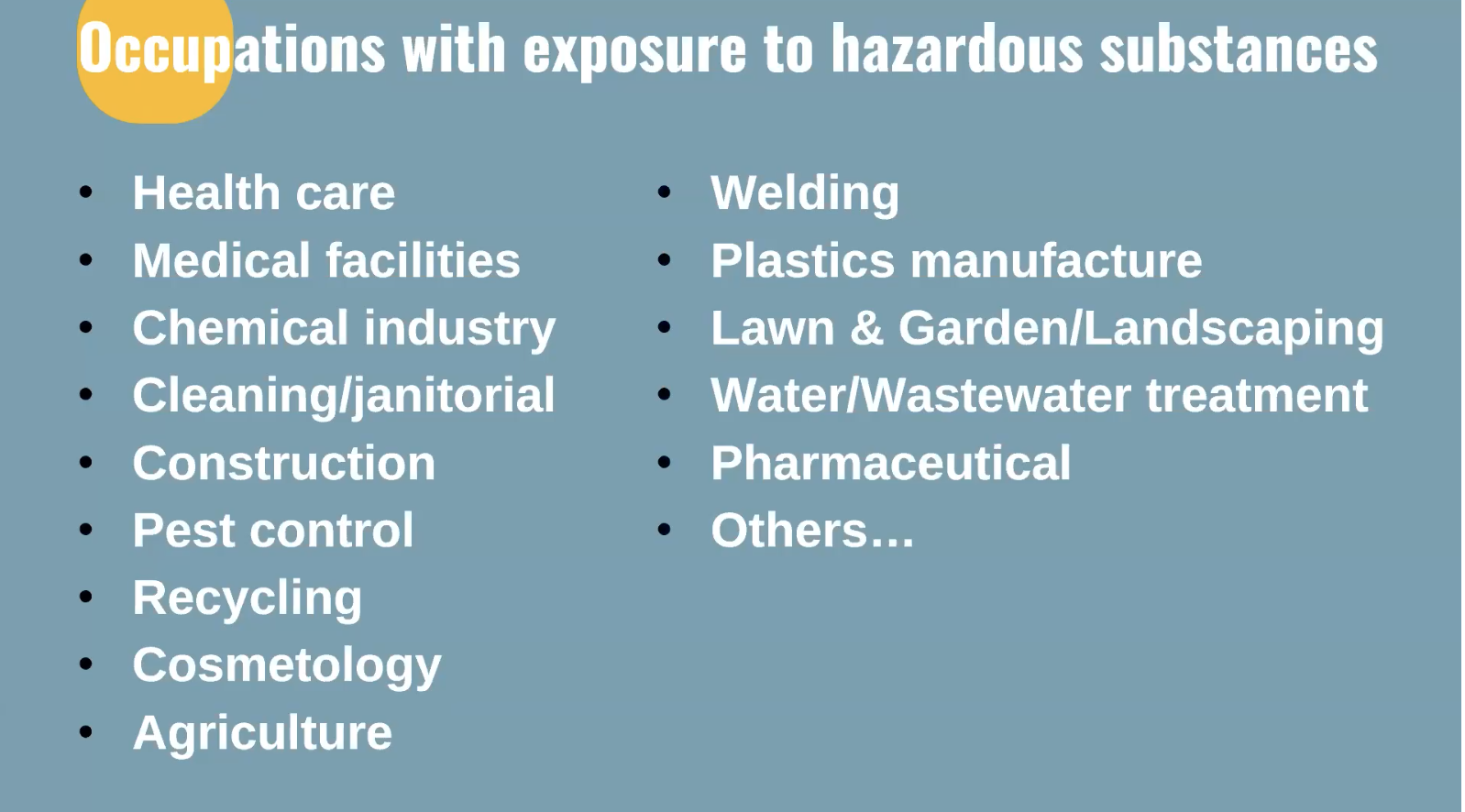
occupations exposed to chemical
KNOW AT LEAST #
pesticides
any substance or mixture of substances intended for preventing, destroying, repelling, or mitigating any pest
Are pesticides just for insects?
no, they can be herbicides, fungicides, and others
solvent
a substance, usually a liquid capable of dissolving another substance
Aerosol
Small particles, usually in the range of 0.01 to 100 micrometers, dispersed in the air, which include liquid (mist) and small particles (dust)
Asphyxiant
A substance that is capable of causing death from suffocation—for example, by decreasing the capacity of the blood to carry oxygen
Antineoplastic. drug
a drug used in cancer chemotherapy
Chloracne
is a more severe form of acne [. . .]. Chloracne results from exposure to halogenated aromatic hydrocarbonsLinks to an external site. such as chlorinated dioxinsLinks to an external site. and dibenzofuransLinks to an external site.. Dioxin exposure and development of chloracneLinks to an external site. can occur occupationally or environmentally. Chloracne is the hallmark of dioxin exposure
Dioxins
A class of structurally and chemically related halogenated aromatic hydrocarbons that includes polychlorinated dibenzodioxins (PCDDs or dioxins), polychlorinated dibenzofurans (PCDFs or furans) and the “dioxin-like” polychlorinated biphenyls (PCBs)
Organic solvent syndrome
A cluster of neurologic symptoms—for example, impaired memory, confusion, restlessness, and insomnia—associated with inhalation of solvents
Sensitizer
The OSHA Hazard Communication Standard, or HCS, defines a sensitizer as “a chemical that causes a substantial proportion of exposed people or animals to develop an allergic reaction in normal tissue after repeated exposure to the chemical” (emphasis added).
benzene (solvent hazard)
human exposure occurs frequently; associated with leukemia and blood disorders
formaldehyde (solvent hazard)
colorless with a strong smell; KNOWN human carcinogen
tetracholoroethylene (solvent hazard)
used in dry cleaning; a LIKELY human carcinogen
2-butanone (solvent hazard)
used in coatings, paints, cleaners, and glues; causes mild irritation of the nose, throat, skin, and eyes
organophosphates (type of pesticide)
affect the nervous system by disrupting the enzyme that regulates acetylcholine, a neurotransmitter. Most organophosphates are insecticides.
Carbamate pesticides
affect the nervous system by disrupting an enzyme that regulates acetylcholine, a neurotransmitter (similar to organophosphates)
Organochlorates
were commonly used in the past, but many have been since removed from the market due to their health and environmental effects and their persistence
pyrethroids
developed as a synthetic version of the naturally occurring pesticide pyrethrin. Some are toxic to the nervous system
PCB’s are
man made
PCB’s used to be used for what?
an insulating fluid in electrical components such as capacitors and transformers
Are PCB’s still used?
no, they were banned in 1979
PCB is linked to increases of what
cancer
dioxins cause what
they cause chloracne
asthmagen
Asthmagens can be divided into two separate types, namely inducers and inciters.
Inducers are substances which, on single or repeated exposure, cause a previously well individual to develop asthma.
inciters (or triggers) are substances which can cause symptoms in an individual with pre-existing abnormal airway responsiveness.
carcinogen
A substance or agent that causes cancer in mammals, including humans
dermatopathic agent
An agent that causes diseases of the skin.
Immunologic agent
An agent that affects the immune system, which forms part of the body’s natural defenses against disease
Neurological toxicant /neurotoxin
A toxic substance that is “[a]ble to produce chemically an adverse effect on the nervous system: such effects may be subdivided into two types: central nervous system effects…and peripheral nervous system effects
Pneumonoconiotic agent
An agent (e. g., inorganic and organic dusts) etiologically associated with pneumoconiosis (fibrosis of the lung)
Reproductive toxicant
Substance or preparation that produces non-heritable adverse effects on male and female reproductive function or capacity and on resultant progeny
Sensitizer
A substance that causes sensitization, which is an “immune response whereby individuals become hypersensitive to substances, pollen, dandruff, or other agents that make them develop a potentially harmful allergy when they are subsequently exposed to the sensitizing material (allergen)
Systemic toxin
A toxin that affects the body as a whole
Teratogen
Agent that, when administered prenatally (to the mother), induces permanent structural malformations or defects in the offspring
most ______ are insecticides
organophosphates