M6 MacLean- Population Genetics of Adaptation I + II
 Studied by 0 people
 Call Kai
 Learn
Learn Practice Test
 Spaced Repetition
 Match
Match Flashcards
 Knowt Play
1/5

There's no tags or description
Looks like no tags are added yet.
Name | Mastery | Learn | Test | Matching | Spaced | Call with Kai |
|---|
No study sessions yet.
6 Terms
what are the assumptions in the hardy-weinberg theorem and what does it state?
assumptions:
there is an infinite population size
mating is random
the genes of interest have no impact on fitness/do not have differences in viability
the hardy-weinberg theorem states that allele and genotype frequencies in a population will remain constant from generation to generation in the absence of other evolutionary influences eg. mutations, selection, or genetic drift
P² + 2PQ + Q² = 1
P + Q = 1
how can the hardy-weinberg theorem be adapted to account for selection?
fitness (W) can be calculated- the relative reproductive rate of an individual with a given genotype (how likely the allele is to be inherited)
this is dependent on:
the selection coefficient (s)- whether the allele is more beneficial (positive coefficient) or more deleterious (negative coefficient) than Q
the dominance (h)- dominant = 1, recessive = 0
fitness is measured relative to Q, so Q = 1:
the fitness of P in P homozygous individuals (P²) is 1+s
the fitness of P in heterozygous individuals (2PQ) is 1+hs (accounts for whether it is dominant or recessive)
the fitness of P in Q homozygous individuals (Q²) is 0
if you add the fitnesses for the P allele and the Q allele (1), you get the average fitness (W) = P²(1+s) + 2PQ (1+hs) + Q²(1)
the frequency of the P allele in the next generation is P²(1+s)/W + PQ(1+hs)/W
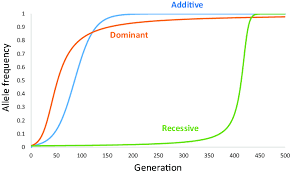
what is the graph of a beneficial allele frequency when it is introduced to a new population?
recessive beneficial alleles take longer to fix in a population because they can only show a beneficial effect when homozygous, which is rare at first
the frequency slowly increases at first, until some organisms are homozygous, where it causes a ‘selective sweep’ because that allele will then be greatly selected for
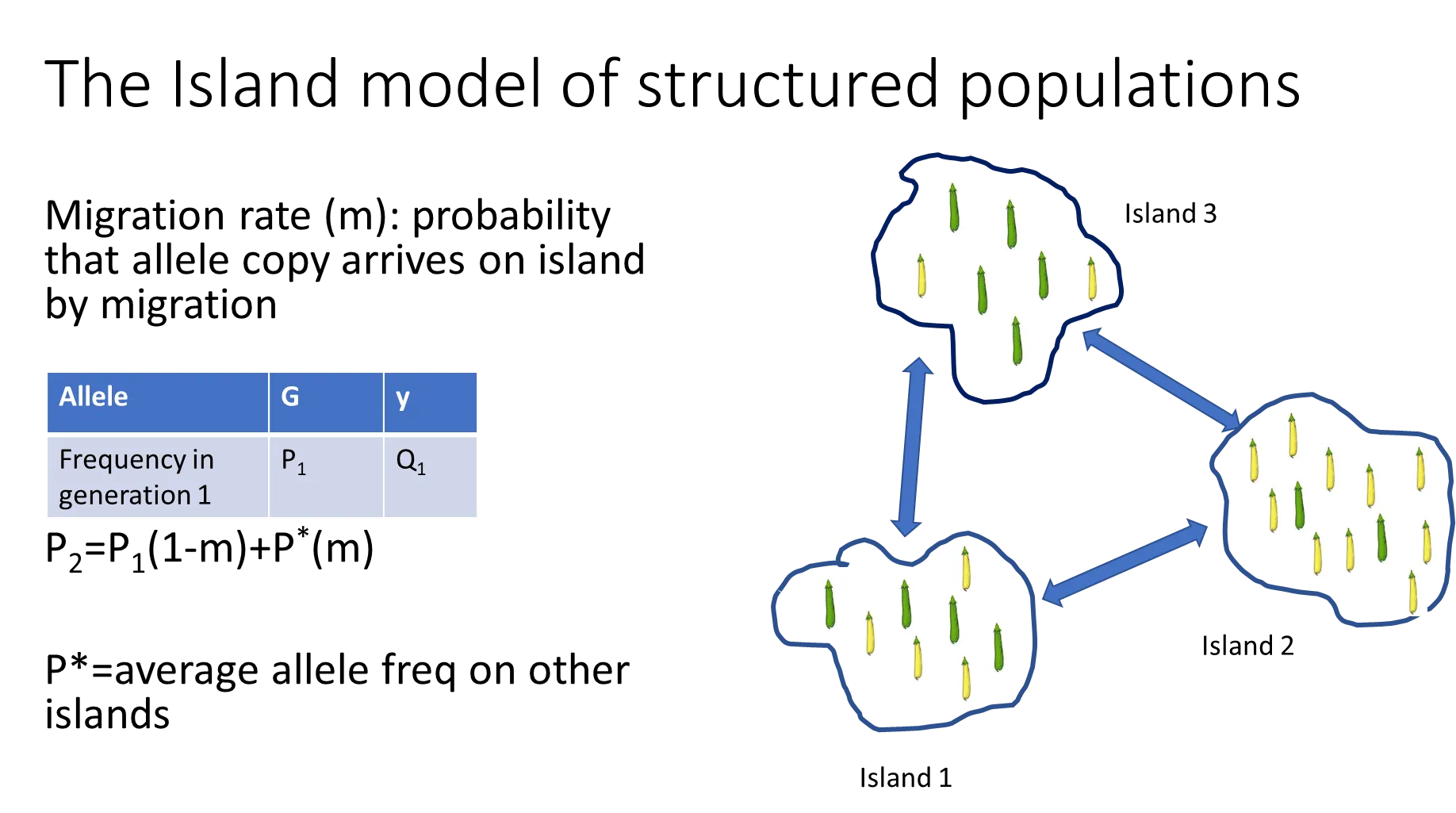
how can the hardy-weinberg theorem be adapted for an island model of structured populations?
the allele frequency in the next generation (on one island) is dependent on the migration rate (m)- the probability that the allele arrives on the island by migration
the frequency in the next generation (P2) = P1(1-m) + P* (m)
where P* = the average allele frequency on other islands
(the 1-m is because if there is migration of the allele onto the island, there is also migration of the allele off the island)
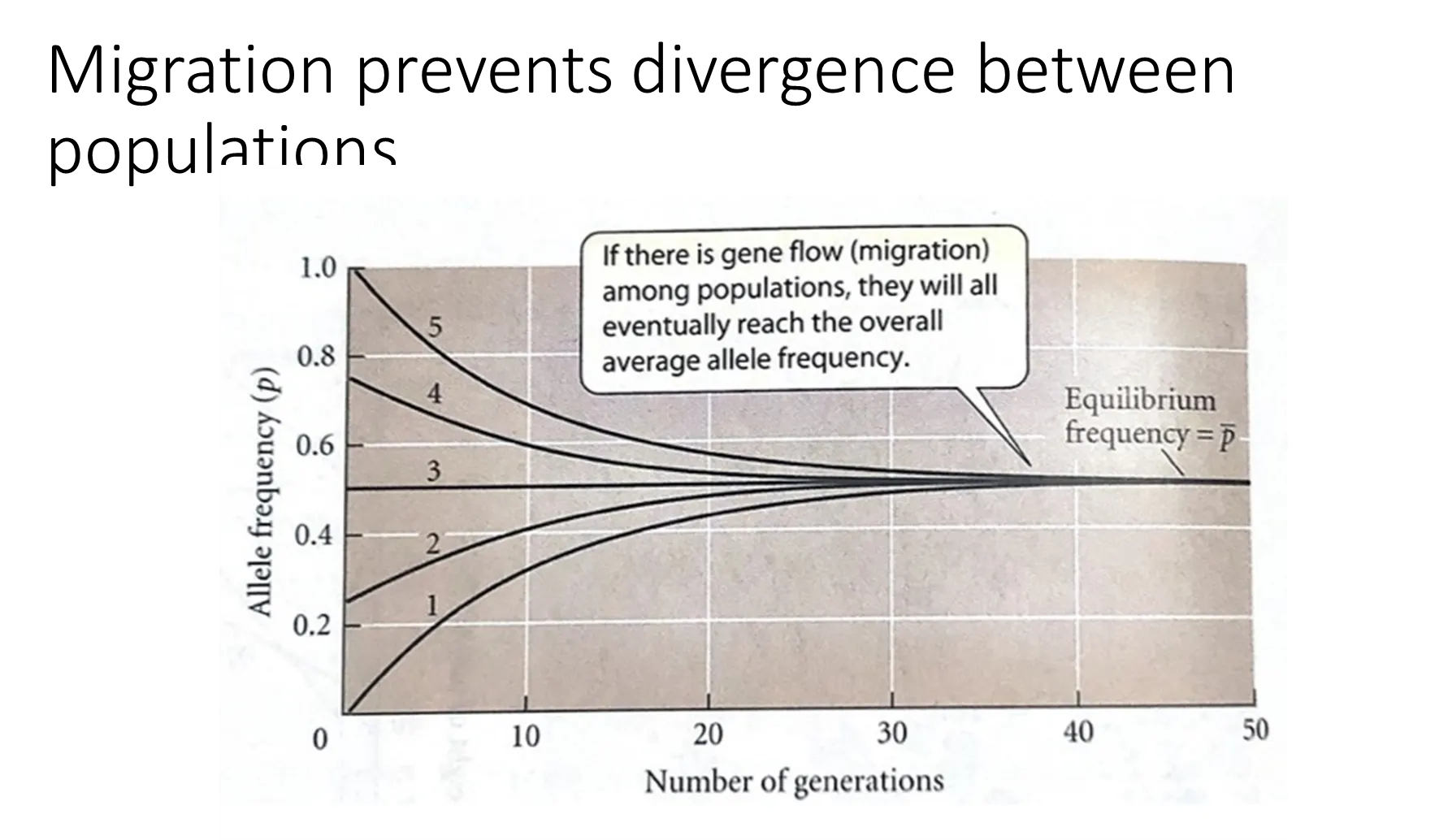
how does migration affect allele frequencies?
if there is gene flow between populations, they will all eventually reach an average allele frequency
the number of generations that this takes to occur is dependent on the rate of migration
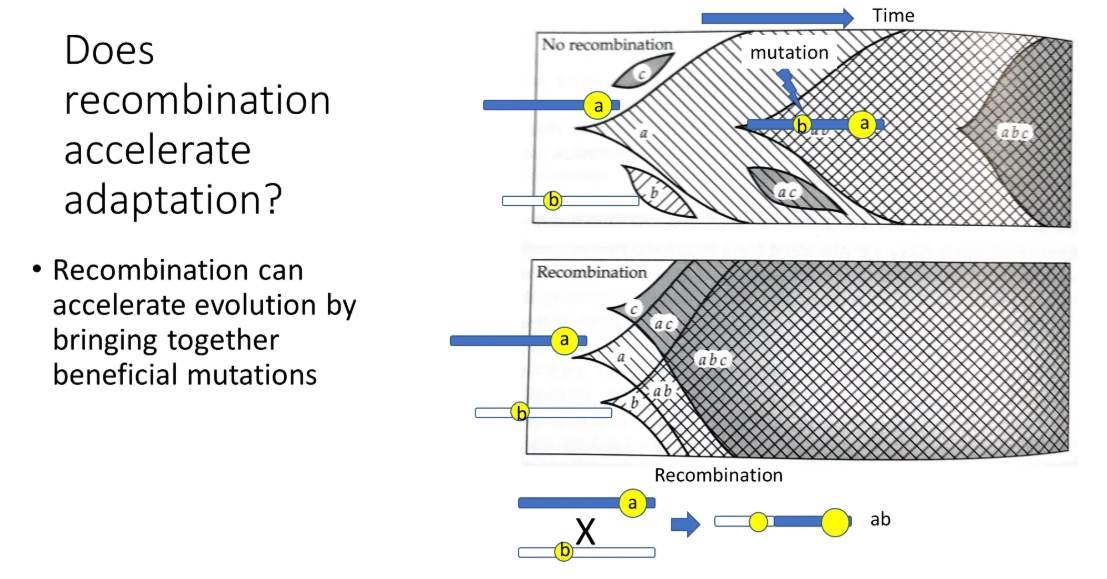
how does recombination affect adaptation?
recombination accelerates adaptation and evolution by bringing together beneficial mutations
without recombination (in a haploid population), two beneficial alleles would have to compete with each other, as they could never be inherited together
in the top diagram, without recombination, b and c are outcompeted by a, and ac is outcompeted by ab
in the bottom diagram, with recombination, evolution happens much faster because the beneficial mutations can combine
sexual reproduction creates much greater genetic diversity through recombination