biol 230 unit 1 test: chapter 3
 Call Kai
 Learn
Learn Practice Test
 Spaced Repetition
 Match
Match Flashcards
 Knowt Play
1/17

There's no tags or description
Looks like no tags are added yet.
Name | Mastery | Learn | Test | Matching | Spaced | Call with Kai | Chat |
|---|
No analytics yet
Send a link to your students to track their progress
18 Terms
Describe how catabolic reactions are used to generate building blocks and produce energy intermediates to make larger molecules
When a protein is improperly folded or is no longer needed by a cell., the peptide bonds between the amino acids in the protein are broken by enzymes called proteases.-> generates amino acids that can be used in the construction of new proteins.
The breakdown of macromolecules and smaller organic molecules is to obtain energy that is used to drive endergonic processes in the cell.-->covalent bonds store a large amount of energy, when cells break covalent bonds in organic molecules such as glucose, they do not directly use the energy released in this process.--> released energy is stored in [ Energy Intermediates ].->directly used to drive endergonic reactions.
Explain how activated carriers can store and transfer energy that cells can use
Can store either as a readily transferable chemical group or as readily transferable (“high-energy”) electrons
they capture energy from catabolism (breakdown reaction) and deliver it to anabolism (building reaction), acting as shuttles
how does ATP carry energy?
through its “high energy” phosphate groups
Which of the following is a reason why ATP hydrolysis has a negative ΔG?
the removal of the phosphate is energetically favorable
what is the role of activated carriers in cells?
they capture energy from releasing reactions and transfer it to other reactions
Reactions that build larger molecules in the cell are called ___________; reactions that break down molecules into smaller ones are called ___________.
anabolic; catabolic
Condensation reactions are energetically ___________ and hydrolysis reactions are energetically ___________.
unfavorable; favorable
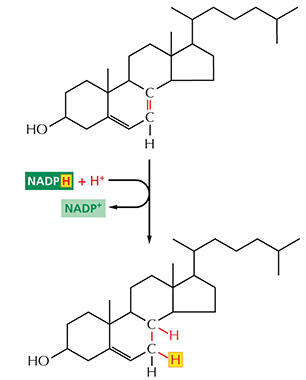
What purpose does NADPH serve in biosynthetic reactions like the one pictured below?
donating electrons for a reduction reaction

In the following condensation reaction, how does ATP power the formation of product A–B?
a phosphate is first transferred to reactant A-OH to form a high energy intermediate
Which of the following has a higher concentration in the cell to allow it to be available to accept electrons from oxidation of food molecules?
NAD+
what is the role of ATP in cells?
serves as a convenient and versatile store, or currency, of energy that can be used to drive a variety of chemical reactions in cells
ATP is synthesized in an energetically unfavorable phosphorylation reaction, where a phosphate group is added to ADP
When needed, ATP gives up the energy in an energetically favorable hydrolysis to ADP and phosphate
The ATP is then available to be used for another round of the phosphorylation reaction that forms ATP, creating an ATP cycle in the cell
how does NADH carry energy?
high-energy electrons
what is the role of NADH in cells?
acts as an intermediate in the catabolic system of reactions that generate ATP through the oxidation of food molecules
how does NADPH carry energy?
high-energy electrons
what is the role of NADPH in cells?
operates with enzymes that catalyze anabolic reactions, supplying the high-energy electrons needed to synthesize energy-rich biological molecules
what is the mode synthesis for proteins?
Transcription: DNA is copied into mRNA inside the nucleus.
Translation: tRNA reads the mRNA at the ribosome to link amino acids into a protein chain.
what is the mode synthesis for polysaccharides?
dehydration synthesis
Process: Monomers (simple sugars) are joined together.
Byproduct: One water molecule (H2O) is removed for every bond formed.
Bond formed: Glycosidic linkage (a covalent bond).
what is the mode synthesis for nucleic acids?
Dehydration synthesis (Condensation reaction)
A hydroxyl group (-OH) from one nucleotide combines with a hydrogen atom (-H) from another.
The result: A water molecule (\(H_{2}O\)) is released, and a covalent phosphodiester bond forms to link the nucleotides