Foundations for Teaching English Language Learners - Chapter 3 Vocabulary
 Call Kai
 Learn
Learn Practice Test
 Spaced Repetition
 Match
Match Flashcards
 Knowt Play
1/54

Earn XP
Description and Tags
Key vocabulary and theoretical concepts from Chapter 3: Language Learning and Teaching.
Name | Mastery | Learn | Test | Matching | Spaced | Call with Kai | Chat |
|---|
No analytics yet
Send a link to your students to track their progress
55 Terms
Behaviorist Perspective (First Language Acquisition)
A perspective championed by B. F. Skinner in the 1940s and 1950s proposing that children learn their first language through imitation and positive reinforcement.
Innatist Perspective (First Language Acquisition)
A perspective associated with Noam Chomsky asserting that children possess an innate ability to learn language via a Language Acquisition Device (LAD) that enables them to figure out universal grammar.
Language Acquisition Device (LAD)
An innate mental structure proposed by Noam Chomsky that enables children to deduce universal grammar rules and generate an infinite number of unique utterances.
Monitor Model
Stephen Krashen's 1980s second language acquisition model comprising five central hypotheses: Acquisition-Learning, Natural Order, Monitor, Input, and Affective Filter.

Language Acquisition (Krashen)
A subconscious process of gaining language competence that results in knowing the language.

Language Learning (Krashen)
A conscious process of gaining explicit language knowledge that results in knowing about the language.

Acquisition-Learning Hypothesis
A component of Krashen's Monitor Model asserting that due to language complexity, the vast majority of language is acquired subconsciously rather than consciously learned.
Natural Order Hypothesis
A component of Krashen's Monitor Model positing that learners acquire parts of a language in a predictable order that is immune to explicit teaching.
Monitor Hypothesis
A component of Krashen's Monitor Model stating that consciously learned language acts as an internal editor ('a little language teacher in our heads') to self-correct and monitor acquired language output.
Input (Comprehension) Hypothesis
A component of Krashen's Monitor Model stating that language is acquired when learners receive comprehensible input containing structures slightly above their current level (i+1).
i+1
A concept in Krashen's Input Hypothesis where i represents a student's current proficiency level and +1 represents input just slightly above that level needed for acquisition.
Affective Filter Hypothesis
A component of Krashen's Monitor Model stating that emotional variables such as anxiety, low self-esteem, or lack of group membership create a filter blocking comprehensible input from reaching the learner.
• A major goal in language teaching and learning is to
“lower” the affective filter to maximize
comprehensible input.
• When the filter is “down” and appropriate
comprehensible input is presented (and
comprehended), acquisition is inevitable
Interaction Hypothesis
Michael Long's theory that interaction and modified interaction reaching mutual comprehension are essential for second language acquisition to occur.
Comprehensible Output Hypothesis
Merrill Swain's theory that comprehensible input alone is insufficient for language acquisition, requiring learners to speak and produce output to confront limits in their L2 ability.
Noticing Hypothesis
Richard Schmidt's theory stating that learners must consciously attend to and notice specific language features in the input before they can acquire them.
Processability Theory
Manfred Pienemann's theory stating that the sequence in which learners acquire language features depends on how easy those features are for the brain to process.
Input Processing Model
Bill VanPatten's model explaining how learners process input for meaning first using content words, leading to accommodation and restructuring of their developing linguistic system.
Learners must have access to input and interaction with
other speakers of the L2 they are learning
Positive Transfer
The process where language learners successfully transfer content-area knowledge and literacy skills gained in their first language (L1) to their second language (L2).
Negative Transfer (Interference)
The inappropriate application of first language (L1) structural rules, such as syntax, to the second language (L2).
Communicative Competence
Dell Hymes's 1972 concept emphasizing the functional ability to use language appropriately in context, serving as the basis for communicative language teaching and content-based instruction.
Sociocultural Approach Terminology
Refers to the shift from traditional cognitive terms to sociocultural terms, replacing L1 with home language, ELL with emergent bilingual/multilingual learner, and ESL with English as an additional/new language.

Zone of Proximal Development (ZPD)
Lev Vygotsky's concept of a domain or metaphoric space where learners achieve higher knowledge and performance through collaboration and support from a more knowledgeable other.
Scaffolding
Support provided by a teacher or more knowledgeable peer that enables a student to reach a higher level of performance within their Zone of Proximal Development.
Language Socialization
The process described by Ochs and Schieffelin by which individuals acquire the knowledge and practices that allow them to participate effectively in a language community.
Translanguaging
Pedagogical practices and natural communicative acts that use a student's full bilingual repertoire as a resource to maximize comprehension of rigorous academic content.
Holistic Biliteracy Framework
A framework by Escamilla et al. in which teachers place two languages side-by-side during instruction and assessment to track students' biliteracy trajectories.
The 'Bridge'
A concept developed by Beeman and Urow where teachers intentionally bring two languages together to promote cross-linguistic transfer.
Approach vs. Method
An approach is an overarching philosophy of second language instruction, whereas a method is a set of specific procedures for delivering that instruction.

Grammar-Translation Method
A traditional L2 teaching method (1840s–1940s) derived from Latin instruction in which students memorize grammar rules and translate sentences between languages.
Not based on any theory and has no advocates, but
is widely used
Audiolingual Method
An L2 teaching method popular in the late 1930s and 1940s rooted in structural linguistics and behaviorism, treating language learning as habit formation through mechanical drills and dialogue memorization.
• Students had difficulty moving from their memorized dialogues
to real-life communication.
• Still apparent in many language teaching materials
Natural Approach and Limitations
An L2 teaching method developed in the late 1970s and 1980s that applies Krashen's Monitor Model by providing comprehensible input in an enjoyable context where students naturally acquire the language.
• Lacking a clear focus and guidance for teachers
• Leaving too much to chance in terms of learning
vocabulary and grammatical forms
Communicative Language Teaching (CLT)
An L2 approach favored since the 1980s based on communicative competence, emphasizing authentic communication and incorporating a grammar instruction- 'focus on form'- within meaningful contexts.
Content-Based Instruction (CBI)
A form of CLT that focuses on teaching second language learners to communicate successfully about academic content subjects.
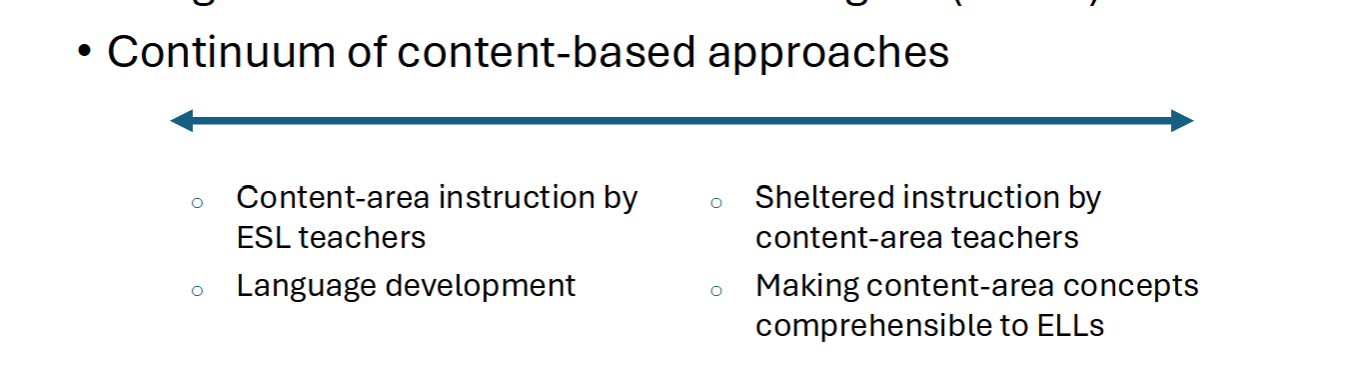
Sheltered Instruction Observation Protocol (SIOP)
An instructional model developed by Echevarria et al. for planning, delivering, and evaluating sheltered content-area instruction for ELLs.
Content and Language Integrated Learning (CLIL)
A European-originated model from the 1990s that integrates language learning with content instruction, widely used in non-English dominant countries.
• More recent models unite theories of language with broader
theories of learning, with a particular focus on deeper learning.
Whole Language
An approach to literacy instruction emphasizing reading strategies and skills within the context of complete stories, poems, or texts rather than isolated parts.
Multiple Intelligences
A psychological framework applied in classrooms to tailor and maximize instruction to students' diverse cognitive strengths, such as linguistic, logical/mathematical, spatial, musical, or kinesthetic intelligences.
Cooperative Learning
An instructional approach involving small student groups collaborating to solve problems or complete academic tasks together.
Critical Pedagogy
An educational approach developed by Paulo Freire in the 1960s aimed at liberating oppressed students by transformative education challenging unequal power relations and rejecting passive learning.
Banking Model of Education
A concept critiqued by Paulo Freire in which teachers treat students as passive containers, attempting to 'deposit' knowledge and skills into their heads.
Daniel Everett
Language is the handmaiden of culture.
New breakthroughs in understanding the origin of language and of
first and second language acquisition
second language acquisition theories
• Behaviorism
• Traditional cognitive approaches
• The innatist perspective
• The cognitive/developmental perspective
(psychological theories)
• Sociocultural perspective
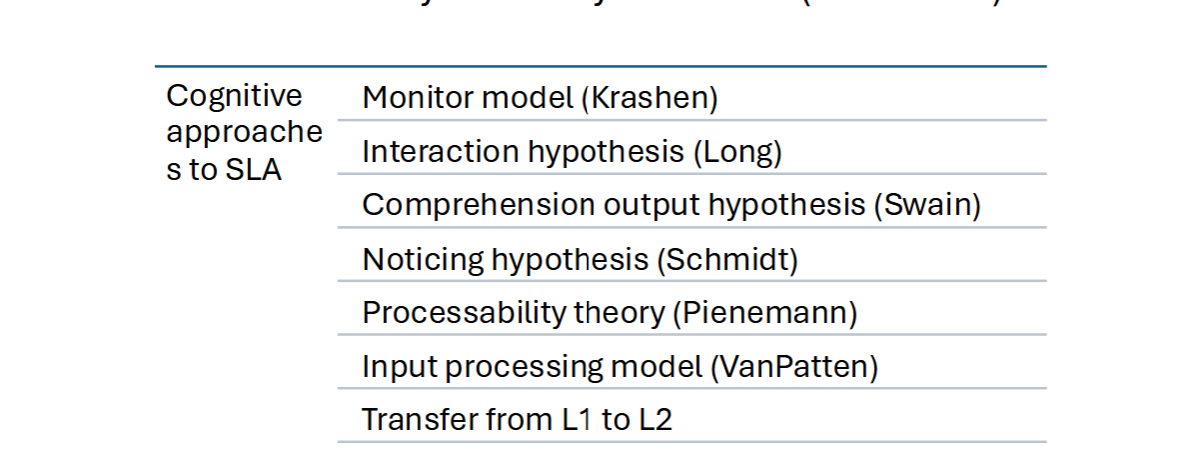
Cognitive approaches to SLA
Interested in what is happening inside the brain
of the language learner
• Direct challenge to behaviorism
• Influenced by Chomsky’s theories (late 1970s)
Cognitive
approache
s to SLA
Monitor model (Krashen)
Interaction hypothesis (Long)
Comprehension output hypothesis (Swain)
Noticing hypothesis (Schmidt)
Processability theory (Pienemann)
Input processing model (VanPatten)
Transfer from L1 to L2
Critiques of Krashen’s theories
• Theories do not necessarily provide guidance about what
should be directly taught and what is naturally acquired.
• Difficulty of identifying a strict order of acquisition of
grammatical forms and components of language
• The constructs i and +1 cannot be operationalized with
any degree of exactness.
• Oversimplification of complex processes in second
language acquisition (SLA)
• Downplaying of the importance of production
• Nonetheless, Krashen’s theories have inspired a great
amount of research and led to new theories.
Output processing
how learners make use of their acquired
implicit knowledge in conversations with others
Sociolinguistic Contributions
Began in the late 1960s
• Hymes’s (1972) notion of communicative competence
provides the basis for communicative language
teaching (CLT) and content-based instruction (CBI).
• Research on nonstandard varieties of language
• Inequities for speakers of these varieties in schools
• Help educators understand:
• The dynamics of the relationship between standardized
English and home languages
• The implications for structuring language and content-
area instruction programs best suited for ELLs
Zone of Proximal Development
• Different from Krashen’s input hypothesis (i + 1)
• The teacher and students co-construct knowledge based on
interactions in a given sociocultural context.
• Different from Long’s psycholinguistic interaction hypothesis
• The focus is on the conversations themselves, through which
learning occurs
Bilingual and Multilingual Pluralist Perspectives
Four guiding principles for making decisions about policies, programming, curriculum, instruction, assessment, and accountability from a bilingual perspective (de Jong, 2011):
1. Striving for equity
2. Affirming linguistic and cultural identities
3. Promoting developmental bilingualism
4. Structuring for integration
Bilingual education programs
• Use two languages for instructional purposes
• Not all programs embrace bilingual perspectives.
Bilingual perspective
• Embraced by teachers working with bilinguals in any program
• Considers translanguaging to be natural and normal
Monolingual/compartmentalized perspective
• Reluctance to allow use of home languages in the classroom
• Strict separation of languages in bilingual education
Five stages of language acquisition (natural approach)
• Preproduction → early production → speech emergence
→ intermediate → advanced
beyond approaches and methods
• No single method or approach is applicable to every
language classroom.
• The context of the classroom and the needs of the
students should be the starting point.
• Teachers can use the following guiding questions:
• What are the students’ strengths and needs?
• What are the instructional goals?
• What is likely to be challenging about these goals for
these students?
• What strategies can help address these challenges?
• How will you know whether these strategies are
effective?
Personal approach
Teachers should try out different methods and approaches.
• They should be flexible and creative, drawing on their own beliefs,
values, principles, and experiences to adapt the methods and
approaches they use to the realities of the classroom.
• Core principles include:
• Engage all learners in the lesson.
• Make learners the focus of the lesson.
• Provide maximum opportunities for student participation.
• Be tolerant of learners’ mistakes.
• Develop learners’ confidence.
• Respond to learners’ difficulties and build on them.
• Use a maximum amount of student-to-student activities.
• Promote cooperation among learners.
• Address learners’ needs and interests.
summary
Whether one takes a cognitive or sociocultural view of
language development, researchers and educators seem
to agree on the need for students to receive
comprehensible input and to engage in meaningful
interactions with other speakers of the target language
When teachers know their students well, adopt bilingual
and multilingual pluralist perspectives, and understand the
sociocultural contexts, they can draw on their knowledge
of language teaching and learning theories, methods, and
approaches to inform their own principled approach to
providing an equitable learning environment that builds on
their students’ strengths and addresses their unique
needs.