Biology
 Call Kai
 Learn
Learn Practice Test
 Spaced Repetition
 Match
Match Flashcards
 Knowt Play
1/135

There's no tags or description
Looks like no tags are added yet.
Name | Mastery | Learn | Test | Matching | Spaced | Call with Kai | Chat |
|---|
No analytics yet
Send a link to your students to track their progress
136 Terms
Living things and Non-living things
________ are organisms that possess life and perform vital life processes and has life.
________ are objects that do not have life and do not carry out these processes
7 Characteristics of Life
1. GROWTH & DEVELOPMENT
2. ENERGY METABOLISM
3. HOMEOSTASIS
4. ADAPTATION
5. RESPONSE TO STIMULI
6. ORGANIZATION
7. REPRODUCTION
GROWTH and DEVELOPMENT
(Characteristics of Life)
get bigger, more complex, or develops in some way
Metabolism
(Characteristics of Life)
refers to all the chemical reactions an organism uses to take in and transform energy from the environment
build up, break down, and transform matter and energy to sustain life
- plants convert solar energy (from sunlight) into chemical energy (sugar molecules) via photosynthesis
Homeostasis
(Characteristics of Life)
The maintenance of a stable level of internal conditions is called ————-
- All living things have mechanisms that regulate their bodies so things stay balanced
Adaptation
(Characteristics of Life)
is an inherited feature that improves an organism's ability to survive.
- Adaptations can take many forms:
. a behavior that allows better evasion of predators
. a protein that functions better at body temperature
. a body structure that allows easier resource-gathering
Response to Stimuli
(Characteristics of Life)
Living things RESPOND TO A STIMULUS
- a physical or chemical change in the environment produces a purposeful response
stimulus can be within or outside the organism
Movement
is a type of response to stimuli
- a unicellular organism moves in response to chemical changes outside the cell
- amoeba exhibits locomotion (change in location)
- paramecium use cilia to get around
- a sessile organism such as a plant turns toward the sun (change of position)
· phototropism
Organization/Cells
(Characteristics of Life)
All living things are composed of one or more microscopic cells
Cells are the smallest units able to perform all the necessary processes to sustain life
The size of multi-celled organisms depends on the number of cells, NOT their size
In multicellular organisms, many cells are specialized to perform specific functions
Reproduction
(Characteristics of Life)
Production of new organisms is essential for the continuation of a species
Hereditary information (DNA) is transferred to offspring in one of two ways:
1. Sexual reproduction
two parents supply the DNA
hereditary information recombines from two organisms of the same species
most plants & animals
2. Asexual reproduction
a single parent supplies DNA
original and new organisms are genetically the same
bacteria, some plants & algae, primitive animals (worms, sponges, hydra)
Cornell Method
Mark off sections:
CUES (during/after class) - main points
NOTES (during class) - Outline form or brief sentences. Leave space to fill in later.
SUMMARY (after class) - big-picture ideas.
Organic Compounds
are those which are of biological origin.
Molecules associated with living organisms are organic.
- Include nucleic acids, fats, sugars, proteins, enzymes and many fuels.
e.g DNA, table sugar or sucrose, C2H22O11, benzene, C,H6, methane, CH,
Inorganic Compounds
are of inanimate (non-living) origin.
- Salts, metals, and substances made from a single element
- Any compounds that don't contain carbon
- Carbon-containing substances that lack carbon-hydrogen bonds
e.g table salt (sodium chloride or NaCl), carbon dioxide, CO2, diamond (pure carbon)
Autotrophs
Organisms that make their own food are called __________.
Phototrophs - use solar energy (photosynthesis) to get energy
-Convert H,O and CO, into sugar and O2
-i.e. plants and algae
Chemotrophs - use different chemical processes to get energy
-i.e. iron-oxidizing bacteria near lava beds
Heterotrophs
Organisms that must take in food to meet their energy needs are called ________.
- Complex chemicals are broken down and reassembled into chemicals and structures needed by organisms
. herbivores consume only autotrophs (plants or animals/algae)
. carnivores eat other heterotrophs (animals)
. omnivores take in both plants and animals for their energy needs
. detritivores get their energy from dead and decaying matter (plants or animals)
TYPES OF ASEXUAL REPRODUCTION
Binary fission
Budding
Spores
Fragmentation
Vegetative propagation
Cloning
Cloning (TYPES OF ASEXUAL REPRODUCTION)
scientifically-engineered reproductive technology that creates a genetically identical copy of a cell, tissue, or entire organism.
Vegetative Propagation (TYPES OF ASEXUAL REPRODUCTION)
new plant grows from sections of roots, stems, or leaves which are cut or fall off the parent
Fragmentation (TYPES OF ASEXUAL REPRODUCTION)
severed body parts grow into new organisms
Spores
special cells released by the parent become new organisms
(TYPES OF ASEXUAL REPRODUCTION)
Budding
small growths on surface of parent organism break off
(TYPES OF ASEXUAL REPRODUCTION)
Binary Fission (TYPES OF ASEXUAL REPRODUCTION)
parent cell simply divides into two parts
Careers in Laboratory

Charles Darwin (1809-1882)
He was an English Naturalist
He traveled around the world on his ship, the Beagle
Studied species and fossils (mocking birds, finches, tertoise) in the Galapagos Islands and around the world
Why did some species survive while others became extinct?
Natural selection - the process where organisms with traits best suited to their environment are more likely to survive and reproduce.
Published The Origin of Species in 1859
Charles Darwin’s theory four main parts

Patterns of Evolutions
Darwin believed that natural selection can ultimately lead to the formation of new species.
Adaptive Radiation
most commonly occurs when a species of organisms successfully invades an isolated region where few competing species exist. If new habitats are available, new species will evolve.
(a single species splits into many new)
Divergent Evolution
is the process of two or more related species becoming more and more dissimilar. (splits into different species)
Example: The red fox and the kit fox
Convergent Evolution
is the opposite of divergent evolution
unrelated species become more and more similar in appearance as they adapt to the same kind of environment.
Frogs and Chameleons are examples of convergent evolution because although they are different amphibians, they have both developed harpoon-like tongues to catch insects
Co-evolution
is the joint change of two or more species in close interaction. Predators and their prey sometimes co-evolve; parasites and their hosts often co-evolve; plant-eating animals and the plants upon which they feed also co-evolve.
(two or more species influence each other's evolutionary)
Divergent, Convergent, and Co-evolution
are different ways organisms adapt to the environment. These are examples of how the diversity of life on earth is due to the ever-changing interaction between a species and its environment.
Extinction
is the disappearance of an entire species
If a species does not have the genetic traits to survive in its environment, then the species will eventually become extinct forever
Example: Dinosaurs, Dodo bird, Laughing Owl, Quagga
Reasons for Extinction
Rarity
Inbreeding
Hybridization
Gradual loss of habitat
Long-term environmental trends
Rarity
(reason of extinction)
when there are very few animals of a species left
Inbreeding
(reason of extinction)
when animals mate (reproduces very often) too much within their own group the offspring become less able to survive and adapt in a healthy way
Hybridization
(reason of extinction)
two animals from different sub-species mate, they might pass on genes that are less healthy (Quagga-half horse half zebra)
Gradual loss of habitat
(reason of extinction)
an animal's habitat is slowly destroyed and they have nowhere to live.
Long-term environmental trends
(reason of extinction)
Scientists think that dinosaurs became extinct because of a slow cooling of the earth
Applications
Knowledge about evolution and natural selection has benefited our society in many ways, and has helped make numerous technological advances, especially in the field of biology and medicine
Carbon-based life
all of life is built on carbon
life on earth is “carbon-based”
How many electrons does carbon need to fill its outer energy level? 4 - FOUR
(5) Carbon forms covalent bonds
a. Ethane
b. Ethylene
c. Acetylene
d. Octane
e. Benzene
Chemistry of Life
Organic chemistry is the study of organic compounds, or carbon compounds
Macromolecules of Life
Found in all living things
Building blocks of all cells
There are 4:
1. Carbohydrates > C, H, & O
2. Lipids > C, H, & O
3. Proteins > C, H, O, N, & S
4. Nucleic Acids > C, H, O, N, & P
Macromolecules
Large molecules that are formed by joining smaller organic molecules together.
Monomers
Macromolecules are actually made up of even smaller subunits. Each sub-unit of a macromolecule is called _________.
one basic unit or subunit

Polymers
The macromolecules themselves are called ________, because they are made up of many of subunits.
a chain of many basic units

Biological Macromolecules (4)
Carbohydrates
Lipids
Proteins
Nucleic Acid
Monosaccharide
(CH2O)3-7
Simple sugars
Function: Energy source for organisms
- Example: glucose (C6H12O6)
Disaccharides
2 monosaccharide units linked together.
Polysaccharides
long chains of monosaccharides
Lipids
Mostly made up of carbon and hydrogen
Primary Function: energy storage
Include oils, fats, waxes, and steroids
Triglycerides
a type of lipid (fat) made up of one glycerol molecule attached to three fatty acid chains
Saturated Fat
If the fatty acid tail only has single bonds between the carbon atoms, it is a _________. (Triglycerides)
Unsaturated Fat (Triglycerides)
If the fatty acid tail has one or more double bonds between the carbon atoms, it is an ________.
Phospholipids
Special lipids that make up cell membranes.
Like most lipids they are hydrophobic
- Repels water
- This makes for great barriers in the watery environment of our cells
Proteins
Monomer: amino acids
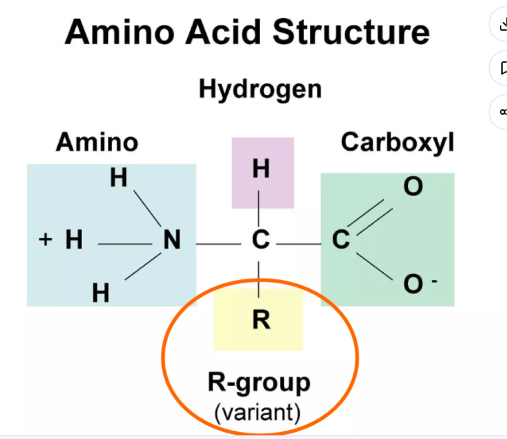
Amino acids are small compounds that are made of carbon, nitrogen, oxygen, hydrogen, and sometimes sulfur.
Function: enzymes, transport, and cell structure
Amino Acids
an organic molecule that serves as the basic building block of proteins
bonded by peptide bonds
these form between one amino group and one carboxyl group
Protein Structure
Primary Structure
Secondary Structure
Tertiary Structure
Quaternary Structure
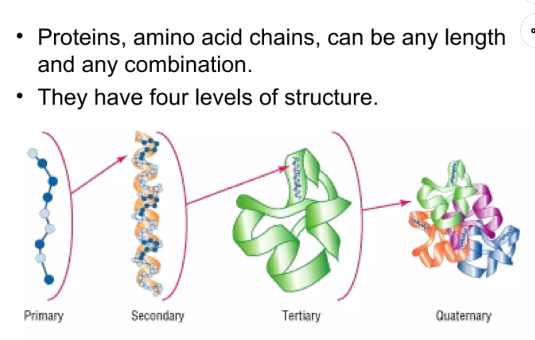
Primary Structure (protein structure)
number and order of amino acids in a chain
Secondary Structure
(Protein structure)
Hydrogen bonds between different amino acids cause the chain to fold
They can form shapes like a helix, pleated sheet, or fold
the result of hydrogen bonding
Tertiary structure (protein structure)
The full structure of the protein with can include many 2° structures.
Quaternary structure (protein structure)
Not all proteins have a 4° structure.
The combination of proteins that work together as one.
Protein Function
Proteins are ~15% of your total body mass
Involved in almost every function:
- Muscles, skin, hair
- Cellular communication
- Enzymes
- Control cell growth
- Protection (immunity)
- Storage
Our cells contain over 10,000 different proteins
Nucleic Acid
Function: store and transmit genetic information
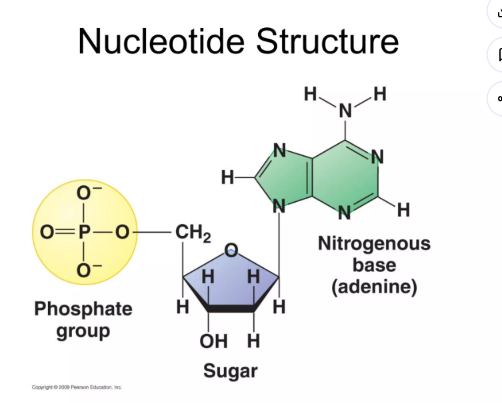
Monomer: nucleotides
- Nucleotides are composed of C, N, O, P, H
There are 5 major nucleotides
- The book says 6, because it includes ATP (wrong)
Nucleotide Structure
The sugar of one nucleotide bonds to the phosphate of another nucleotide
The nitrogenous base sticks out to form hydrogen bonds that hold the double helix together.
Types of nucleic acids
Deoxyribonucleic acid (DNA)
Ribonucleic acid (RNA)
Adenosine Triphosphate (ATP)
A modified nucleotide
primary energy-carrying molecule found in all living cells
3 phosphate groups
Phosphate groups, Adenine, Ribose
Cell membrane
(also called the plasma membrane) is a biological membrane separating the interior of a cell from the outside environment.
chemical composition (three components): lipids, proteins, carbohydrates
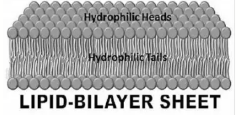
Phospholipid Bilayer
Two layers of phospholipid molecules arranged tail-to-tail; each phospholipid has a hydrophilic ("water-loving") phosphate head and hydrophobic ("water-fearing") fatty acid tails.
building block of cell membrane
Selective Permeability (function of cell membranes)
the membrane's ability to allow certain substances to pass while restricting others.
Function of Cell Membranes
Protective function
Selective permeability
Absorptive function
Excretory function
Exchange of gases
Maintenance of shape and size of the cells

Transport Mechanism
The permeability of substances across cell membranes is dependent on their solubility in lipids and not on their molecular size.
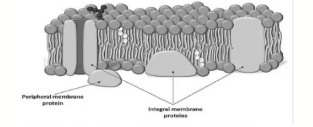
2 parts in Protein
Integral Proteins: embedded within the bilayer, often spanning it completely (transmembrane proteins).
Peripheral Proteins: proteins attached to the surface of the membrane, not embedded within it
Transport Mechanisms
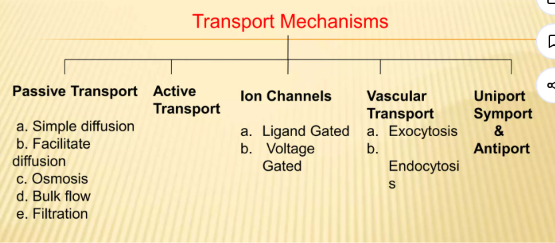
(5) Transport Mechanisms classified into:
Passive Transport
simple diffusion
facilitated diffusion
osmosis
bulk flow
filtration
Active Transport
Ion Channels
Ligand Gated Channels
Voltage Gated Channels
Vascular Transport
Exocytosis
Endocytosis
Uniport, Symport and Antiport
Simple Diffusion
(Passive Transport)
Solute and gases enter into the cells passively.
They are driven by the concentration gradient.
Simple diffusion occurs from higher to lower concentration.
The rate of entry is proportional to the solubility of that solute.
This does not require any energy., but it is a very slow process
Facilitated Diffusion
(Passive Transport)
It is a carrier mediated process
Structurally similar solutes can competitively inhil the entry of the solute.
This mechanism does not require energy , but the rate of transport is more rapid than diffusion process.
It is dependent on concentration gradient. Hormones regulate the number of carrier molecule.
Osmosis
(Passive Transport)
is the process of moving water across a semi permeable membrane towards ion or solute rich region in a solution.
Lower concentration to higher concentration through semi permeable membrane.
Bulk flow
(Passive Transport)
the movement of a group of molecules together in a single direction due to apressure difference, and it acts as a passive process because it does not require cellular energy (ATP).
Filtration
(Passive Transport)
uses physical pressure to push fluid and small molecules through a membrane without using any cellular energy.
Ion Channels
Membranes have special devices called ion channels for quick transport of electrolyte such as Ca++, K+, Na+ and
This may compared to opening of the gate of a cinema house, when people rush to enter. Hence this regulation is named as "Gated".
Ligand Gated Channels
Voltage Gated Channels
Ligand Gated Channels
Acetylcholine receptor is an example for ligand gated ion channel.
special proteins in cell membranes that open to let ions pass through when a chemical messenger binds to them
(1. Ion Channels)
Voltage Gated Channels
The channel is usually close in the ground state. The membrane potential change switches the ion channel to open.
(2. Ion Channels)
Active Transport
This form of transport requires energy . About 40% of total expenditure in a cell is used for the active transport system.
It requires specialized integral protein called transporters. The transporters are susceptible to inhibition by specific organic or inorganic compounds.
Vesicular Transport
It is the transport of membrane bounded bounded substance moving across plasma membrane classified to :-
1. Endocytosis
2. Exocytosis
Endocytosis
It is a process by which the large number of particles are taken with forming the vesicle into the cell. It is classified into: Phagocytosis; It is a process by which the large number of particles are engulfed in to the cell.: Pinocytosis; It is a process by which the large number of particle which are soluble in water are taken into the cell.
(1. Vesicular Transport)
Exocytosis
active transport of process in which an intracellular vesicles (membrane bounded sphere) moves to the plasma membrane and fused the substance into the Extra cellular fluids.
(2. Vesicular Transport)
Uniport, Symport and Antiport
UNIPORT SYSTEM: Movement of a single substance. It requires no energy from the cell
SYMPORT SYSTEM: Transport of two substances using the energy produced by concentration difference developed by primary active transport. Substances are moving in the same direction.
ANTIPORT: In this process, the two substances move across the membrane in opposite directions .
Glycolipids/glycoproteins (carbohydrates)
carbohydrate chains attached to lipids or proteins on the outer surface, important for cell recognition and signaling.
Cholesterol
found interspersed in animal cell membranes; regulates fluidity across temperature changes.
The Fluid Mosaic Model
describes the cell membrane molecules (phospholipid, cholesterol and proteins) that are constantly moving.
This movement helps the cell membrane maintains its role as a barrier between the inside and outside of the cell environment.
Cellular respiration
All organisms use ________ to extract energy from organic molecules.
Respiration
Organisms can be classified based on how they obtain energy:
autotrophs: are able to produce their own organic molecules through photosynthesis
heterotrophs: live on organic compounds produced by other organisms
Cellular respiration is a series of reactions that:
-are oxidations - loss of electrons
-are also dehydrogenations - lost electrons are accompanied by hydrogen
Therefore, what is actually lost is a hydrogen atom (1 electron, 1 proton).
During respiration, electrons are shuttled through electron carriers to a final electron acceptor.
aerobic respiration: final electron receptor is oxygen (O2)
anaerobic respiration: final electron acceptor is an inorganic molecule (not O2)
fermentation: final electron acceptor is an organic molecule
During redox reactions, electrons carry energy from one molecule to another.
NAD+ is an electron carrier.
-NAD accepts 2 electrons and 1 proton to become NADH
-the reaction is reversible
Electron transport chain
The goal of respiration is to produce ATP.
energy is released from oxidation reaction in the form of electrons
a series of protein groups in cell parts called mitochondria that pass tiny energy pieces called electrons to make most of the cell's power (ATP)
electron energy is converted to ATP at the….
Oxidation of Glucose, ATP via:
Cells are able to make ATP via:
1. substrate-level phosphorylation - transferring a phosphate directly to ADP from another molecule
2. oxidative phosphorylation - use of ATP synthase and energy derived from a proton (H+) gradient to make ATP
Oxidation of glucose
4 Stages in…..
1. Glycolysis
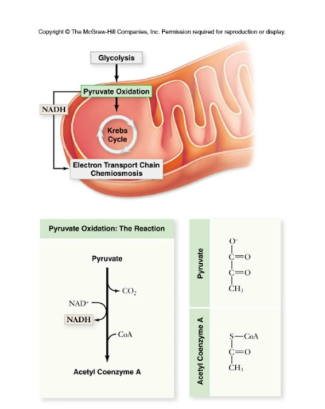
2. Pyruvate oxidation
3. Krebs cycle
4. Electron transport chain & chemiosmosis
Glycolysis
(4 stages of oxidation of glucose)
converts glucose to pyruvate.
the metabolic process that breaks down one molecule of glucose into two molecules of pyruvate while releasing energy

Pyruvate Oxidation
(4 stages of oxidation of glucose)
In the presence of oxygen, pyruvate is oxidized.
the linking step in cellular respiration that converts a three-carbon pyruvate
-occurs in the mitochondria in eukaryotes
-occurs at the plasma membrane in prokaryotes