8.1-8.12 Astrophysics concepts
 Call Kai
 Learn
Learn Practice Test
 Spaced Repetition
 Match
Match Flashcards
 Knowt Play
1/42

There's no tags or description
Looks like no tags are added yet.
Name | Mastery | Learn | Test | Matching | Spaced | Call with Kai | Chat |
|---|
No analytics yet
Send a link to your students to track their progress
43 Terms
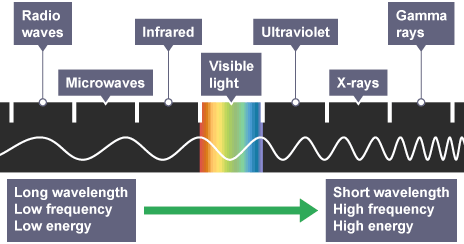
What is the order of EM waves in decreasing wavelength?
Radio, micro, infrared, visible, UV, x-rays, gamma
What is a geostationary orbit?
A circular orbit above the Earth’s equator in which a satellite’s orbital period is equal to the Earth’s
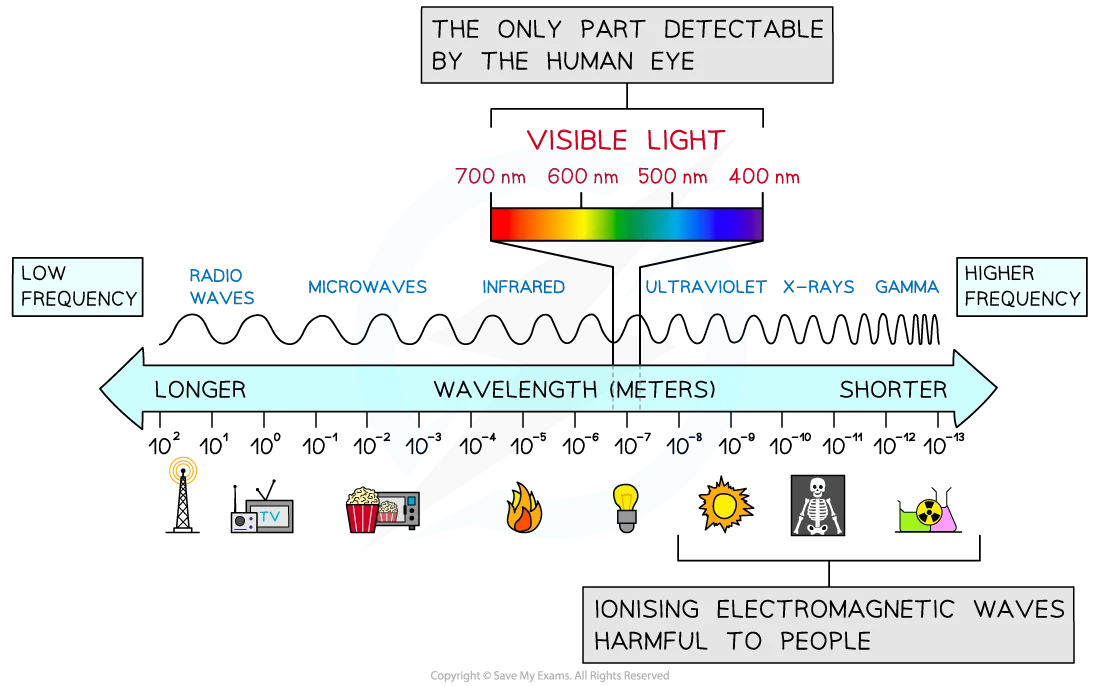
What is the order of visible light waves in decreasing wavelength?
Red
Orange
Yellow
Green
Blue
Indigo
Violet
What is a galaxy made up of?
Many millions of stars
What shape orbits do comets, moons and planets all have?
Elliptical orbits
What is the universe?
The universe is everything: it includes all of space, and all the matter and energy that space contains
How many stars are there in the Milky Way?
About 100 billion
What is the definition for a galaxy?
A collection of stars held together by the force of gravity
What is the definition of a star?
A body which emits energy powered by nuclear fusion
What is a dwarf planet?
A very small planet which is still spherical in shape
What is the universe?
A large collection of billions of galaxies
What is the criteria to be a planet?
it must orbit the Sun
be massive enough for its own gravity to make it spherical
have consumed/scattered away other massive objects in its orbit path
What orbits do communication satellites have?
Geostationary orbits
How does the speed of a comet change in its orbit?
It accelerates ot its max speed when closest to the Sun due to the strong gravitational pull
The Sum emits a stream of charged particles called the Solar Wind which blow the melted ice away from the Sun, producing the tail which points away from the Sun
What is luminosity?
The amount of energy emitted per second by a star
What is the luminosity of the Sun?
4 × 10^26 W
What is a protostar?
A protostar is a large ball of gas that contracts to form a star
What part of the life cycle of a star is the Sun in?
Main sequence stage
How does a protostar physically begin to form?
A cloud of cold hydrogen gas and dust collapses due to gravity
What happens microscopically as the cloud of hydrogen gas and dust collapses?
The atoms and molecules move very fast and collide with each other
How does a collapsing protostar become a main sequence star?
The kinetic energy from the molecular collisions is transferred to the gas’ internal energy store, cuasing the temperature to rise to several million degrees C
What does the extremely high temperature initiate?
The collisions of hydrogen nuclei, beginning nuclear fusion
What is a main sequence star?
A star that releases energy by fusing hydrogen to form helium
What immediate changes happen when a main sequence star begins to run out of hydrogen?
The star’s supply runs out, becoming unstable. Without hydrogen fusion, the pressure decreases and the star begins to collapse
How does a collapsing main sequence star turn into a red giant?
Additional Hydrogen is pulled into a zone where the temp and pressure are high enough to cause fusion in a shell around its core
What does this high pressure and high temp core zone in a collapsing main sequence star initiate?
The great expansion of the outer layers, entering the red giant phase
What is a red giant?
A very large star with a diameter and luminosity much greater than the Sun
What is a white dwarf?
After fusion stops when a main sequence star collapses and its core becomes the white dwarf
What happens during the initial red giant phase as it transitions towards a white dwarf?
The star’s outer layers cool and the star glows red
What in the star leaving red giant phase triggers the fusion of helium into carbon and oxygen?
The further warming up of the core
What happens after a red giant finishes fusing its helium?
Core cools down, collapses into a white dwarf star
Fill in the gap: A white dwarf star is _ _ _ than Earth
A white dwarf star is not much larger than Earth
What is a black dwarf?
When the fusion in a white dwarf stops, the white dwarf cools down and eventually becomes a dark cold star - the end of the star’s lifetime
What do stars much more massive than the Sun become at the end of their main sequence lifetime?
They become red supergiants
What is a supernova caused by?
A supernova is caused by runaway fusion reactions in a very large star
What is a neutron star?
A very dense small star made out of neutrons
What is a black hole?
The most concentrated state of matter from which even light cannot escape
What triggers the initial death and collapse of a red supergiant?
The star runs out of nuclear fuel
The core cools down, causing internal pressure to drop
The star rapidly collapses
When and why might a star collapse?
A star might collapse when the outward pressure is too low as it cannot resist gravity any more
What does the rapid collapse of a red supergiant lead to?
The rapid collapse leads to extreme temp, which triggers a runaway nuclear reaction
What happens during a red supergiant’s runaway nuclear reaction?
The star explodes violently, spreading the remnants of a supernova out into space
What happens to the core of a red supergiant simultaneously with the supernova explosion DEPENDING ON MASS?
LOW MASS: The core is left behind as a very dense neutron star
HIGH MASS: The collapse is so complete that the star disappears into a black hole
Why does a star collapse at the end of its life?
A stable star relies on a balnace between outward pressure from nuclear fusion and inward gravity