MSE Midterm Exam 1
 Call Kai
 Learn
Learn Practice Test
 Spaced Repetition
 Match
Match Flashcards
 Knowt Play
1/67

Earn XP
Description and Tags
0.1, 1.1, 1.2, 1.3
Name | Mastery | Learn | Test | Matching | Spaced | Call with Kai | Chat |
|---|
No analytics yet
Send a link to your students to track their progress
68 Terms
What is MSE paradigm’s 3 interrelated corners?
Process, Structure, and Properties
What does Processing refer to in the engineering paradigm?
How a material was made/manufactured
What does Structure refer to in the engineering paradigm?
The arrangement of atoms/microstructure in a material. (Crystal Structure)
Define Material Property
An intrinsic property that doesn’t depend on size and shape
Define Performance Parameter
A property determined by size, shape, and type of material
Equation Relating Resistance (R) to Resistivity (𝞀)
R = 𝞀 * L/A
Why might you need to select a different material than originally planned?
all of the above
List 4 main material property categories
Mechanical
Thermal
Chemical
Electrical/Magnetic (Includes optical, cross-properties, and Price/Cost)
Can a material property be “designed around”?
Almost always yes, by changing a components size or shape. HOWEVER doesn’t always work.
What is a good first order estimate for material cost?
Terrestrial Abundance of the element
Terrestrial Abundance vs Cost
Terrestrial abundance doesn’t always correlate with cost.
If a material can be easily found (abundant) but they are less concentrated of said material, it will be more expensive because more mining is required.
Difference between Material driven cost vs People driven cost
Material → tied to the raw material itself; People → Labor, processing, refining costs
For zince extraction, how much purity does mining and milling get raw ore to?
~3% - ~65%
5 Steps of Zinc mining and milling
Remove from ground, Crushing, Gravity sink seperation, Milling, Flotation
Zinc Refining (Smelting) %
~65% - ~99.99%
List 4 steps of Zinc smelting
Roasting, Leaching + Purification, Electrolysis, Melting + Casting
What 3 factors can cause price spikes/crashes?
Technology, Supply Changes, and Geopolitics
Define Stiffness σ
How much force (stress) it takes to flex the material.
Define Strength
How much force (stress) it takes to permanently deform the material.
Define Toughness
How much energy it requires to break the material.
Formula for Stress σ
σ = Load / Cross-sectional Area = Force/Area (N/m²)
Formula for Strain ε
ε = ∆L/L = (Lf - Li)/Li [No units]
What does the tensile test measure/produce?
Stress Strain Curve
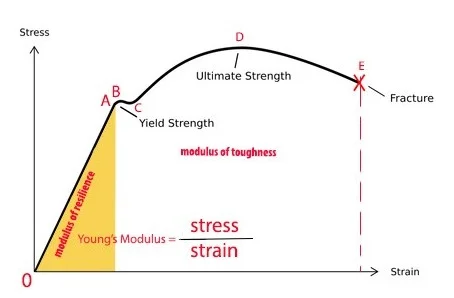
What characterized Elastic Deformation?
Non-permanent; material returns to original shape; stress and strain have a linear relationship.
What characterizes Plastic Deformation?
Permanent deformation; stress is NOT proportional to strain (non-linear)
What is the Elastic Modulus (E)
A measure of stiffness; the material's resistance to stretching, bending, or flexing; higher E = more resistant/stiffer.
Hookes Law
F = -kx
Elastic (E) deformation stress-strain relationship (equation)
σ = Eε → E = σ/ε (slope of elastic region)
Name 4 different Elastic moduli and their loading type.
Youngs/Elastic Modulus (E) - Axial Loading; Shear Modulus (G) - Shearing; Bulk Modulus (K) - Hydrostatic Pressure; Flexural Modulus (Ef) - Bending
Define Poisson’s Ratio
The negative ratio of transverse (lateral) strain to axial (longitudinal) strain in axial tensile loading
Typical Poissons Ration
-0.3
Exceptions to Poissons Ratio
Highly porous materials and Auxetic Materials (certain origami folds, crystal structures)
Define Yield Stress (σy)
AKA Strength; stress required to permanently deform the material. {point on graph which stops being linear}
What happens to strain if you load past σy and then unload?
Strain doesn’t return to zero and there is plastic deformation
Define Ultimate Tensile Strength (σUTS)
Stress beyond which the material fails/fractures
Define Ductility (εf)
AKA Strain at break; max amount of strain (% elongation) at failure.
Define Modulus of Resilience (Ur)
A Material Property describing amount of elastic energy per volume is returned to the material after the stress is unloaded
Modulus of Resilience (Ur) Equation
Ur = σy²/2E = σyεy/2
Assuming uniaxial tension and linear elasticity
What is the Coefficient of Restitution?
Performance Parameter corresponding to resilience
What are areas where high resilience is desired?
Bouncy Balls
Shock Absorbers
Helmets/Protective Gear
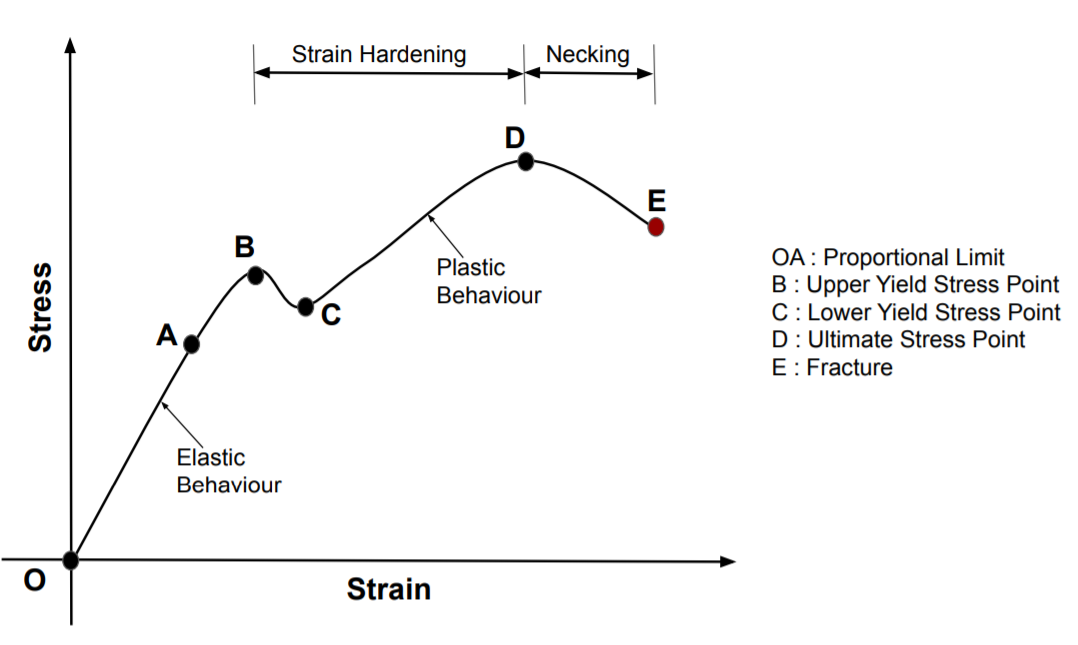
How is Toughness represented on a stress-strain curve?
Total Area under the curve
Define Hardness
A surface property of a material describing how difficult it is to scratch it
What scale is used to semi-quantitatively assess hardness?
Moh’s Hardness Scale
How does Vickers Hardness Scale relate to yield strength?
V. H. ≈ σy/3 ; both are measures of resistance to plastic deformation
How does the Vickers Hardness tester work?
A diamond pyramidal indenter presses into the sample → softer materials means more indenting and larger diagonal measurements
How id sound transmitted through materials?
As longitudinal strain waves/Mechanical Waves
Formula for velocity of sound in a material
v ∝ √(E/𝞀) → Proportional to Elastic Modulus but inversely proportional to density
Formula for Acoustic Impedance
Z ∝ √(𝞀E)
What determines how much sound is transmitted vs. reflected between two materials?
The difference in acoustic impedance between the two materials.
Large Z vs. Small Z mismatch
Large Z = more sound is reflected → Small Z = more sound is transmitted
Why is foam used for sound insulation?
Its low density and elastic modulus give it different acoustic impedance.
List the 5 thermal Properties
Service Temperature, Heat Capacity, Thermal Conductivity, Thermal Diffusivity, Thermal Expansion Coefficient.
Define Maximum Service Temperature
The maximum "useable" temperature for a material; above this temperature the material will "fail."
Service Temperature vs Melting Temperature
S.T. are often much lower than M.T. -> 50-80%
What are 5 ways a heated material might fail?
Melting, Expansion, Sag/buckle, Chemical Reaction, Loss of Magnetism/Conductivity
Define Heat Capacity (Cp)
The heat energy required to raise the temperature of a material by one degree (a material constant).
Define Thermal Conductivity (Λ)
The rate of heat flow at steady state (across a temperature gradient constant with time); units W/(m·K); it's the "speed" of heat flow.
States Fourier’s Law
Q= -Λ(∆T/∆x) where ∆T= Fixed Hot Temp - Fixed Cold Temp
To achieve a greater ∆T across a material at steady state, would you choose a material with higher or lower thermal conductivity?
Lower Thermal Conductivity
Define Thermal Diffusivity (Dth)
Ratio of Thermal Conductivity to Heat Capacity; Dth (m²/s) = ⋀/Cp; describes how long it takes to heat or cool a material in a transient state
When is thermal diffusivity high?
When ⋀ is high and Cp is low