RAD 111 Electromagnetic and particulate radiation
 Call Kai
 Learn
Learn Practice Test
 Spaced Repetition
 Match
Match Flashcards
 Knowt Play
1/31

There's no tags or description
Looks like no tags are added yet.
Name | Mastery | Learn | Test | Matching | Spaced | Call with Kai | Chat |
|---|
No analytics yet
Send a link to your students to track their progress
32 Terms
Who is the scottish physicist and mathematician responsible for theory of EM radiation?
James Maxwell
Em Spectrum from low to high
Radiowaves- radio stations and MRI
Microwaves- cell phones , heating food
Infrared light- signal between remote and TV
Visable light- colors visible to the human eye
Ultraviolet light- higher energies, tanning beds
X-rays- medical imaging
Gamma rays- Nuc med
Which EM radiation is able to ionize atoms?
X-rays- medical imaging
Gamma rays- Nuc med
All EM Radiation characteristics
-Has no mass
-Carries energy in waves of electric and magnetic disturbances through space
-Travels at the speed of light
PROPERTIES OF x and gamma photons
-Ionize
-Cannot be focused, refracted, or reflected
-Can be collimated, filtered, absorbed and remitted
-Cannot be seen, heard, felt, or smelled
-Cause certain materials to fluoresce
-Travel at the speed of light
Ionize
high energy
A method of ordering or grouping the EM radiations
-Energy
-Wavelength
-Frequency
WAVE-PARTICLE DUALITY of EM Radiation
properties of both a wave or a particle depending on its energy and possibly environment.
Usually all Em radiation is based on
ave characteristics
Lower energy EM radiation behaves more like
a wave
Higher energy EM radiation behaves more like
a particle
When interacting with tissue, x-rays behave more like
particles
X-ray particles are referred to as
photons
How are photons measured
Electron volts (eV)
X-ray particles move like waves because
they have a wavelength and frequency
EM radiation has wave characteristics of transmission but
-They can burn the skin
-Intensity varies according to distance
-They can ionize matter
WAVE CHARACTERISTICS OF EM RADIATION
-Velocity
-Amplitude
-Wavelength
-Frequency
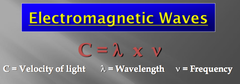
Velocity
= speed
Velocity of all EM radiation is
the speed of light OR 3x10^8 m/s
Amplitude
Maximum height of wave.
- Not important for EM radiation

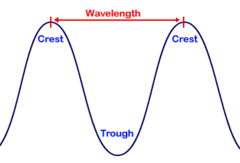
Wavelength
- angstrom or one tenth-billionith or nanometer
- measure of the peak of one wave to the peak of the next
- described as long or short
1 angstrom =
0.1 nanometer
Frequency
- Hz or one cycle per second
-Number of waves that pass a given point per second- described as high or low (rate at which the wave repeats itself)

Longer wavelength means
less energy
Shorter wavelength means
more energy
Because all EM radiation travels at the same velocity
relationship between wavelength and frequency is inverse
As wavelength becomes longer, frequency becomes
lower
Which wave would be associated with the higher KVP?
Shorter wavelength with higher frequency

Which wave has more penetrating power?
Shorter wavelength due higher energy
Velocity =
requency x wavelength
Frequency =
velocity/wavelength
Wavelength =
velocity/frequency