PSY389 Lecture Week 3: Major psychological effects of Alcohol and Other Drugs
 Call Kai
 Learn
Learn Practice Test
 Spaced Repetition
 Match
Match Flashcards
 Knowt Play
1/24

There's no tags or description
Looks like no tags are added yet.
Name | Mastery | Learn | Test | Matching | Spaced | Call with Kai | Chat |
|---|
No analytics yet
Send a link to your students to track their progress
25 Terms
Approaches in studying the effects of AOD - Epidemiological approach (Naturalistic observations)
Observes people in natural settings
Cannot control variables (e.g., dose, sampling bias, personality)
e.g., self-selection process (drug users may differ in many aspects from those who use less or non-users)
A major limitation of this approach
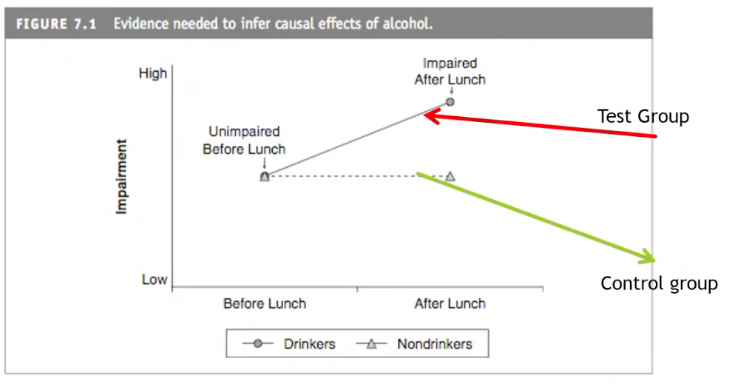
Approaches in studying the effects of AOD - Experimental approach
Conducts experiment in laboratory settings
Observes/records behaviours in presence/absence of drug
Controls experimental conditions:
Random allocation of participants (rules out selfselection bias)
Use sophisticated designs (e.g., double-blind placebo control cross over design, balance placebo design)
Has high validity and can draw some conclusions.
Balanced placebo Design
Can control for influence of expectancy (a psychological effect)
Can separate the pharmacological effects from expectancy effect
1. Group 1: told alcohol/receive alcohol
2. Group 2: told no alcohol/receive alcohol
3. Group 3: told alcohol/receive no alcohol
4. Group 4: told no alcohol/receive no alcohol
Experimental approach - Limitations
Only small doses of legal drugs are allowed (compared to real doses)
Testing effects (participants may behave differently when they know they are being observed)
Drugs are administered to participants versus voluntarily taking drugs
Observations are shorter in duration
Small and unrepresentative samples
Lack of generalisability
Influence of alcohol on Mood and Emotion
Two primary AOD use motives:
Enhancement: to increase positive emotions (pleasure, enjoyment).
Coping: to reduce negative emotions (stress, sadness, boredom).
-Most people drink for both enhancement and coping motives, with motives varying across contexts.
-Coping-motivated drinking shows the strongest relationship with mood, suggesting greater vulnerability to emotion-driven use.
-Sadness does not always increase drinking; however, shy and fearful individuals may be more likely to use alcohol as a coping strategy, possibly due to differences in social and coping skills.
Ascending vs Descending Blood Alcohol Curve (BAC)
BAC influences mood changes: euphoria/stimulation at lower BACs may transition to fatigue, negative mood, and sedation at higher BACs.
Timing matters: alcohol effects differ across the ascending vs. descending BAC curve, contributing to variability in research findings.
Individual differences matter: moderate/heavy drinkers tend to experience greater stimulant effects and fewer sedative/aversive effects than lighter drinkers, despite similar BAC levels.
Influence of alcohol on Sensory Motor skills
Vision: High doses impair visual processing and perception.
Attention & reaction time: Low doses can impair attention and slow responses.
Motor coordination: Impaired dual-task performance contributes to driving difficulties.
Alcohol expectancies: Beliefs about alcohol effects can influence performance and perceived ability.
Risk perception: Alcohol reduces hazard detection and increases impulsive responses.
Driving Simulator Performance
Driving relies on attention, reaction time, and motor coordination.
Alcohol: Increasing BAC → reduced driving ability; impairment becomes particularly dangerous around BAC 0.08%.
Fatigue: >19 hours of wakefulness can produce severe driving impairment; even “safe” BAC levels may become impairing when combined with sleep deprivation.
Nicotine: Smokers showed improved simulator performance with nicotine compared with placebo, likely reflecting relief of withdrawal effects.
Marijuana (THC) impairs driving-related skills:
High doses → increased body sway and reduced motor control.
THC → slower braking responses and delayed reactions to hazards.
Moderate THC doses (≈3.95%) can produce impairment comparable to BAC 0.05% alcohol.
Effects vary depending on individual and situational factors, including driving experience, attitudes, speed, and driving conditions.
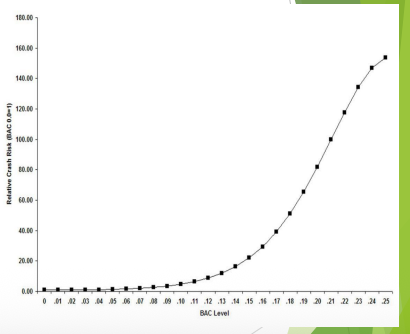
Crash risk related to alcohol - Blomberg et al. (2005)
BAC and crash risk:
Increased crash risk begins at approximately 0.04 g/dL BAC.
Risk rises sharply and accelerates at BACs >0.10 g/dL due to greater impairment in cognitive and motor functions
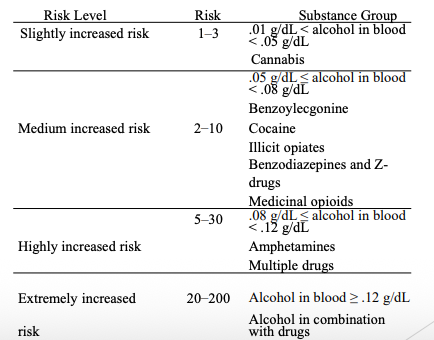
The European Integrated Project DRUID (Hels et al., 2011)
The Relative Risk Level of Serious Injury or Death for Various Substance Groups
Australian study: Substance use and crash risk - Drummer et al. (1994)
Alcohol: ↑ crash risk (OR = 7.6)
Stimulants: ↑ risk (OR = 2.0, n.s.)
Benzodiazepines: ↑ risk (OR = 2.0, n.s.)
Opiates: ↑ risk (OR = 2.0, n.s.)
Cannabis: ↓ crash risk (OR = 0.6) (interpret cautiously; may reflect confounding factors)
Influence of alcohol on Cognition - Alcohol Expectancies and Aggression
Individuals who believed “alcohol increases aggression” were primed with alcohol-related or neutral words.
Alcohol-related priming increased hostile responses following provocation.
Suggests that expectancies and learned associations with alcohol can shape behaviour, even in the absence of alcohol consumption.
Influence of alcohol on Cognition - Chronic Effects of Alcohol on Memory
Chronic heavy drinking → cognitive and memory impairment
Long-term binge drinkers show poorer spatial memory and pattern recognition.
Wernicke–Korsakoff syndrome:
Brain damage associated with thiamine deficiency from prolonged alcohol misuse.
Symptoms: Anterograde amnesia (impaired new learning), Confusion, Balance problems and visual disturbances
Alcohol-related dementia:
General decline in intellectual functioning associated with longterm alcohol-related brain damage.
Influence of other drugs on cognitive functions
Cannabis: ↓ attention and memory
Cocaine: ↓ memory, learning, attention, and abstract reasoning
Amphetamines: ↓ memory, working memory, attention, cognitive flexibility, and verbal fluency
Prolonged AOD use → prefrontal cortex dysfunction → impaired executive functions (planning, reasoning, decision-making, impulse control)
Influence of other drugs on cognitive functions - Smokers
May show improved cognitive functioning after nicotine exposure.
Possible explanations:
Pharmacological effects: increased alertness, attention, and satisfaction.
Expectancy effects: beliefs that nicotine improves wakefulness and reduces stress.
Improvements may reflect reversal of withdrawalrelated cognitive deficits rather than enhanced cognition
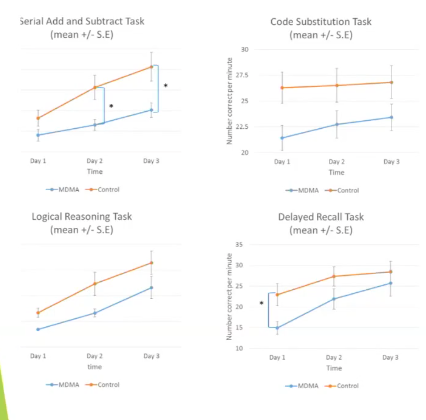
McCann et al. (1999) - Drug users VS non-drug uses performance
23 methamphetamine users
(abstained for 3 weeks)
23 non-drug users as controls
Meth users performed poorer compared to controls in some of these tasks.
Decision Making Task (Bechara et al. (2002) - IOWA Gambling task
Involves risk taking, reward, penalties
Participants need to: plan, weigh the pros and cons, and risk, consider rewards/penalties\
Dependent individuals performed worse than controls, showing impaired decision-making.
Controls showed stronger physiological responses to risky choices, whereas dependent individuals showed reduced emotional signalling.
70% of SDIs vs 36% of controls showed decision-making patterns resembling ventromedial prefrontal cortex damage.
Suggests dysfunction in brain systems involved in risk evaluation, emotion-based learning, and decision-making.
Conclusion:
Impaired decision-making in SDIs
Controls performed better as they might be guided by ‘gut feeling’ (psychogenic sweating)
The impairment could be due to damage in the prefrontal cortex due to long-term drug use
Decision Making Task (Bechara et al. (2002) - IOWA Gambling task - Limitation
Some SDI’s are poly-drug users so we can’t really conclude that impairment is due to a particular drug
Predicted cognitive impairment from alcohol according to different neuropsychological models
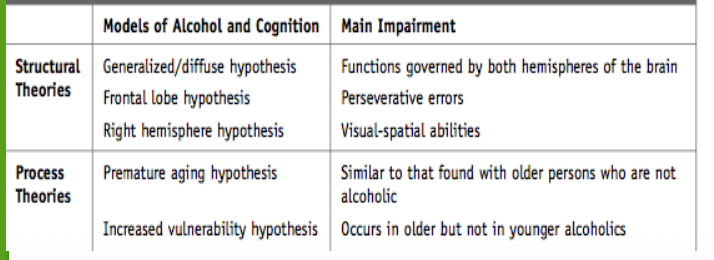
Structural theories - General/Diffuse Hypothesis
Alcohol damages both cerebral hemispheres → widespread disruption of cognitive functioning
Structural Theories - Frontal Lobe Hypothesis
Alcohol-related damage is concentrated in the frontal lobes.
Frontal dysfunction → impaired executive functions (attention, problem-solving, emotional control, planning, decision-making)
Evidence:
Working memory
Chronic alcohol users showed poorer spatial working memory performance.
fMRI revealed reduced frontal cortex activation during working memory tasks.
Suggests frontal lobe dysfunction contributes to cognitive deficits.
Social cognition: Long-term alcohol users show impairments in:
interpreting facial expressions and tone of voice
understanding others’ emotions and intentions
interpreting humour and non-literal communication
Structural Theories - Right Hemisphere Hypothesis
Chronic alcohol users show:
Preserved verbal abilities → left hemisphere relatively intact.
Impaired visuospatial abilities → right hemisphere dysfunction.
Supports the idea that chronic alcohol use may produce greater damage to the right hemisphere.
Process Theory
Emphasises the underlying cognitive functions/processes rather than the anatomical areas of the brain
-Premature aging vs Increased vulnerability hypotheses
Alcoholism accelerated (premature aging) cognitive impairments
Older brains are more vulnerable to alcohol than younger brains
-Cognitive deficits by aging is not usually recoverable
-However, many studies showed the cognitive impairments can be reversed with long-term abstinence (Bartels et al., 2007)
-Functions can be recovered which challenged the premature aging hypothesis
Self-Harm, Substance Use & Psychological Distress Moller, Tait & Byrne (2013)
Australian longitudinal community study (N = 4,126)
8.2% reported self-harm in the previous year.
Substance use was independently associated with greater odds of self-harm:
Alcohol dependence-level use: OR = 2.08
Cannabis use: OR = 1.77
Smoking: OR = 1.52
Psychological distress, adverse life events and financial strain were also associated with self-harm.
Other significant predictors included younger age, male gender, childhood sexual abuse and bisexual orientation.
Self-Harm, Substance Use & Psychological Distress Moller, Tait & Byrne (2013) - What do the findings tell us?
Substance use and self-harm are strongly associated, particularly problematic alcohol use.
The relationship is not explained by substance use alone — psychological distress and broader psychosocial factors also contribute.
Alcohol showed the strongest substance-related association with self-harm (OR = 2.08).
Findings highlight the potential role of AOD use as part of a broader pattern of distress and maladaptive coping.
Association ≠ causation: the study cannot establish that substance use causes self-harm.
The relationship may be bidirectional: substance use may increase vulnerability to self-harm, while distress and self-harm may also contribute to substance use.