Analytical Chemistry 1 Practice Test
 Call Kai
 Learn
Learn Practice Test
 Spaced Repetition
 Match
Match Flashcards
 Knowt Play
1/190

There's no tags or description
Looks like no tags are added yet.
Name | Mastery | Learn | Test | Matching | Spaced | Call with Kai | Chat |
|---|
No analytics yet
Send a link to your students to track their progress
191 Terms
Sampling type that eliminates questions of bias in selection
a. composite
b. stratified
c. systematic
d. random
d. random
Random sampling gives every member of the population an equal and independent chance of being chosen, which entirely removes selection bias.
Systematic and stratified sampling use structured rules or subgroups rather than pure equal-chance selection for every single unit (though they incorporate randomization steps to minimize bias).
Composite is not a standard primary random sampling technique for individual selection in this context.
When aqueous and nonaqueous liquids are combined, they usually form an immisciblemixture, such as oil and water. A ________ helps in separating the liquids into two samples.
a. pipet
b. beaker
c. separatory funnel
d. rotary evaporator
c. separatory funnel
Mixtures of liquids and solids are usually separated prior analysis by
a. filtering
b.decanting
c. centrifuging
d. All of the given choices
d. All of the given choices
Pre-treatment of solid samples prior analysis.
a. Leaching and extraction of soluble components
b. Filtering of mixtures of solids, liquids and gases to leave particulate (solid) matter
c. Grinding
d. All of the given choices
d. All of the given choices
In the decomposition and dissolution of solids during sample preparation, which of thefollowing is expensive and often the last resort?
a. Acid treatment using oxidation
b. Fusion technique
c. Dissolution using ultrasound & appropriate solvent
d. Simple dissolution
b. Fusion technique
Reliability of the results decreases with a decrease in the level or concentration of the:
a. matrix
b. analyte
c. reactant
d. Product
b. analyte
Properties of nitric acid making it the preferred acid for digesting samples for the analysis ofmetals
a. acts as a strong acid
b. as an oxidizing agent
c. does not form insoluble compounds with metals/nonmetals
d. All of the given choices
d. All of the given choices
Primary sample preparation method for organics
a. Sonication
b. Acid-digestion
c. Extraction
d. All of the given choices
c. Extraction
Possible sources of contamination during sample preparation include:
a. Reagents (tracers)
b. Glassware/equipment
c. Cross-contamination between high- and low-activity samples
d. All of the given choices
d. All of the given choices
Containers that should not be used for dry ashing because the elevated temperatures exceed the melting point of these materials
a. zirconium
b. Platinum
c. Glass and plastic
d. Porcelain
c. Glass and plastic
The size of the sample taken for analysis depends on the concentration of the
a. Analyte
b. equipment to be used
c. specific tests
d. All of the given choices
d. All of the given choices
Equipment commonly used to homogenize the contents of an open beaker.
a. Magnetic stirrer
b V-blenders
c. Ball and rod mills
d. tube rotator
a. Magnetic stirrer
The maximum holding time for acid preserved samples that will be subjected todetermination of metals is
a. 3 months
b. 1 week
c. 6 months
d. 48 hours
c. 6 months
A fraction of the sample actually used in the final laboratory analysis.
a. composite sample
b. sub-sample
c. laboratory sample
d. a, b and c
c. laboratory sample
. A change in the analytical signal caused by anything in the sample other than analyte.
a. matrix effect
b. interference
c. absorbance
d. transmittance
a. matrix effect
Matrix effect: This occurs when non-analyte components (the sample matrix) alter, enhance, or suppress the analytical signal.
Interference: While related, interference is a specific action where a contaminant directly causes a false signal or blocks the measurement, whereas the matrix effect is the broad term for any signal change caused by the overall sample environment besides the analyte itself.
Absorbance & Transmittance: These are specific optical measurement properties, not general definitions for signal changes from other sample components. [1, 2, 3]
Medium containing analyte.
a. reactant
b. matrix
c. solute
d. reference material
b. matrix
The total error of an analytical result is the sum of
a. sampling
b. sample preparation
c. analytical errors
d. All of the given choices
d. All of the given choices
The holding time for samples for metal determination preserved using nitric acid, 4 mL of dilute 3:1 is
a. 28 days
b. 2 weeks
c. 3 days
d. 1 year
a. 28 days
When samples cannot be dried because they decompose at the temperatures necessary to drive off the water, the samples can be analyzed as
a. wet basis
b. dry basis
c. received basis
d. All of the given choices
d. All of the given choices
Organic components in solid samples are extracted from the matrix by continuously washing the solid with a volatile solvent in a specialized piece of glassware
a. Soxhlet extraction
b. Ultrasonic extraction
c. Filtration
d. Rotary evaporation
a. Soxhlet extraction

In liquid-liquid extraction, it is often necessary to determine which liquid is aqueous and which liquid is nonaqueous. To test the liquids, add a drop of water to the top layer. If the drop dissolves in the top layer, the top layer is
a. nonaqueous
b. aqueous
c. miscible
d. denser
b. aqueous
It is important to discard containers that are scratched or abraded on their interior surfaces.The internal surface area of a container, whether used for sample preparation or storage, may cause loss of
a. Matrix
b. Analyte
c. weight
d. ash
b. Analyte
Process by which a sample population is reduced in size to an amount of homogeneous material that can be conveniently handled in the lab in which the composition is representative of the population.
a. Selection
b monitoring
c. sampling
d. segregation
c. sampling
As a general rule, the error in sampling and the sample preparation portion of an analytical procedure is considerably higher than that in the
a. Methodology
b treatment
c. preservation
d. subsampling
a. Methodology
Locating the adulterated portion of the lot for sampling is an example of
a. random sampling
b. selective sampling
c. composite sampling
d. stratified sampling
b. selective sampling
-Random sampling: Every portion of the lot has an equal chance of being selected. It eliminates bias but is inefficient if you want to find a specific, localized defect. [1, 2]
-Composite sampling: Multiple individual samples are combined into a single, physically blended mixture to measure the average concentration of the entire lot.
-Stratified sampling:
The lot is divided into distinct subgroups (strata) based on a characteristic (like depth, layer, or location), and samples are taken randomly from each subgroup.
Homogenization during sample preparation can be achieved using
a. mechanical devices (mixers, blenders, etc.)
b enzymatic methods
c. chemical methods
d. All of the given choices
d. All of the given choices
mechanical devices (e.g.,grinders, mixers, slicers, blenders),
enzymatic methods (e.g., proteases, cellulases, lipases)
chemical methods (e.g., strong acids, strong bases, detergents).
Glass container is not suitable for
a. inorganic trace analysis
b. oil and grease determination
c. microbiological analyses
d. All of the given choices
a. inorganic trace analysis
To increase/decrease analyte concentration, pre-concentration is needed for almost all trace analysis, ________ is used for the analysis of highly contaminated samples so the concentration falls within the calibration range.
a. Centrifugation
c. dilution
b. Separation
d. None of the given choices
c. dilution
Partitioning of analytes between water phase and organic phase
a. Liquid-liquid extraction
b. Solid phase extraction
c. Ultrasonic extraction
d. Pressured Fluid Extraction (PFE)
a. Liquid-liquid extraction
Liquid-liquid extraction (LLE) is a separation technique based on the differential solubility and partitioning of analytes between two immiscible liquid phases—typically an aqueous (water) phase and an organic solvent phase. [1, 2]
Solid phase extraction relies on analytes partitioning between a liquid sample and a solid stationary phase/sorbent.
Ultrasonic and pressurized fluid extractions are techniques used primarily to extract analytes from solid matrices using ultrasound waves or elevated temperatures and pressures rather than separating them via two immiscible liquid phases.
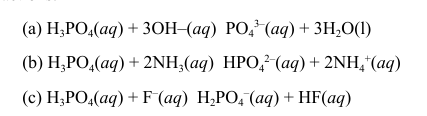
Calculate the equivalent weight and normality for a solution of 6.0 M H3PO4 given the
following reactions:
a. (a) 18 N, (b) 12 N and (c) 6N
b. (a) 12 N, (b) 18 N and (c) 6N
c. (a) 6 N, (b) 12 N and (c) 18N
d. (a) 16 N, (b) 12 N and (c) 3
a. (a) 18 N, (b) 12 N and (c) 6N
What is the molality of solution made by dissolving 25 g of NaCl into 2.0 Liter of water. Assume the density of water d = 1.0 g/mL (= kg/L).
a. 0.210 m
b. 0.250 m
c. 0.211 m
d. 0.214 m
d. 0.214 m
The amounts of all constituents in the samples were determined
a. Complete (or ultimate) analysis
b. Partial analysis
c. Elemental analysis
d. All of the given choices
a. Complete (or ultimate) analysis
Implies that the constituent determined was present in high concentration
a. Trace analysis
b. Macro analysis
c. Elemental analysis
d. all of the given choices
b. Macro analysis
Macro analysis deals with major constituents that are present in high concentrations (typically greater than 1% up to 100% of the sample).
Trace analysis deals with constituents present in very low or small concentrations.
Elemental analysis identifies the specific elements present rather than their relative concentration level
Quantitative chemical analysis of weighing a sample, usually of a separated and dried precipitate.
a. Titrimetric analysis
b. Volumetric analysis
c. Gravimetric analysis
d. Elemental analysis
c. Gravimetric analysis
A chemical grade of highest purity and meets or exceeds purity standards set by American Chemical Society
a. Technical grade
c. Pure or practical grade
b. Laboratory grade
d. ACS grade
d. ACS grad
Which of the following is a primary standard for use in standardizing bases?
a. Ammonium hydroxide
b. Sulfuric acid
c. Acetic acid
d. Potassium hydrogen phthalate
d. Potassium hydrogen phthalate
How would you prepare 500.0 mL of 0.2500 M NaOH solution starting from a concentration of 1.000 M?
a. Transfer 125 mL from initial solution (1.000 M) and complete with solvent to 500.0 mL.
b. Transfer 121 mL from initial solution (1.000 M) and complete with solvent to 500.0 mL.
c. Transfer 122 mL from initial solution (1.000 M) and complete with solvent to 500.0 mL.
d. Transfer 112 mL from initial solution (1.000 M) and complete with solvent to 500.0 mL.
a. Transfer 125 mL from initial solution (1.000 M) and complete with solvent to 500.0 mL.
A student performs five titrations and obtains a mean result of 0.110 M, with a standard\ deviation of 0.001 M. If the actual concentration of the titrated solution is 0.100 M, which of the following is true about the titration results?
a. Accurate but not precise
b. Precise but not accurate
c. Both accurate and precise
d. Neither accurate nor precise
b. Precise but not accurate
How many grams of Sodium Persulfate (Na2S2O8) required to prepare a 1 L solution of SodiumPersulfate with concentration of 10% (w/v). This solution is widely used as an oxidizing reagent for Total Organic Carbon analyzer (TOC).
a. 100 g of Sodium Persulfate
b. 101 g of Sodium Persulfate
c. 102 g of Sodium Persulfate
d. 99 g of Sodium Persulfate
a. 100 g of Sodium Persulfate
A solution has been prepared by transferring 60 mL from Ortho-phosphoric acid 85 % (v/v) H3PO4 and diluting it to 1.0 L, what is the concentration of the new solution.
a. 10.10%
b. 9.25%
c. 12.2%
d. 5.10%
d. 5.10%
A student has got three stock standard solutions of 3 different elements, zinc (Zn) 2000 ppm, cadmium (Cd) 1500 ppm and lead (Pb) 1000 ppm. A student took 10 mL from each solution and transferred it to a 200 mL volumetric flask then completed to total volume with solvent. What is the final concentration of each element in the diluted mix solution?
a. 50 ppm Zinc, 32 ppm Cd, 25 ppm Pb
b. 100 ppm Zinc, 75 ppm Cd, 50 ppm Pb
c. 75 ppm Zinc, 75 ppm Cd, 50 ppm Pb
d. 100 ppm Zinc, 25 ppm Cd, 25 ppm Pb
b. 100 ppm Zinc, 75 ppm Cd, 50 ppm Pb
Bidirectional harpoons or double arrows (⇆) should be used to indicate ________ reactions
a. one sided
b. resonance
c. dynamic
d. reversible
d. reversible
A few ways in which solution composition can be described are as follows.
a. Molarity
b. Normality
c. Molality
d. All of the given choices
d. All of the given choices
The substance which does the dissolving and must be greater than 50% of the solution.
a. Solvent
b. Solute
c. mixture
d. solution
a. Solvent
Naphthalene (C10H8) is one of the aromatic hydrocarbons measured by GC-MS. If molecular weight of naphthalene is 128.6 g/mol; how many milligrams are required to prepare 100 mL of 2,000 ppb stock standard solution of naphthalene from powder Naphthalene (purity of 91.5 % w/w)?
a. 2.18
b. 2.1858
c. 2.186
d. 2.1859
b. 2.1858
if 3 significant figures 2.18
Used to measure volumes approximately, typically with errors of several percent except for one.
a. beakers
b. pipettes
c. reagent bottles
d. graduated cylinders
c. reagent bottles
Nitrate (NO3-) anion solution prepared by dissolving 3.0 g of KNO3 in 250 mL of water. What is the concentration of Nitrate ion, expressing the concentration in Molarity and ppm.
a. 0.1187 M, 7359.05 ppm
b. 0.1190 M, 7349.05 ppm
c. 0.1107 M, 7459.00 ppm
d. 0.1120 M, 7400.00 ppm
a. 0.1187 M, 7359.05 ppm
The number of formula mass of any solute dissolved in 1 liter of solution
a. formality
b. normality
c. molality
d. molarity
a. formality
The method of standardization can be used if a _______________ reacts quantitatively with the reagent needed in the standard solution.
a. primary standard
c. working standards
b. secondary standard
d. intermediate solution
a. primary standard
You have a stock solution of 15.8 M HNO3. How many mL of this solution should you dilute using only a graduated pipette to make 100.0 mL of .250 M HNO3?
a. 1.58
b. 1.582
c. 1.50
d. 1.583
a. 1.58
HCl cannot be considered to be a primary standard because of its gaseous form at room temperature, but its solutions may be standardized against anhydrous ______.
a. NaSO4
b. NaHCO3
c. Na2CO3
d. all of the given choices
c. Na2CO3 - can be easily purified and dried in an oven to remove any trace moisture, converting it fully to its anhydrous form. It is a strong, stable base that reacts completely and predictably with hydrochloric acid
Na2SO4 (Sodium Sulfate): This is a neutral salt. It does not react with acids like HCl, so it cannot be used as a primary standard for an acid-base titration.
NaHCO3 (Sodium Bicarbonate): While it can react with acids, it is thermally unstable. When heated to dry off moisture, it easily decomposes into sodium carbonate, water, and carbon dioxide. Therefore, it cannot be reliably prepared as a pure primary standard.
When making a solution from a solid reagent, if necessary, dry the solid reagent on a clean, oven dried, watch glass at _____ for 2 hours and cool it in a desiccator.
a. 121 ºC
b. 105 ºC
c. 80 ºC
d. 118 ºC
b. 105 ºC
53. Requirements of primary standards.
a. High Purity, 99.9% or better
b. Stability in air
c. Absence of hydrate water
d. all of the given choices
d. all of the given choices
Blank samples are prepared so that you have a measure of the amount that needs always to be added to or subtracted from the end point to achieve the ________point.
a. titration error
b. equivalence
c. accuracy
d. precision
b. equivalence
Which of the following hastens the rate of solution?
a. pulverization
b. scratching the sides of the container
c. seeding
d. cooling
a. pulverization - increases surface area
Scratching the sides of the container and seeding are techniques used to induce crystallization (forcing a solute out of a solution), not dissolve it.
Cooling generally decreases the rate of solution and lowers the solubility for most solid solutes.
A solution is _______ if more solute can dissolve in it.
a. saturated
b. supersaturated
c. unsaturated
d. Concentrated
c. unsaturated
The normality of a solution is always _______ the molarity.
a. greater than or equal to
c. less than or equal to
b. greater than
d. less than
a. greater than or equal to
Which of the following concentration units is independent of temperature?
a. molarity
b. normality
c. molality
d. percent volume
c. molality
A solution contains 34.0% by mass HClO4 (100.45). It has a density of 1.242 g/ml.
The molarity of the solution is
a. 5.13
b. 4.20
c. 8.40
d. 0.916
b. 4.20
A solution contains 34.0% by mass HClO4 (100.45). It has a density of 1.242 g/ml.
The normality of the solution is
a. 5.13
b. 4.20
c. 8.40
d. 0.916
b. 4.20
A solution contains 34.0% by mass HClO4 (100.45). It has a density of 1.242 g/ml.
The molality of the solution is
a. 5.13
b. 4.20
c. 8.40
d. 0.916
a. 5.13
A solution contains 34.0% by mass HClO4 (100.45). It has a density of 1.242 g/ml.
The mole fraction of the solute is
a. 0.338
b. 3.67
c. 0.916
d. 0.0845
d. 0.0845
A solution contains 34.0% by mass HClO4 (100.45). It has a density of 1.242 g/ml
The mole fraction of the solvent is.
a. 0.338
b. 3.67
c. 0.916
d. 0.0845
c. 0.916
The recommended procedure for preparing a very dilute solution is not to weigh out a very small mass or measuring a very small volume of a stock solution. Instead it is done by a series of dilutions. A sample of 0.8214 g of KMnO4 (158.04) was dissolved in water and made up to the volume in a 500-ml volumetric flask. A 2.000-ml sample of this solution was transferred to a 1000-ml volumetric flask and diluted to the mark with water. Next, 10.00 ml of the diluted solution was transferred to a 250-ml flask and diluted to the mark with water.
What is the concentration (in molarity) of the final solution?
a. 0.1039 M
b. 2.079 x 10‒5M
c. 8.316 x 10‒7 M
d. None of the given choices
c. 8.316 x 10‒7 M
The recommended procedure for preparing a very dilute solution is not to weigh out a very small mass or measuring a very small volume of a stock solution. Instead it is done by a series of dilutions. A sample of 0.8214 g of KMnO4 (158.04) was dissolved in water and made up to the volume in a 500-ml volumetric flask. A 2.000-ml sample of this solution was transferred to a 1000-ml volumetric flask and diluted to the mark with water. Next, 10.00 ml of the diluted solution was transferred to a 250-ml flask and diluted to the mark with water.
Calculate the mass of KMnO4 needed to directly prepare the final solution
a. 3.28 x 10‒5 g
b. 6.57 x 10‒5 g
c. 0.4107 g
d. 0.2054 g
a. 3.28 x 10‒5 g
Ambient laboratory conditions are not the same as standard conditions, therefore the volumes dispensed in volumetric glassware are often not the same as the manufacturer's specifications, but within some acceptable limits determined by the manufacturer. This slight variation in volume will cause a _________ error that is based on volume-volume or mass-volume concentrations.
a. random
b. systematic
c. gross
d. all of the given choices
b. systematic
Filters that can be heated and used in gravimetric analysis.
a. ordinary filter paper
b. GFF
c. Sintered glass fibers
d. None of the given choices
b. GFF
Sintered glass filters are made of heat-resistant porous glass. They can be dried, heated, and weighed directly with the collected precipitate in gravimetric analysis. [1, 2, 3]
Ordinary filter paper chars or burns during high-temperature ignition/heating (though ashless paper is burned off, the paper itself is not weighed as part of the final filter matrix). [1, 2]
GFF (Glass Fiber Filter) pads generally lack the rigid, heat-stable structural configuration suitable for direct constant-weight heating cycles compared to sintered glass crucibles in standard precipitation gravimetry.
Objects cannot be weighed when hot or warm. But if you were to take a sample out and wait for it to cool it would pick up moisture like that so put it in ________.
a. an oven
b. a dessicator
c. at room temperature
d. fumehood
b. a dessicator
Weighing to constant weight means a weighing difference of ±0.1mg using a calibrated analytical balance.
a. ±1.0 mg
b. ±0.01g
c. ±0.01mg
d. ±0.1mg
d. ±0.1mg
The following are common desiccants except for _______
a. Calcium Sulfate
b. Ammonium Acetate
c. Calcium Chloride
d. Magnesium Oxide
b. Ammonium Acetate
Calcium Sulfate (CaSO4): Widely used as a solid drying agent (often known by the trade name Drierite).
Calcium Chloride (CaCl2): A very common hygroscopic salt used to absorb moisture in laboratories and packaging.
Magnesium Oxide (MgO): Acts as a drying or desorptive component in specific chemical and industrial drying applications.
During ignition for ashing, muffle furnaces that go up to 1100oC are used primarily for this and ________ is needed to contain the sample.
a. porcelain crucible
b. evaporating dish
c. beaker
d. all of the given choices
a. porcelain crucible
In making standard solutions, ______ are used for measuring liquid with high accuracy.
a. Beakers
b. volumetric flasks
c. Erlenmeyer flasks
d. Nesslers Tubes
b. volumetric flasks
Used for distillation or heating of liquids, allows uniform heating.
a. round bottom flask
b. Erlenmeyer flask
c. test tube
d. Florence flask
a. round bottom flask
Most popular burettes are 10 mL, 25 mL and 50 mL types. Which has the highest resolution?
a. 25 mL
b. 10 mL
c. 50 mL
d. all of the given choices
c. 50 mL
Used for vacuum filtration using filter paper.
a. gooch crucible
b. Buchner funnel
c. rotary evaporator
d. rubber aspirator
b. Buchner funnel
The nominal volume of water (or mercury) contained, or delivered by an article of volumetric glassware, at its reference temperature.
a. Capacity
b. Liter
c. mL
d. uL
a. Capacity
In verification of laboratory glassware, ________ is usually measured in terms of the tolerance, which is the uncertainty in a measurement made with the glassware. Class A volumetric glassware has a lower tolerance than Class B.
a. Mean
b. Accuracy
c. difference
d. precision
b. Accuracy
Glass apparatus that are generally received with calibration certificates from suppliers.
a. Class B
b. Class A
c. Erlenmeyer flasks
d. Beakers
b. Class A
The following will cause drift errors in an analytical balance except:
a. Balance door is open.
b. Balance is not levelled.
c. Air currents are present in the laboratory.
d. Temperature of the balance and the sample to be weighed is the same
d. Temperature of the balance and the sample to be weighed is the same
It is a document that provides useful information on the chemical hazards, advice on safe handling, use and storage, and the emergency measures to be followed in case of an accident. It usually contains 16 headings.
a. Certificate of Analysis
b. Product Specification
c. Safety Data Sheet
d. Environmental Compliance Certificate
c. Safety Data Sheet
In operating a UV-Vis spectrophotometer, the following shall be done, except for:
a. Before turning on the power, check if the sample holder does not contain anything.
b. Keep the sample compartment open during measurement.
c. If there is any spillage that gets onto the instrument, immediately wipe it away.
d. After turning on, allow the spectrophotometer to initialize and stabilize according to its user manual.
b. Keep the sample compartment open during measurement.
In maintenance and storage of pH meters, which of the following procedure shall not be done?
a. To keep the electrode bulb moist during storage, store the electrode in distilled water.
b. Rinse pH electrodes in between measurements.
c. Blot the electrode dry after rinsing the pH electrodes.
d. Mild soap solution may be used in general cleaning of the electrodes
a. To keep the electrode bulb moist during storage, store the electrode in distilled water.
In using fume hoods, the following shall be done, except for:
a. Ensure the exhaust is operating before using the hood.
b. The hood shall be kept closed, except during apparatus set-up or when working within the hood.
c. The hood may be used as a permanent storage area for volatile chemicals when an appropriate storage cabinet is not available.
d. Items contaminated with odorous or hazardous materials should be removed from the hood only after decontamination or if placed in a closed outer container to avoid releasing contaminants into the laboratory air
c. The hood may be used as a permanent storage area for volatile chemicals when an appropriate storage cabinet is not available.
Which of the following does not require a minimum of annual third party calibration?
a. analytical balance
b. drying oven
c. autoclave
d. sets of weights
d. sets of weights
In starting-up laboratory operations the following should be observed except ________.
a. Turning on the hoods, vents and exhaust fans.
b. Turning the equipment and instruments on.
c. Performing the analysis immediately.
d. Monitoring operating parameters.
c. Performing the analysis immediately.
The following must be avoided in using the analytical balance except ______________.
a. Weighing warm objects in the balance.
b. Closing the draft shield before reading the result.
c. Placing the sample not at the center but on the side of the pan.
d. Touching the samples or sample containers with your bare fingers.
b. Closing the draft shield before reading the result.
Which of the following must be performed before using the analytical balance?
a. Cleaning the balance and removing sample residues.
b. Determine the sensitivity of the balance using calibration weight.
c. Checking the level of the balance by adjusting the air bubble.
d. all of the given choices
d. all of the given choices
Sealable enclosures containing desiccants used to protect chemicals which are hygroscopic or which react with water from humidity.
a. Mortar and Pestle
b. Desiccator
c. Evaporating dish
d. Separatory Funnel
b. Desiccator
To determine the specific gravity of a liquid, which of the following glassware should be used?
a. volumetric flask
b. pycnometer
c. pipette
d. graduated cylinder
b. pycnometer
Preparation of highly toxic and volatile compounds should be carried out in an efficient _____________.
a. canopy hood
b. laminar hood
c. fume hood
d. any of the above
c. fume hood
Which of the following shall not be followed when boiling a solution in a hot plate?
a. Make sure that the glass ware being used is heat resistant
b. Inspect the glass ware for cracks before putting it in the hot plate.
c. Add boiling stones to facilitate boiling.
d. When removing the heated material, use polyethylene gloves to protect your hand from heat
d. When removing the heated material, use polyethylene gloves to protect your hand from heat
How many grams of sodium chloride are required to prepare 250 mL of a solution of 1 M sodium chloride?
a. 7.3054 grams
b. 14.6108 grams
c. 29.2216 grams
d. 43.8324 grams
b. 14.6108 grams
In recording laboratory results, the following shall be done, except:
a. Use permanent ink
b. When an error is committed, put multiple lines to cross out the wrong data
c. Always indicate the date of analysis
d. Record all necessary details including qualitative observations
b. When an error is committed, put multiple lines to cross out the wrong data
In sample acceptance, which of the following shall be checked?
a. sample density
b. sample integrity
c. amount of sample
d. both b and c
d. both b and c
Method of passing the sample through a metal or plastic mesh of a uniform cross-sectional area to separate particles into uniform sizes.
a. Sieving
b. pulverizing
c. macerating
d. milling
a. Sieving
Method that involves mechanical cutting of sample into smaller parts
a. sieving
b. chopping
c. crushing
d. blending
b. chopping
Method of passing the sample through a metal or plastic mesh of a uniform cross-sectional area to separate particles into uniform sizes.
a. Sieving
b. pulverizing
c. macerating
d. milling
a. Sieving
This refers to a single sample or measurement taken at a specific time or over as short a period as feasible.
a. grab sample
b. composite sample
c. laboratory sample
d. None of the given choices
a. grab sample
Grab sample: An individual, discrete sample taken from a single spot at a specific time or over a very short duration (typically under 15 minutes). It represents conditions only at that precise moment.
Composite sample: A mixture of multiple individual grab samples collected at different times or locations to represent an average condition over a longer period.
Laboratory sample: A homogenized, reduced quantity of material prepared from gross samples for actual testing in a lab
A sample comprising two or more increments selected to represent the material being analyzed.
a. grab sample
b. composite sample
c. laboratory sample
d. None of the given choices
b. composite sample
Which of the following parameters shall be analysed immediately after collection?
a. Density
b. Temperature
c. Viscosity
d. Solids
b. Temperature