Final For evolutonary biology (only practice exams)
 Call Kai
 Learn
Learn Practice Test
 Spaced Repetition
 Match
Match Flashcards
 Knowt Play
1/126

There's no tags or description
Looks like no tags are added yet.
Name | Mastery | Learn | Test | Matching | Spaced | Call with Kai | Chat |
|---|
No analytics yet
Send a link to your students to track their progress
127 Terms
Which of the following is NOT a target cell of HIV?
a) Macrophage Cells
b) Eosinophil Cells
c) Effector T Cells
d) Memory T Cells
B
Why is HAART more effective than AZT for treating HIV?
a) It targets a different mechanism that AZT that is immune to evolution
b) It has been used more carefully that AZT to prevent selection
c) It targets multiple mechanisms at once to limit risk of resistance
d) It has not been more effective than AZT
C
How does HIV enter human immune cells?
a) By binding to the CCR4 And CD4 Cell Receptors
b) By using a spike shaped protein to bind to a transmembrane protein
c) By using Integrase to spice it’s DNA into the host cell
d) By creating functional proteins from polypeptides using proteases
A
Which of the following best describes the mechanism of AZT?
a) It stops integrase from functioning by binding to an allosteric inhibition site
b) It changes the shape of the CCR4 receptor to prevent viral particles from binding
c) It prevents translation from taking place in an infected cell by blocking ribosome
binding
d) It interferes with reverse transcription by inserting itself in place of
thymidine.
D
HIV-1 likely arose from _______ SIV strains while HIV-2 likely arose from _____ HIV-2
Strains
a) Sooty Mangabey; African Green Monkey
b) Chimpanzee; Gorilla
c) Gorilla; Colobus Monkey
d) Chimpanzee; Sooty Mangabey
D
In HIV selection tends to favor _____ virulence
a) High
b) Low
c) Intermediate
C
Which of the following was NOT a principle of Special Creation?
a) Each organism perfectly matched its environment
b) Species were immutable
c) The earth was very young
d) Continental Drift happened rapidly
D
Which of the following is generally credited to the work of Hutton?
a) The idea of geological change
b) The term uniformitarianism
c) Theory of Inheritance of acquired characteristics
d) The principle of continental drift
A
The work of Lamarck has been partially reevaluated in recent years due to advances in
the understanding of __________
a) Natural Selection
b) Epigenetics
c) Hydrogen Bonding
d) The Modern Synthesis
B
Where were Darwin’s most important observations made while on the voyage of the
Beagle?
a) Patagonia
b) Indonesia
c) Galapagos Islands
d) South Georgia Island
C
Homologous structures provide evidence for ________ while analogous structures
provide evidence for _________
a) Convergent Evolution; Common Ancestry
b) Phenotypic Plasticity; Heritability
c) Heritability; Phenotypic Plasticity
d) Common Ancestry; Convergent Evolution
D
Pseudogenes are genetic examples of:
a) Analogous structures
b) Homoplasy
c) Vestigial Structures
d) Phenotypic Plasticity
C
Fossil records are especially important to establishing the concepts of
a) Gene flow and Genetic Drift
b) Extinction and Succession
c) Plate Tectonics and Uniformitarianism
d) Selective Breeding and Phenology
B
What are the closest living relatives of theropods?
a) Turtles
b) Alligators
c) Sauropods
d) Birds
D
Which of the following was NOT a geologist whose work influenced our understanding of
modern Evolutionary Biology?
a) Tharp
b) Lamark
c) Lyell
d) Hutton
B
) Modern Radiometric data suggest that the earth is approximately:
a) 3.7 Billion Years Old
b) 250 Million Years Old
c) 6 Billion Years Old
d) 4.5 Billion Years Old
D
Which of the following is NOT one of Darwin’s original four postulates?
a) Individual species are variable
b) Mutation is the ultimate source of genetic variation
c) Some variation is passed on to offspring
d) Survival and reproduction are not random
B
Who independently Who independently developed the idea of Natural Selection aside from Darwin?
a) Lamark
b) Wallace
c) Lyell
d) Tharp the idea of natural selection aside from Darwin
B
Which of the following is the best definition of Darwinian fitness?
a) The ability of an individual to survive and reproduce in its environment
b) The individuals with the highest rates of survival in a given environment
c) The ability of an individual to survive and reproduce independent of its
environment
d) The strongest individuals
A
Which of the following is NOT a reason why measuring heritability is difficult in the
Daphne Major finches?
a) Difficult to determine paternity
b) Conspecific nest parasitism
c) Frequent dispersal to other islands
d) Shared environments
C
Which of the following is NOT a reason why measuring heritability is difficult in the
Daphne Major finches?
a) Difficult to determine paternity
b) Conspecific nest parasitism
c) Frequent dispersal to other islands
d) Shared environments
After a drought event, selection favored deep beaks in finches. Which of the following is
the best explanation for why small beaked finches still exist on the island?
a) Selective pressures are dynamic between years
b) Migration of small beaked individuals from other islands
c) Not enough time has passed for them to go extinct
d) New mutations produce new small beak birds each generation
A
Natural selection acts on ________ but evolution occurs in _________
a) Populations; Individuals
b) Individuals; Populations
c) Populations; Communities
d) Communities; Populations
B
Natural selection allows individuals to prepare for future environmental changes
a) True
b) False
B
Which of the following is NOT a reason that individuals may engage in apparently
altruistic acts
a) The individuals may be related to each other
b) The individuals may be engaged in reciprocity
c) The individuals are doing it for the good of the group as a whole
d) The act might not have any selective cost associated with it
C
A modern understanding of how traits were inherited required the synthesis of the work
of Darwin and _______
a) Wallace
b) Mendel
c) Lyell
d) Kelvin
B
The field of ______ is concerned with classifying organisms into groups, while ________
is concerned with reconstructing evolutionary relationships
a) Cladistics; Taxonomy
b) Taxonomy; Agronomy
c) Ecology; Evolutionary Biology
d) Taxonomy; Phylogeny
D
Occam’s razor is associated with what method of phylogenetic tree construction
a) Maximum Likelihood
b) Neighbor Joining
c) Maximum Parsimony
d) Bayesian Analysis
C
Reptiles are ______ with respect to birds in current taxonomy
a) Monophyletic
b) Diphyletic
c) Paraphyletic
d) Polyphyletic
C
Distance-Based methods have what notable drawback?
a) They are very slow to run
b) The cannot incorporate morphological data
c) They are susceptible to error associated with homoplasy
d) They cannot incorporate molecular data
C
Which of the following lines of evidence did NOT support a whale+hippo clade within
artiodactyls
a) Parsimony of Astragalus evolution
b) Analysis of extinct whale legs
c) SINE/LINE data
d) Genetic Distance
A
Environmental sex determination in Leopard Geckos is an example of what type of
inheritance?
a) Genetic
b) Environmental
c) Genotype-by-environment interaction
d) None of the above
C
Mutations are at least twice as common as ______ in nature
a) Transition; Transversion
b) Transversion; Transition
A
A _____ Mutation results in the change of an amino acid sequence while a ______
mutation does not
a) Transition;Transversion
b) Transversion;Transition
c) Synonymous; Nonsynonymous
d) Nonsynonymous;Synonymous
A
Why are gene duplications interesting from an evolutionary perspective
a) They are always deleterious
b) They free the extra copy from natural selection
c) They mutate slower
d) They only happen in prokaryotes
B
n Drosophila, inversion frequencies are linked to
a) Chromosome count and mutation rate
b) Temperature and body size
c) Sex and Age
d) Inversion frequencies are invariant
B
If Dr. Richard Schmidt had been innocent and had not inoculated his nurse/ex-lover/patient Ms.
Trahan with HIV, what would we have seen?
a) HIV virions in Ms. Trahan would have been phylogenetically unrelated to any HIV virions
in any of Dr. Schmidt’s patients
b) HIV virions in Ms. Trahan would have been phylogenetically distantly related to any
virions in any of Dr. Schmidt’s patients
c) HIV virions in Ms. Trahan would have been phylogenetically closely related to any virions
in any of Dr. Schmidt’s patients
d) HIV virions in Ms. Trahan would have been phylogenetically identical to virions in any
patient of Dr. Schmidt
B
In a sample of cows, there are 3MM, 7Mm, and 10mm genotypes. What can we calculate from
these data?
a) Allele frequency of the M allele
b) Genotype frequency of the Mm genotype
c) Frequency of heterozygous genotypes
d) Total number of alleles in the population
e) All answers are correct
E
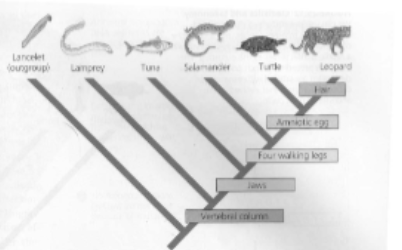
Hair is a/an ___________ with regard to the tree below.
a) Reversal
b) Autapomorphy
c) Sympleisiomorphy
d) Synapomorphy
B
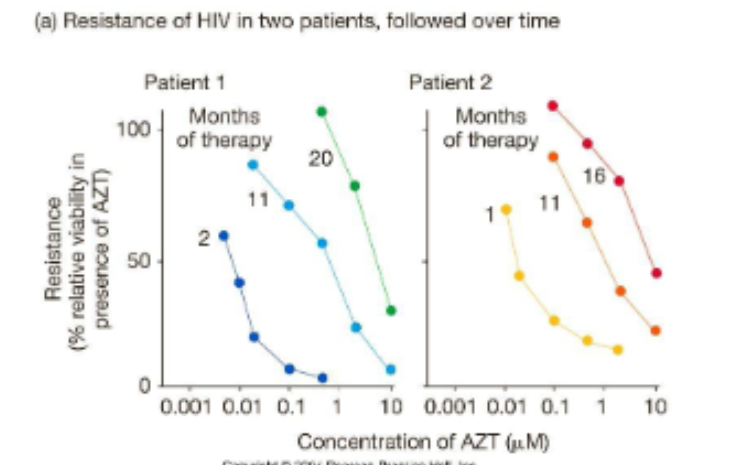
What do the graphs suggest with regard to resistance of HIV?
a) Patient 2 is more resistant to HIV than patient 1.
b) That increasing AZT concentration will eventually kill all HIV virions in the bloodstream.
c) That a population of HIV virions has evolved resistance to AZT in less than 20 months in
both patients.
d) All answers are correct.
e) No answers are correct
C
Which of the following statements is true regarding maximum likelihood methods?
a) They are often done by hand.
b) They are inaccurate but easy to use
c) They build trees based on models of evolution
d) They require little computational power.
e) All of the above
C
Which best describes a one-island model of migration?
a. One population exists and alleles are lost and gained at random in that population
owing to the island’s small population size.
b. One population exists and allele frequencies are lost owing to genetic drift.
c. A mainland sends migrants into a smaller population causing allele
frequencies to change in the smaller population.
d. A small population sends migrants to a mainland, which slowly cause the allele
frequencies of the mainland to change.
e. Two small populations exist and the average allele frequency will be obtained in
an infinite number of generations.
C
In the absence of other evolutionary forces, migration will cause __________.
a. allele frequencies to homogenize across populations
b. FST to go to 1
c. FST to go to 0.5
d. FST to go to 0
e. a and d
e
Which of the following is an assumption of Hardy-Weinberg equilibrium?
a. Mutation occurs
b. Random mating occurs
c. Chance events occur
d. Selection occurs
e. None are assumptions of HWE
b
An individual’s genotype is AARr and gets a new mutation in a gamete such that a “A”
mutates to “a” so one of its offspring is AaRr with two genes on the same chromosome
such that Ar and aR are together, which is true?
a. Selection that favors the new “a” allele will equally impact “R” and “r”
b. Selection that favors the new “a” allele will cause an increase in the “R”
allele
c. Selection that favors the new “a” allele will cause an increase in the “r” allele
d. In future generations, the “a” and “R” alleles will always be on the same
chromosome
e. Eventually, the “r” allele will be lost from this population
b
In a population, 68% of eggs and sperm received an allele W and the remaining gametes
received an allele w. What is the expected genotypic frequency of heterozygotes?
a. 0.1024
b. 0.2176
c. 0.4352
d. 0.4624
e. 0.50
C
n cases where a perpetual "arms race" occurs between biological antagonists, such as
parasites and their hosts, sex is favored because it increases genetic recombination
increasing the likelihood of evolving novel genotypes in a variable environment. This is
called ________.
a. Hardy-Weinberg Equilibrium
b. Red Death Hypothesis
c. Muller’s Ratchet
d. Red Queen Hypothesis
e. Queen of Hearts Selection
D
Why is it that “Muller’s ratchet” does not explain, by itself, the adaptive significance of
sex?
a. Muller’s ratchet requires genetic drift, which is rare
b. Muller’s ratchet cannot work along with selection
c. Muller’s ratchet requires a fast rate of mutation
d. Muller’s ratchet takes a long time for chance events to eliminate low
mutation classes
e. Muller’s ratchet requires recombination, which is rare
D
QTL mapping is used to…?
a. Locate genes with phenotypic effects on quantitative traits
b. Find genes in Hardy-Weinberg equilibrium
c. Map genetic differentiation among populations
d. Create a linkage map by crossing two different inbred lines
A
You observe a population where the number of each individual of a single locus trait
controlled by two alleles A and a is:
AA = 113
Aa = 156
aa = 201
After a harsh winter you observe the following numbers of each genotype:
AA = 101Aa = 112aa = 194
Given the observed pattern of survival, what type of selection appears to be acting on
these genotypes?
a. Selection against “A”
b. Selection against “a”
c. Stabilizing selection
d. Underdominance
e. Heterozygote advantag
D
After controlling for the effect of relatedness among species of bats, what was the
conclusion with regard to testes size in bats?
a. testes size is not really related to body size
b. larger bats had smaller testes
c. larger bats had larger testes size
d. testes size is related to social group size
D
This population is in HWE
a. True
b. False
B
Why don't Fuchsia flowers drop immediately after pollination has finished?
a. they cannot because they are physically unable
b. they want to trick the pollinators into visiting more
c. they wait until the pollen tube has reached the ovary
d. the color change allows more photosynthesis
C
In which of the following scenarios would it be important to perform phylogenetically
independent contrasts?
a. To infer whether variation in beak size is heritable in a single population
b. To test for a correlation between diet and toxicity across populations within a
species
c. To test for a correlation between genome size and host specificity among an
array of parasitic species
d. all of the above
e. none of the above
C
An adaptation is?
a. A trait or suite of traits formed by natural selection and or random genetic drift.
b. A trait or suite of traits which increases one's abilities.
c. A trait or suite of traits which increases one's fitness.
d. A trait or suite of traits which increases one's genetic variation.
C
What is sexual dimorphism?
a. a population with a mix of sexual and asexual individuals
b. an asymmetric sex ratio at birth.
c. a difference in males and females of a species.
d. a difference in male reproductive rates
C
If one parent invests more resources in offspring than the other, this
a. would limit reproductive success of the more heavily investing parent.
b. would limit the overall fitness of both parents.
c. would limit reproductive success of both parents.
d. would not limit reproductive success of either parent.
A
Male pipefish selecting less parasite-ridden females to mate with is an example of which
type of sexual selection?
a. intersexual selection
b. intrasexual selection
A
Stalk-eyed flies are a good example of what type of sexual selection?
a. runaway sexual selection
b. Sexy-son hypothesis
c. Handicap hypothesis
d. Sensory biases
A
What is the similarity between frequency-dependent selection and heterozygote
superiority?
a. Both patterns of selection lead to an increase in mutations.
b. Both patterns of selection maintain genetic diversity in populations.
c. Both patterns of selection decrease genetic diversity among individuals.
d. Both patterns of selection lead to homozygotes having a much higher fitness that
the other
B
The frequency of recessive deleterious allele q is 0.09 in a population of fruit flies. You
examine many individuals over many generations and measure that the mutation rate of p
to q is 0.0003. What would the strength of selection against the q allele need to be for the
frequency of q=0.06 to be maintained by selection-mutation balance?
a. 0.14
b. 0.19
c. 0.37
d. 0.62
C
The initial frequency of the delta 32 allele is 0.01 in a population where 25% of the wild
type and 25% of the heterozygotes contract AIDS and die without reproducing. Under
such circumstances how would selection change the allele frequency?
a. Almost not at all
b. Frequency of delta 32 allele should quickly increase in frequency
c. Frequency of delta 32 allele should be lost
d. Frequency of wild type allele will slowly rise
A
. Why do Pier and colleagues hypothesize that cystic fibrosis (CF) might have such a high
allele frequency?
a. During Medieval times, CF was favored in Eastern Europe.
b. CF heterozygotes may be resistant to Typhoid fever.
c. CF heterozygotes may be resistant to AIDS
d. Families with a history of CF were seen as capable of causing magic
B
In the one-island model, which quantity can you ignore?
a. The proportion of island immigrants
b. The proportion of island emigrants
c. The allele frequencies on the mainland
d. The allele frequencies on the island
B
Sewall Wright proved that the probability that any given allele in a population will be the
one that drifts to fixation is equal to what?
a. Two times the population size
b. Frequency of 0.5
c. Allele's initial frequency
d. Zero
C
What is the effective population size if you have 50 males and 100 females in a
population? Assume random mating, no selection, mutation, or migration, and round to
the nearest whole number.
a. 144
b. 133
c. 122
d. 111
B
When considering the role of mutations on allele frequency changes through time, the
occurrence of back mutations (that fix the mutation) are often ignored.
a. This is problematic, but needs to be done because of simplicity.
b. This is not problematic because the back mutation rate is so low.
c. This is not problematic because back mutations cannot occur.
d. This is problematic, but geneticists are not sure why.
B
As allele frequencies in a finite population drift toward fixation or loss, what happens to
the frequency of heterozygotes in the population?
a. Heterozygosity decreases
b. Heterozygosity increases
c. Heterozygosity doesn't change
d. Cannot say because heterozygosity and drift are unrelated
A
Which of the following is FALSE concerning the neutral theory of natural selection?
a. It was formulated by Motoo Kimura
b. Holds that advantageous mutations are common enough that they cannot be
ignored
c. Surprised evolutionary biologists because population size has no role and positive
selection is excluded
d. Predicts that genetic drift dominates evolution at the level of DNA sequences
B
Most of the 20 amino acids are encoded by more than one codon. We might expect that
codon usage would be random, and that each codon in a suite of synonymous codons
would be present in equal numbers. However, this is not true. What name is given to the
above phenomenon?
a. Hitchiking
b. Background selection
c. Positive selection
d. Codon bias
D
hat is a species?
a. The fundamental unit of evolutionary change
b. All groups of individuals that send genetic migrants back and forth
c. A group of interbreeding populations
d. A group of organisms with an independent evolutionary trajectory
e. All of the above
E
Which of the following transitions in energy allocation do you expect to see before vs. after
sexual maturity is reached?
a. Growth, then Reproduction
b. Metabolism, then Repair
c. Metabolism, then Reproduction
d. Growth, then Repair
e. Growth, then Metabolism
A
Evolutionary game theory…
a. Can be used to explain the evolution of altruism
b. Can be used to explain how cooperation can evolve in populations
c. Can be used in a “Prisoner’s Dilemma” game to show that an ESS is always to defect,
even though cooperation leads to a higher average payout.
d. Can be used to explain why unrelated vampire bats would share a blood meal.
e. All of the above
E
In parental studies in villages in Trinidad, Flynn discovered that:
a. fathers had more interaction but a higher homicide rate with genetic children
b. there was no significant difference in interaction or homicide rates among genetic and
non-genetic children
c. there was less interaction but more of it was agonistic (negative) with non-genetic
children
d. there was less interaction and hence less agonistic behavior with non-genetic children
e. fathers had fewer interaction with genetic children but more of it was agonistic
C
Which of the following is FALSE?
a. Homo sapiens are the sole survivors of a large human radiation.
b. Multiple human species have coexisted in the past.
c. Earlier human species died sequentially, leading to Homo sapiens today.
d. Determining phylogenies is difficult due to ancestral polymorphisms and introgression
events.
e. Early hominin fossils have bone structures enabling them to walk, even when the
braincase was small.
c
What is currently the earliest known hominin?
a. Australopithecus africanus
b. Sahelanthropus tchadensis
c. Australopithecus anamensis
d. Kenyanthropus platyops
e. Ardipithecus ramidus
B
Which behavior results in a cost to both actor and recipient?
a. cooperative
b. altruistic
c. selfish
d. spiteful
e. Ritualistic
D
If the African Replacement theory were true, allele patterns should demonstrate:
a. the splitting of races at around 1.8 million years ago
b. greater diversity in Europe and Asia with European and Asian alleles as subsets of African
alleles
c. equal diversity in all areas with alleles present not showing any specific pattern of being
subsets of African, European or Asian alleles
d. greater diversity in Africa with European and Asian alleles as subsets of African alleles
e. greater diversity in Europe and Asia with African alleles as subsets of European and Asian
alleles
D
Which trait would we likely see appear around the same time that language evolved?
a. Larynx is lower in throat
b. Hyoid bone similar to that of modern chimps
c. Early use of simple tools
d. A shift from hunter-gatherer to farming
e. All of the above
A
Every concept of species and speciation has what common thread?
a. Some type of geographic isolation
b. Post-zygotic barriers
c. Restricted gene flow
d. A disruptive selection pressure
e. Reinforcement
C
What features of Homo floresiensis make this discovery so interesting?
a. That the skeletons are so large compared to modern humans
b. That this new species of human has been missed despite its widespread range
c. That this new species of human temporally overlapped with modern humans
d. That no other Homo species were known to live in same vicinity
e. All of the above
C
Given the data that we now know, what can we say about Homo sapiens?
a. They evolved in Africa
b. They hybridized with Neanderthals
c. They hybridized with Denisovans
d. They co-occurred with multiple species of hominin
e. All answers are correct
E
Which of the following hypotheses best describes virulence evolution for the majority of known
pathogens?
a. the coincidental evolution hypothesis
b. the shortsighted evolution hypothesis
c. the hygiene hypothesis
d. the trade-off hypothesis
e. the recent entrance hypothesis
D
Male reed buntings do not always father all nestlings given birth by their mate. Therefore, we
would expect that male reed buntings would allocate ________ resources to clutches where
________ chicks are fathered by them.
a. Fewer, fewer
b. Fewer; more
c. More; fewer
d. None of these answers are correct
A
You are studying two populations of white-tailed deer and notice that the populations are quite
distinct in many traits, including body size, size of offspring, and number of offspring. Natural
selection should act on the deer in each population in such a way that they allocate energy to
maximize…?
a. Lifespan
b. Time to maturity
c. Lifetime reproductive success
d. Body size
e. Number of offspring in second clutch
C
Why is it that certain strains of influenza (such as the 1918 Spanish flu) are so much more
deleterious than other annual strains?
a. Some strains of influenza carry more viral genes, enabling them to cause additional
harm.
b. Some strains of influenza have RNA’s that code for additional proteins that cause
additional harm.
c. Influenza is known to be able to swap RNA’s causing associated host species switching.
d. Certain strains of influenza have evolved resistance to antibiotics
e. Certain strains of influenza cause short periods of stomach illness (e.g. the “24 hour” flu)
making them easier to pass from person to person
C
There is a species of plant that occurs along a mountain slope, over tens of thousands of years;
those populations at the top of the mountain differentiate (adapt to higher altitude) from those
in the valley. However, low levels of gene flow exist throughout the entire range creating a hybrid
zone at an intermediate altitude. What has occurred here?
a. Sympatric speciation
b. Allopatric speciation
c. Peripatric speciation
d. Parapatric speciation
D
Social castes, sexual dimorphism and genetic polymorphism are major difficulties for the
__________ species concept.
a. Phylogenetic
b. Evolutionary
c. Biological
d. Morphological
e. None of the above
D
Which was the first species of hominin to leave Africa?
a. Sahelanthropus tchadensis
b. The gracile Australopithecines (Australopithecus)
c. Sasquatch
d. Homo habilis
e. Homo erectus
E
The wealth of evidence of early hominin evolution is that the pattern of evolution leading from
our last common ancestor to present day Homo sapiens has been a steady transformation of a
single lineage.
a. a. True
b. b. False
B
All genetic evidence agrees with the fact that Humans are more closely related to chimpanzees
than either are to gorillas.
a. a. True
b. b. False
B
Humans share a more recent common ancestor with Homo ergaster than with Australopithecus
anamensis
a. a. True
b. b. False
A
Human and chimpanzee genomes are less similar to each other than the mouse genome is to
the rat genome.
a. a. True
b. b. False
B
Based on genomic data, we infer that humans interbred with Neanderthals and Denisovans
because patterns of SNP excess indicate gene flow into non-African human lineages.
a. a. True
b. b. False
A
Language most likely arose after the evolution of modern humans (Homo sapiens).
. a. True
b. b. False
B
Human populations typically show as much genetic diversity within a population as among
populations from different regions.
a. a. True
b. b. False
A
The human and Chimpanzee lineage split approximately __________ years ago.
a. a. 500,000
b. b. 1.2 Million
c. c. 5.4 Million
d. d. 6.4 Million
C
. Which of the following suggests human behavior evolved, at least in part, due to natural
selection?
a. a. the study showing that people given anti-fever medicine for rhinovirus infections have
an inferior immune response compared to people who were given a placebo
b. b. the study of male reed buntings where mate pair males contributed more to clutches
in which they had more parentage
c. c. the study of human interactions where fathers had significantly more negative
interactions with their step-children versus biological children
d. d. the study of human interactions where young children were more likely to be
murdered by their genetic fathers compared to their step-fathers
C
. Is antibiotic resistance costly for bacteria to produce?
a. a. Yes
b. b. No
c. c. Sometimes
C
Compared to the influenza lineages that die out, the influenza lineages that survive over many
generations of infecting humans will have:
a. a. few replacement substitutions throughout the genome
b. b. many replacement substitutions throughout the genome
c. c. few replacement substitutions in antigenic sites but many in non-antigenic sites
d. d. many replacement substitutions in antigenic sites but few in non-antigenic sites
D