3.3 Particle Model & Pressure
 Call Kai
 Learn
Learn Practice Test
 Spaced Repetition
 Match
Match Flashcards
 Knowt Play
1/18

There's no tags or description
Looks like no tags are added yet.
Name | Mastery | Learn | Test | Matching | Spaced | Call with Kai | Chat |
|---|
No analytics yet
Send a link to your students to track their progress
19 Terms
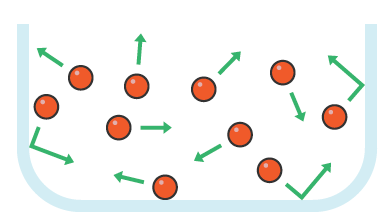
The molecules of a gas are in __________ _________ motion.
The ______________ of the gas is related to the average __________ energy of the molecules.
constant
random
temperature
kinetic
What does changing the temperature of a gas, held at constant volume do?
Changes the pressure exerted by the gas
As a gas gets hotter, what happens to the speed of the particles?
They move faster.
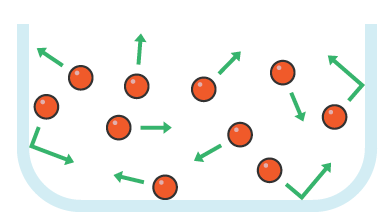
What is gas pressure caused by?
Moving particles continuously colliding with the walls of their container — they exert a force
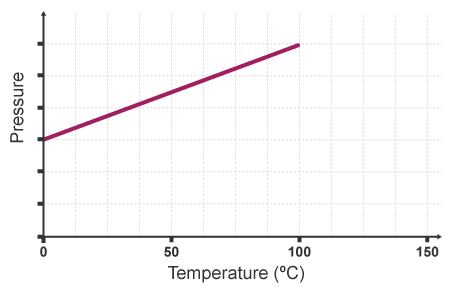
When you heat a gas (constant __________):
the particles gain _________ energy — move __________
They _________ with the container walls more frequently and with a greater _________ — results in a higher overall ______ __________
volume
kinetic
faster
collide
force
gas pressure
What can a gas be compressed or expanded by?
Pressure changes
A gas can be ____________ or ___________ by pressure changes.
The pressure produces a net force at _______ ________ (___________) to the wall of the gas container (or any surface).
compressed
expanded
right angles
perpendicular

When you increase the volume in which a gas is container (at constant temperature), what can it lead to?
Decrease in pressure
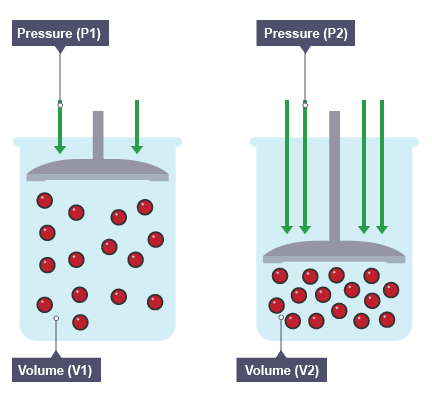
Explain how increasing the volume in which a gas is contained, at constant temperature, can lead to a decrease in pressure.
The gas particles spread out → more room to move
They have to travel further → hit walls of container less often
Fewer collisions = less overall force exerted on the walls → pressure decreases
![<ul><li><p>A student investigated how the pressure in a fixed mass of air varies with the volume of the air.</p></li><li><p><strong>Figure 1</strong> shows the equipment used.</p></li><li><p>When the plunger was pushed slowly into the syringe, the pressure in the syringe increased. </p></li><li><p>The temperature of the air remained constant. </p></li></ul><p>Explain why the pressure increased. [3 marks]</p>](https://assets.knowt.com/user-attachments/53639348-e9ac-4ae2-b9b1-1b483456bd20.png)
A student investigated how the pressure in a fixed mass of air varies with the volume of the air.
Figure 1 shows the equipment used.
When the plunger was pushed slowly into the syringe, the pressure in the syringe increased.
The temperature of the air remained constant.
Explain why the pressure increased. [3 marks]
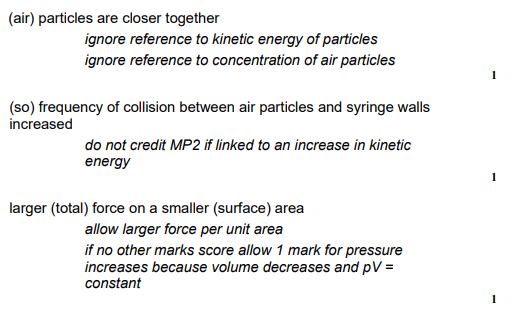
Air particles are closer together
So frequency of collisions between air particles and syringe walls increased
Larger total force on a smaller surface area
![<ul><li><p>A fire piston is a special type of syringe that can be used to start fires. </p></li><li><p><strong>Figure 2</strong> shows a fire piston.</p></li></ul><ul><li><p>The plunger is pushed quickly downwards and compresses the air. </p></li><li><p>When the air is compressed quickly, the temperature of the air increases.</p></li></ul><p>How does an increase in temperature affect the air particles inside the piston? [1 mark]</p>](https://assets.knowt.com/user-attachments/006a2366-0b46-4f6a-ada1-e62b812229e8.png)
A fire piston is a special type of syringe that can be used to start fires.
Figure 2 shows a fire piston.
The plunger is pushed quickly downwards and compresses the air.
When the air is compressed quickly, the temperature of the air increases.
How does an increase in temperature affect the air particles inside the piston? [1 mark]
The mean kinetic energy of the particles increases.
![<ul><li><p>The image shows air being pumped into a car tyre.</p></li></ul><p>Complete the sentence. [1 mark]</p><p>Air particles in the tyre move quickly in ___________________ directions.</p>](https://assets.knowt.com/user-attachments/106f8961-cff1-435f-9c43-68d8e873dca2.png)
The image shows air being pumped into a car tyre.
Complete the sentence. [1 mark]
Air particles in the tyre move quickly in ___________________ directions.
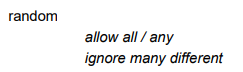
random
![<ul><li><p>The image shows air being pumped into a car tyre.</p></li><li><p>When the tyre is at the correct pressure, pumping more air into the tyre causes the pressure to increase further. </p></li><li><p>The volume and temperature of the air in the tyre do not change. </p></li></ul><p>Explain why the pressure increases as more air is pumped into the tyre. [2 marks]</p>](https://assets.knowt.com/user-attachments/0b6c5f1b-a490-463a-879d-e01ea4f3cf16.png)
The image shows air being pumped into a car tyre.
When the tyre is at the correct pressure, pumping more air into the tyre causes the pressure to increase further.
The volume and temperature of the air in the tyre do not change.
Explain why the pressure increases as more air is pumped into the tyre. [2 marks]
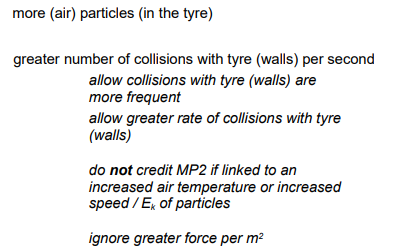
More air particles in the tyre
Collisions with tyre walls are more frequent
![<ul><li><p>The image shows air being pumped into a car tyre.</p></li><li><p>The air pressure in a car tyre changes if the temperature of the air in the tyre increases.</p></li></ul><p>Explain why. [4 marks]</p>](https://assets.knowt.com/user-attachments/9df282fe-ffc2-46b7-9487-8df3cf517da6.png)
The image shows air being pumped into a car tyre.
The air pressure in a car tyre changes if the temperature of the air in the tyre increases.
Explain why. [4 marks]
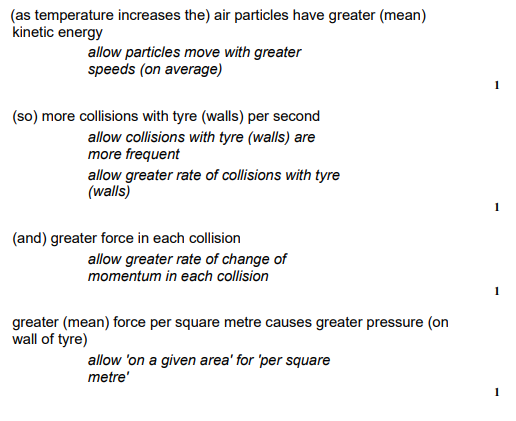
As the temperature increases — particles have a greater mean kinetic energy
Collisions with tyre walls are more frequent
Each collision has a greater force
Greater mean force per square metre causes greater pressure
What is the equation for a fixed mass of gas held at a constant temperature? State the units.
pressure × volume = constant
pV=constant
pressure — pascals (Pa)
volume — metres cubed (m³)
What is ‘work’?
The transfer of energy by a force.
What is the effect on a gas of doing work on a gas? (2)
Increases internal energy
Can cause an Increase in temperature
![<ul><li><p><strong>Figure 3</strong> shows a person using a bicycle pump to inflate a tyre.</p></li><li><p>The internal energy of the air increases as the tyre is inflated.</p></li></ul><p>Explain why. [2 marks]</p>](https://assets.knowt.com/user-attachments/312e76d3-21ab-456f-855e-e0283f9a9561.png)
Figure 3 shows a person using a bicycle pump to inflate a tyre.
The internal energy of the air increases as the tyre is inflated.
Explain why. [2 marks]
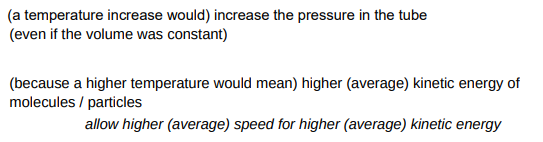
A temperature increase would increase the pressure in the tube.
Because higher temperature means higher kinetic energy of particles.
What is the equation for pressure? State the units.
pressure = force ÷ area
P=AF
pressure — pascals (Pa) or newtons per metre squared (N/m²)
force — newtons (N)
area — metres squared (m²)