Case Study Application (Final)
 Studied by 0 people
 Call Kai
 Learn
Learn Practice Test
 Spaced Repetition
 Match
Match Flashcards
 Knowt Play
1/12

There's no tags or description
Looks like no tags are added yet.
Name | Mastery | Learn | Test | Matching | Spaced |
|---|
No study sessions yet.
13 Terms
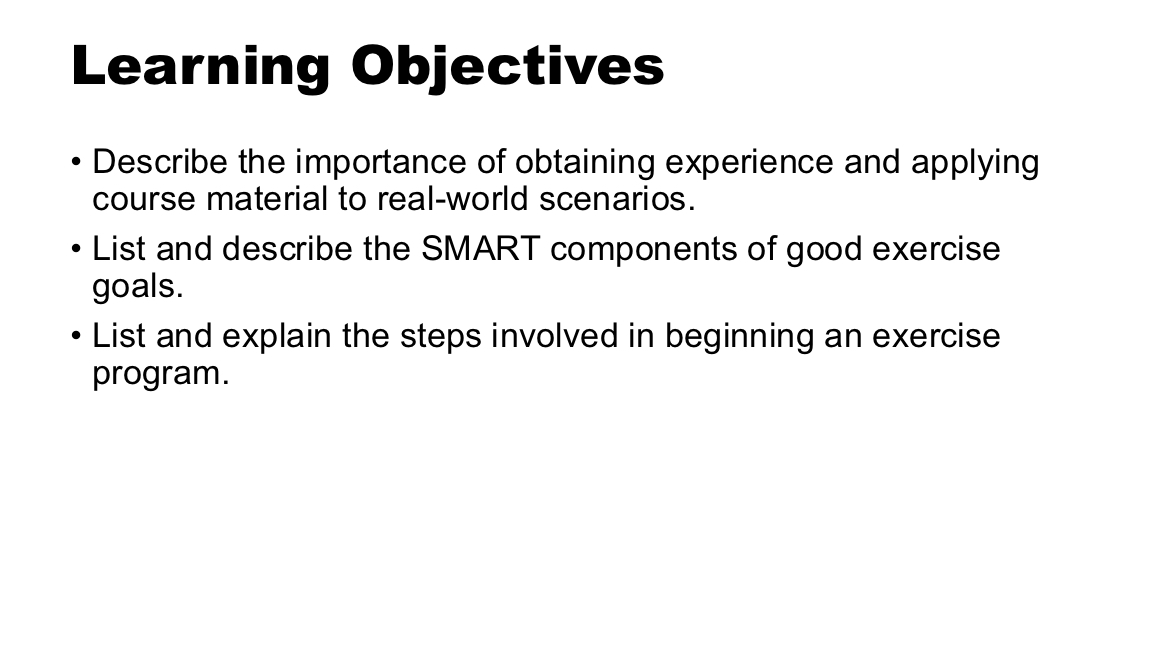
Learning objectives…
Participation in very little physical activity
Sedentary
A person’s ability to participate in physical activity, including basic daily tasks
Functional capacity
A disease in which bone density is reduced, increasing the risk of bone fracture
Osteoporosis
The details of an exercise program, including frequency, intensity, duration, and exercise mode
Exercise prescription
** Look at case study slides **
What are the first steps to ask before beginning a fitness program?
Is exercise safe for the individual?
Is there a need for medical clearance before beginning?
Before beginning a fitness program, it is important to assess the _____ and health-related _____ components
Current body parameters; physical fitness
What acronym should you follow when setting a fitness goal?
SMART goals
What does the acronym SMART stand for when it comes to setting goals?
S (pecific)- avoid general goals
M (easureable)- clearly defined and usually quantifiable
A (chievable)- challenging but within the individual’s physiological range
R (elevant)- important and meaningful to the individual
T (ime-bound)- specific goal date
What are the evidence-based principles of exercise prescription?
FITT-VP Principle (frequency, intensity, time, type, volume, progression)
What are the 3 sub-bullets for Client Screening and Assessment?
use health evaluation and personal interviews
Modifications
Motivational readiness
** these are directly linked to SMART goals **
What goes into a post-program reevaluation?
post assessment
Repeat baselines tests/assessments
Consider quantitative and qualitative data
Reevaluate goals
Revise as necessary