Chemical Oceanography Exam 1
 Call Kai
 Learn
Learn Practice Test
 Spaced Repetition
 Match
Match Flashcards
 Knowt Play
1/132

There's no tags or description
Looks like no tags are added yet.
Name | Mastery | Learn | Test | Matching | Spaced | Call with Kai | Chat |
|---|
No analytics yet
Send a link to your students to track their progress
133 Terms
Marcets Principle
Principle of constant proportions
Water can dissolve almost every solute on earth
Reaction Probability
The probability that the reaction will take place
Usually greater if somethings in the dissolve phase
Heat Capacity
How much energy is required for the temperature to change
Vertical distribution of elements in the water column (image)
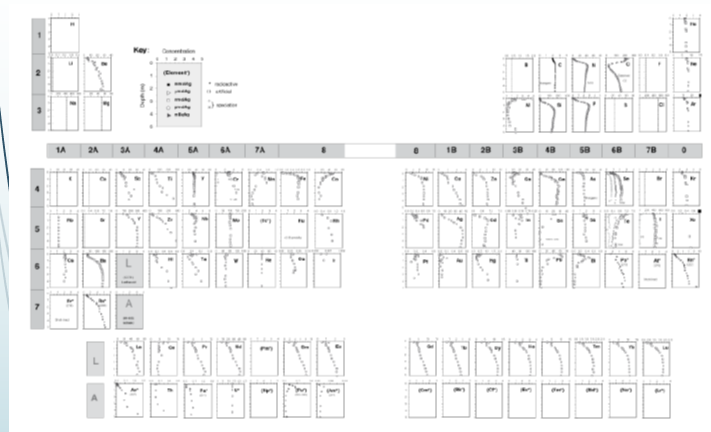
Concentration of Chemicals in Seawater
Cl, Na, Mg, SO4, Ca, K, HCO3, Br
(Know these!!!)

Global Satellite Image of Ocean Color
- Color of the water varies due to chlorophyll
- New maps are created on a daily basis
Chemical Cycling (Image)

Chemical Cycling
- Reservoirs
A place of temporary residence
Chemical Cycling
- Nitrogen → NO3- (Nitrate)
Used to make proteins and enzymes, also important for mRNA
Chemical Cycling
- Phosphorus - PO4^3-
Used for RNA + DNA and phospholipids
Chemical Cycling
- Silica - SO4(OH)4 (Silicate)
Used to make tests (exoskeletons)
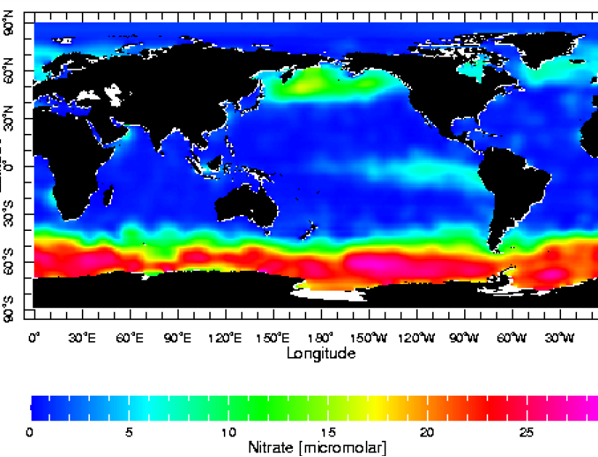
Global Nitrate Distribution (Image)
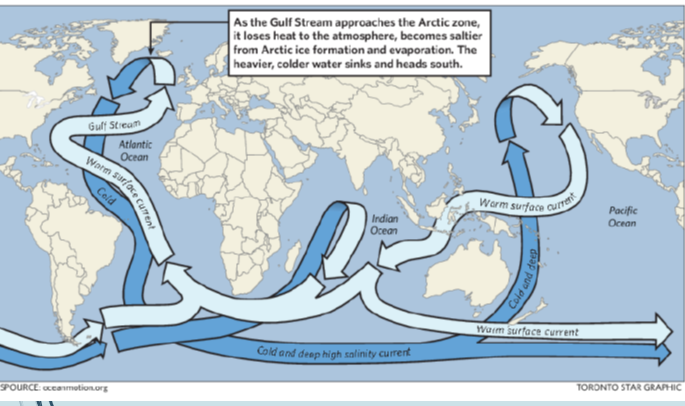
Ocean Circulation
Movement of water

The Oceans conveyor belt system
Movement of water around the world
Timescale of Ocean
Shows time and spacial variability

Timescale of Ocean
- Why care about temporal variability?
To see how things change over time or with seasons
Oceanic Processes
- This model depicts it like a factory
- Biochemical cycling
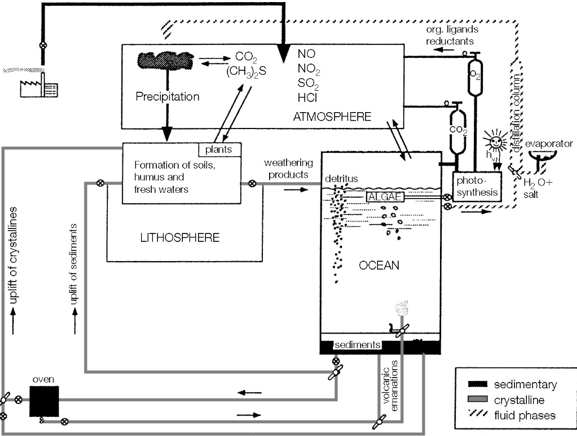
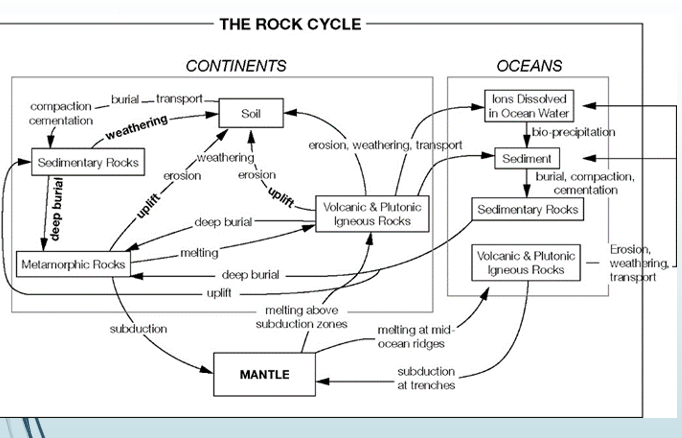
The Rock Cycle
This is a box model
Oceanic Processes - Human Impact
- Red = Human impact
- Humans have changes the steady-state environment
- 70 + 21.9 = 91.9 pg c/yr - input
- 70.6 + 20 = 90.0 pg c/yr - output

Residence Time =
Total amount of substance / total rate of supply or removal from a reservoir
Major Constituents
- 6 most abundant chemicals in ocean
- Long residence time
- Well mixed
- Not well chemically reactive
- Not important biologically
- Tend to be the same in all open oceans
Turnover time
- Similar to residence time but you look at specific processes to fill a reservoir
- Size of reservoir / specific process
IOOS
HOTS
Hawaii Ocean Time Series
IOOS
BATS
Bermuda Atlantic Time Series
- Been measuring data for centuries
- Away from human influence
IOOS
UNOLS
University National Oceanography Laboratory System
- Universities that work together for oceanography work
- Centered at the university of Washington
IOOS
GOOS
Global Ocean Observatory System
- Runs IOOS
IOOS
Integrated Ocean Observatory System
- Split into ocean and coastal
Hydrological Cycle (image)
(Learn how to read this)

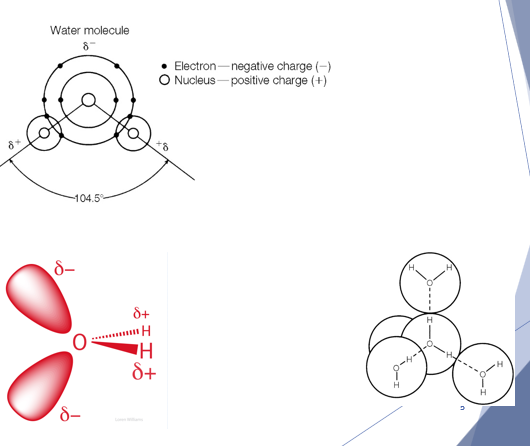
Water Molecules
- Polar Covalent Bonds
- One water molecule can have 4 others water molecules connected to it via hydrogen bonding
- Hydrogen bonds are weak
The phases of water
- Solid - ice
- Liquid - water
- Gas - vapor
- Density = mass/volume
- Hydrogen bonds push crystals apart when forming ice. This makes ice lighter (less dense) than water
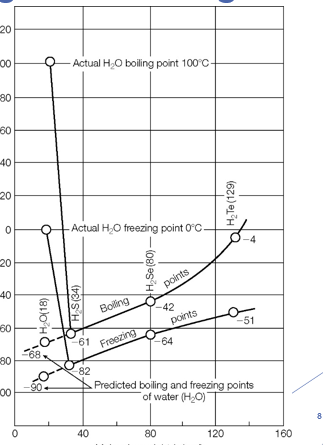
High boiling and freezing points
- Amount going into liquid state = amount going into gaseous state
- Amount going into solid state = amount going into liquid state
- H2O had different freezing and boiling points due to the energy used to create hydrogen bonds
High latent heats of vaporization and melting
- Latent heat of melting - amount of gram of ice turning into liquid. Energy needed/released to break hydrogen bonds (same for vaporization)
- Very important for storms

Heat Capacity
- How much heat can be absorbed per unit of temperature are increase
- Takes a lot of energy to get water to change temperature
- Heat goes into hydrogen bonds instead of warming up the water
Universal Solvent
- Dissolves lots of materials (virtually every solute on earth)
- NaCl (s) → Na+ (aq) + Cl- (aq)
- The positively charged hydrogen ions are attracted to negative charges and will form around the negative molecule in a hydrogen shell which prevents the negative ion from bonding to anything else
- Oxygen does the same to positively charged ions

Impacts of Salinity on physical properties of water
- If salinity is increased the freezing point goes down.
- Density increases with salinity

Residence time is defined as: The size of the _______ divided by the rate of _______ or ________
Reservoir, inflow, outflow
What has unusual properties because it forms _____ bonds with other water molecules
Hydrogen
Density is defined as the _____ per unit ______
Mass, volume
Hydrogen bonds between water molecules are due to the ______ covalent bonds with large dipole
Polar
Saltwater is _____ dense than pure water
more
What is in seawater (image)
What is in seawater
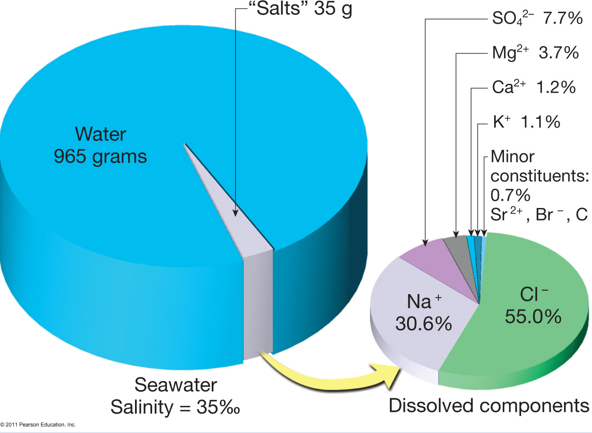
Major Ions
Cl- (55.0%)
NA+ (30.6%)
SO4^2- (7.7%)
Mg2+ (3.7%)
Ca2+ (1.2%)
K+ (1.1%)
- Unrestrictive
- Conservative ions
- Characteristics
- - Long residence time
- - “Constant Proportions”
What is in seawater
Minor Ions
Sr2+, Br-, C (0.7%)
- Reactive or used by organisms
- Short residence time
- Nonconservative ions
What is in seawater
Mass Flux
The amount of particles that move through a unit area in a unit of time
- Looks at what flows through an area

What is in seawater
Fick’s First Law
- The larger the concentration gradient the larger the flux
- Important for when two bodies of water meet
What is in seawater
Common non-major
TCO2, O2, Si, NO3-, Fe
What is in seawater
Dissolves particles
- 1nm or o.o1 um
- What passes through a filter
What is in seawater
Particulate material (suspended particle)
- > 1 um
- Not dissolved, solid floating particles
- What is retained on a filter
What is in seawater
Colloids
- In-between
- Can be organic or inorganic
- Most have a negative charge (metals have a positive charge so they are often attracted)
- Tangential Flow ultrafiltration
- Freon is a transient tracer - used to help track the movement of water
- Humic substances
- High cluster-organic material
What is salinity?
- How much (mass) of dissolved material is in the mass of seawater
- S (%) = g of dissolved ions / g of saltwater x 1000
- Usually no units or ppt
- Most ocean water lies between 33-37 ppt
How is salinity measured?
Refractometer
Index of refraction +-1% 35 ppt +- 3%
How is salinity measured?
Inductive salinometer
Measures conductivity of ions +-0.0001% 35 ppt +-0.003%
How is salinity measured?
Knudsen titration
Measured halides (Cl-, Br-, and I-)
How is salinity measured?
Chlorinity
The weight in grams (in vacuo) of the chlorides in one gram of seawater (in vacuo) when all the bromides and iodides have been replaced with chloride
- Salinity = 1.80655 x chlorinity
- Chlorine rarely interacts with organisms
- Not used often
Salinity sources and sinks (image)

Ratio of Constant Proportions Rule Breakers
- Marginal seas and estuaries
- Anoxic basins SO4^2- → S-
- Areas of sea ice formation or melting
- Areas of creation or dissolution of calcareous shells or coral skeletons
- Hydrothermal vents → Sources and Sinks
- Areas of evaporite formation/dissolution - rocks made from evaporation
- Sea spray
- Interstitial waters - water in sediments
Salinity is roughly defined as the mass of dissolved ______ per kilogram of _______
ions, seawater
The most accurate way to measure salinity is with a(n) _________
Inductive salinometer
The ratios of major ions in seawater are almost constant. This rule is called “The Principle of __________
Constant Proportions
What is a conservative property?
Any property that exhibits a behavior in which physical processes greatly exceed the effects of chemical or biological processes
Conservative tracers
- To look at movement of water
Core technique of mass water tracing

Advection
Water moves from A → B
Turbulent
A → B movement that is not linear
Diffusion vs. Turbulent Mixing
- Molecular diffusion - slow
- Turbulent mixing - fast
- Molecular diffusion happens in the water column and mixes things slowly

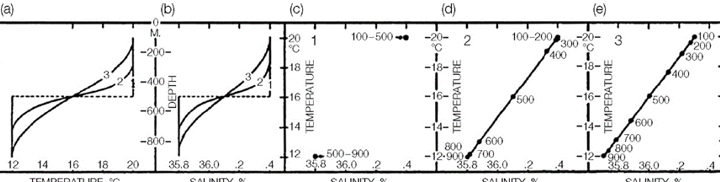
T-S Diagrams
Bend is a mixing point to another water body

Mixing of two water bodies
- Starts off as very distinct as no molecular diffusion has taken place
- Area of mixing is a thermocline - Temp
- Thermocline gets larger with time as more mixing occurs
- Area of mixing is a halocline - Salinity
- Eventually forms a straight line at the same angle
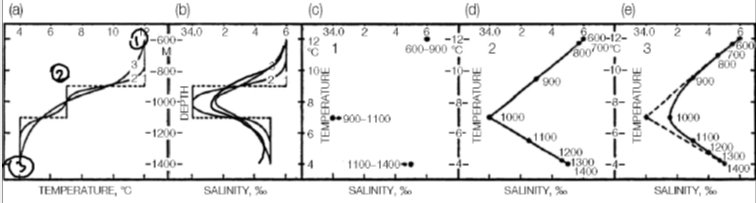
Mixing of 3 water bodies
- Small area of mixing
- For salinity at time 3 you lose some of it
- At time 2 you get a sharp angle, at time 3 you get a curve
- When you get the curve, you lose your conservative mixing
Meridional
- Along a meridian
- From latitude to latitude
- Transect

Latitude and Insolation
Insolation
Looking at the function of solar radiation at the earths surface/atmosphere

Latitude and Insolation
Insolation
- Angle
Influences insolation
- In the summer the _____ is more overhead
- In the winter we are at a larger ____
Latitude and Insolation
Insolation
- Atmosphere
Also effects insolation
- More gasses the sunlight has to go through
- Higher chance of it being reflected back
Latitude and Insolation
Insolation
- Latitude
is important for how much sunlight you’re getting
Seasonal changes
Soltis =
Extremes
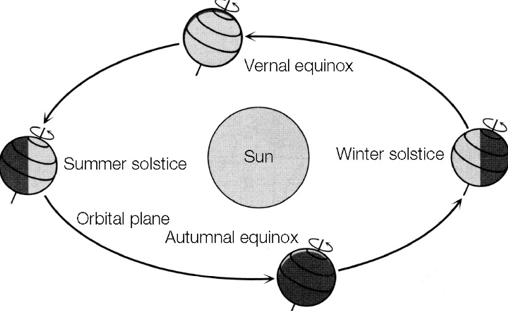
Seasonal changes
Summer Soltis
= June 21st - longest day

Seasonal changes
Winter Soltis
= December 21st - longest night

Seasonal changes
Autumnal equinox
= September 22nd - 23rd

Seasonal changes
Vernal equinox
= March 21st

Seasonal changes
- Temperature change
- Cloud coverage change
- Wind levels pick up
Variations with latitude and temperature
High latitudes
Are cold and there’s little to no change with depth - isothermal
Variations with latitude and temperature
Mid latitudes
Have a summer and winter line (seasonal thermocline) due to a temperature difference with seasons
Variations with latitude and temperature
Low latitudes
Have a thermocline as it’s warm year-round
Wind patterns
- Wind and ocean circulation are important for heat distribution
- Wind is responsible for ½ to ¾ of heat distribution
- Currents are responsible for ½ to ¼ of heat distribution
- Winds drive waves
- Longterm wind patterns create currents
- Along the equator is a permanent low pressure zone
- Air rises and then sinks in subtropical high
- Poles are high pressure

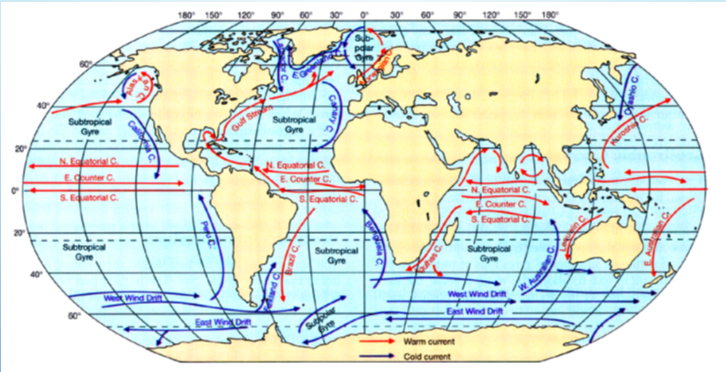
Surface Currents
- Follow wind patterns
- Determined by long-term wind patterns
E-P
- E = evaporation
- P = Precipitation

E - P = -x
Precipitation > Evaporation
- Salinity lower
- Equator, Rivers
E - P = x
Precipitation < Evaporation
- Salinity higher
- Middle of gyros
Salinity Profiles
Halocline
Rapid change in salinity

Salinity Profiles
Isohaline
No change in salinity
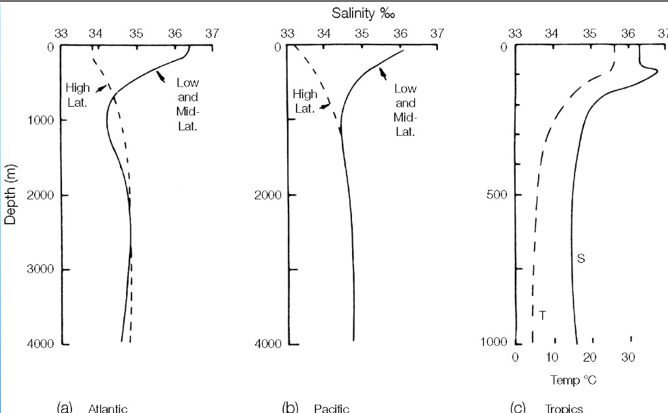
Depth of mixed layer
- More wind causes deeper mixing
- Less wind causes shallow mixing

Density Profiles
- Precipitation causes lower density
- Hotter water causes lower density
- Pycnocline = rapid change of density
- Isopycno = no change in density
- The book argues that temperature has more control over density, but experiments show that salinity has more of an impact on density
- Pycnoclines act as boarders for organisms
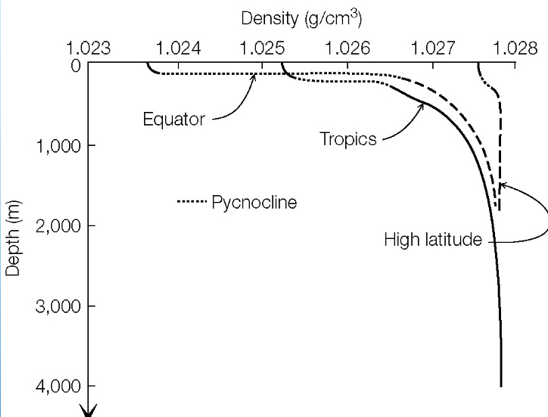
Layer of the ocean
- Mixed layer changes depth based on the wind
- Polar regions have more mixing

Major water masses
Each water mass has its own distinct salinity, temperature, and density values
Thermohaline circulation
- Density drive movement of this water throughout the ocean
- Deep water formation
- Deep water formation drives this circulation
- If the formation stops then deep water will have no oxygen

Biological Pump (image)

Diffusion
- Molecular diffusion
- Turbulent mixing
- Advection
- Bursting bubbles
- Ebullition

Mixing
- Molecular diffusion ~ 10^-5 cm2/sec
- Vertical turbulent mixing ~ o.1 cm2/sec
- Horizontal turbulent mixing 100-100,000,000 cm2/sec
- - Driven by currents
List the three properties of a water mass that are considered to be conservative
Salinity, temperature, density
Surface ocean _______ patterns are caused by variations in solar insolation
temperature
Surface ocean ______ patterns are caused by variations in the balance between evaporation and precipitation
Salinity
Mixing due to molecular diffusion is much ______ than turbulent mixing
slower