*Astrophysics
 Call Kai
 Learn
Learn Practice Test
 Spaced Repetition
 Match
Match Flashcards
 Knowt Play
1/77

Earn XP
Description and Tags
(Those viewing past 8th June 2026, all my flashcards made using mix of pmt detailed notes, pmt definitions and mark schemes from past papers (for niche parts of spec)
Name | Mastery | Learn | Test | Matching | Spaced | Call with Kai | Chat |
|---|
No analytics yet
Send a link to your students to track their progress
78 Terms
Absolute Magnitude (M)
The apparent magnitude that an object would have if it were placed at a distance of 10 parsecs away from Earth
Achromatic Doublet
A convex lens made of crown glass and a concave lens made of flint glass cemented together in order to focus all light rays in the same position
An achromatic doublet is a solution for spherical and chromatic aberration
Apparent Magnitude (m)
How bright an object appears in the sky
This depends on the object’s brightness and its distance from Earth
Arcsecond
A unit used to measure small angles
An arcsecond = 1/3600th of a degree
Astronomical Unit (AU)
The average distance between the centre of the Earth and the centre of the Sun
Big Bang Theory
The theory that the universe originated as a small, dense and hot region that expanded and cooled forming the structures in the universe we see today
Binary Star System
Two stars orbiting a common centre of mass
Black Body Radiator
A perfect emitter and absorber of all possible wavelengths of radiation
Black Hole
A region which has an escape velocity greater than the speed of light. Black holes are formed when the core of a giant star collapses
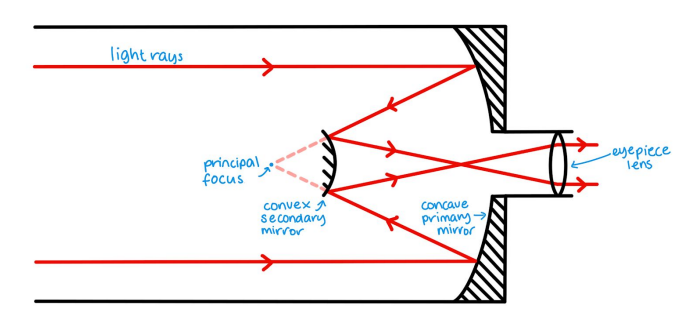
Cassegrain Reflecting Telescope
A reflecting telescope with a concave primary mirror and a small convex secondary mirror in the centre, with the eyepiece lens just behind the centre of the primary mirror
The mirrors in a reflecting telescope are actually a very thin (often less than 25nm thick) coating of aluminium or silver atoms that are deposited onto a backing material. This allows the mirrors to be as smooth as possible and minimises distortions in the image.
Charge-Coupled Device (CCD)
An array of light-sensitive pixels which become charged when they are exposed to light (by the photoelectric effect)
Chromatic Aberration
An effect caused by the different focal lengths of different wavelengths of light that leads to different colours being focused at different points
This can cause a white object to appear as if it has coloured edges
Collecting Power
A measure of the ability of a lens or mirror to collect incident EM radiation
Collecting power is directly proportional to the area of the objective lens/primary mirror
Concave/Diverging Lens
A lens which spreads out incident light – the light rays diverge
Convex/Converging Lens
A lens which focuses incident light – the light rays converge
Cosmological Microwave Background Radiation (CMBR)
After the big bang the hot dense state of the universe was full of photons which interacted with the matter in the universe
At a certain time this interaction stopped due to the lower temperature of the universe and these photons were allowed to propagate freely, at this point these photons were gamma rays
At present the universe has expanded, red shifting these photons so that they are microwaves
Doppler Effect
The apparent change in the wavelength of a wave as the source moves relative to an observer
For a source moving away the wavelength increases (red shift), for a source moving towards the observer the wavelength decreases (blue shift)
Eclipsing Binaries
A binary star system in which the stars’ plane of orbit is in the line of sight of the Earth
This means that the stars will appear to cross over each other as they orbit
Event Horizon
The boundary of a black hole, along which the escape velocity is equal to the speed of light
Exoplanet
Planets that are not part of our solar system and orbit other stars. They are often difficult to detect due to the light of their host star obscuring them
Eyepiece Lens
The lens in a telescope that magnifies the image produced by the objective lens
It produces a virtual image at infinity (since the light rays are parallel) in order to reduce eye strain for the user as they do not have to refocus every time they look between the telescope image and the object in the sky
Focal Length (f)
The distance between the centre of the lens and the principal focus
Hipparcos Scale
A way of classifying astronomical objects by their apparent magnitude
The brightest stars have an apparent magnitude of 1 and the faintest visible stars have an apparent magnitude of 6
The intensity of a magnitude 1 star is 100 times greater than a magnitude 6 star so the scale is logarithmic
Hubble’s Law
The speed of a galaxy moving away from ours is proportional to its distance away from us
The constant of proportionality is Hubble’s constant
Hydrogen Balmer Spectrum
A spectrum formed from the excitation of hydrogen atoms from the n=2 level
The prominence of the Balmer lines from a star can give an indication of the star’s temperature and state of the hydrogen within it
Intensity
The power received from a star per unit area
Lens Power
A measure of how closely a lens can focus a beam that is parallel to the principal axis (i.e. how long the focal length is)
The shorter the focal length, the more powerful the lens
Light Year (ly)
The distance that an electromagnetic wave travels in a year in a vacuum
Long-Lived Gamma Ray Burst
Bursts of gamma radiation that last anywhere between 10 and 1000 seconds
These are thought to be associated with a type II supernova (the death of a massive star)
Luminosity
The rate of light energy released by a star
This is the same as the power output of a star
Magnifying Power/Angular Magnification (M)
The ratio of the angle made by the image from the eyepiece to the angle made by the object with the unaided eye
Main Sequence Star
The equilibrium stage of a star’s life cycle, where the inward gravitational forces balance the outward forces caused by fusion
In this stage, hydrogen nuclei fuse to form helium
Neutron Star
An incredibly dense star that is formed when the core of a large star collapses
Protons and electrons are forced together under gravity to form neutrons
Normal Adjustment
When the distance between the objective and eyepiece lenses in a refracting telescope is equal to the sum of their focal lengths (fo + fe)
This means the principal focus (F) for these two lenses is in the same place
Objective Lens
The lens in a telescope that collects light and creates a real image of a very distant object. Objective lenses should have long focal lengths and be large in order to collect as much light as possible
The collecting power of a telescope is directly proportional to the square of the radius of the objective lens
Parallax
The apparent change of position of a nearer star in comparison to distant stars in the background
This happens as a result of the Earth’s orbit around the sun
Parsec (pc)
The distance at which the angle of parallax is 1 arcsecond
Primary Mirror
The mirror equivalent of an objective lens
The primary mirror collects light and focuses it onto a secondary mirror in a reflecting telescope
Principal Axis
The line passing through the centre of the lens, perpendicular to its surface
Principal Focus (F)
In a converging lens: the point where incident rays travelling parallel to the principal axis will converge
In a diverging lens: the point from which the light rays appear to come
Protostar
A young star formed when clouds of gas and dust are pulled together under gravity
Protostars are surrounded by a circumstellar disc, and when the centre becomes hot enough, the star will begin to fuse elements
Quantum Efficiency
The percentage of photons incident on a CCD which causes an electron to be released
Quasar
Active galactic nuclei – supermassive black holes surrounded by a disc of matter, which, as it falls into the black hole, causes jets of radiation to be emitted from the poles
Quasars display very large red shift, indicating they are very far away
The power output of a quasar is around that of an entire galaxy
Radial Velocity Method
A method of detecting exoplanets
It involves the observation of the host star’s line spectrum
If it is blue-shifted when it moves towards the Earth and red-shifted when it moves towards the Earth, it suggests that the star is ‘wobbling’ and so there must be a mass (exoplanet) exerting a gravitational force on it
Rayleigh Criterion
This states that two objects will not be resolved if any part of the central maximum of either of the images falls within the first minimum diffraction ring of the other
Real Image
Formed when light rays cross after being refracted by a lens
Real images can be projected onto a screen
Red Giant
A stage in the life cycle of a star less than 3 solar masses, in which the hydrogen has run out and the temperature of the star increases
Helium nuclei fuse to form heavier elements
Red Shift (z)
The shifting of an object’s wavelength towards the red end of the spectrum due to the object moving away from the Earth (Doppler effect)
Red shift is evidence for the expansion of the universe
The more distant the object, the greater its red shift
Red Supergiant
For massive stars that are greater than 3 solar masses, when the hydrogen runs out, instead of transitioning into a red giant, the star will transition into a red supergiant (same processes as a red giant but on a larger scale)
The temperature increases and fusion up to iron can occur
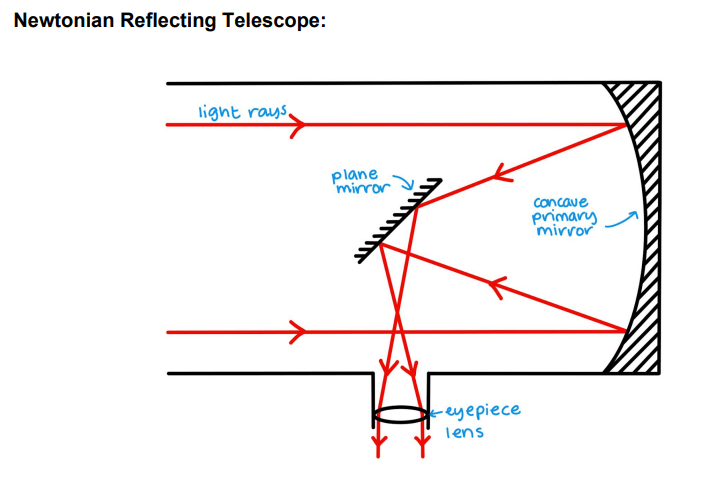
Reflecting Telescope
A telescope which uses mirrors to focus incident light onto an eyepiece lens
Refracting Telescope
A telescope which uses lenses to focus incident light
Resolving Power
The ability of a telescope to produce separate images of close-together objects
Schwarzschild Radius (RS)
The name given to the radius of a black hole’s Event Horizon
Short-Lived Gamma Ray Burst
Short bursts of gamma radiation that last anywhere between 0.01 and 1 second
These are thought to be associated with merging neutron stars (forming a black hole) or a neutron star falling into a black hole
Spectroscopic Binaries
A binary star system in which the stars are too close together to be resolved by a telescope
The Doppler shifts of the light from the stars as they move towards or away from the Earth are used to detect these binary systems
Spherical Aberration
An effect caused by the curvature of a lens or mirror that can lead to light rays at the edges to be focused in different places to those from the centre
This can cause an image to be blurry or distorted
Stefan’s Law
A law stating that the power output (luminosity) of a star is directly proportional to its surface area and its absolute temperature to the 4th power
Supernova
When a star greater than 1.4 solar masses dies, the core collapses rapidly inward and becomes rigid
The outer layers then fall inward and rebound off of the core in a shockwave, causing heavy elements to be fused and distributed into space
Transit Method
A method of detecting exoplanets
It involves the monitoring of the host star’s light intensity
If a planet crosses in front of it, the intensity will dip
Timings and other data can be combined to determine information about the size and speed of the exoplanet
Type I Supernova
The consequence of a star in a binary system accumulating matter from its companion star
When the star reaches critical mass, it will explode
Type Ia Supernova
A consequence of a white dwarf star exploding
They can be used as a standard candle since they always reach the same maximum absolute magnitude (-19.3)
Type II Supernova
The consequence of a high mass star dying when it runs out of fuel
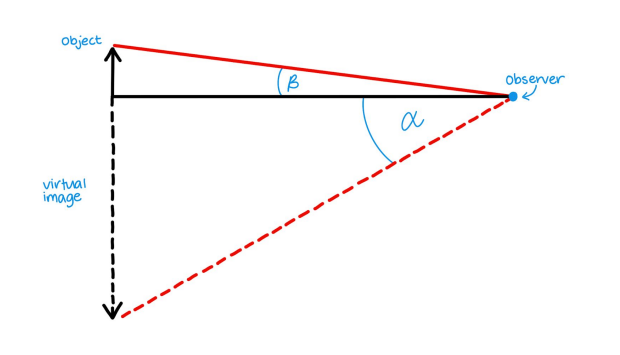
Virtual Image
Formed on the same side of the lens as the object
The light rays do not cross after refraction, so the image cannot be projected onto a screen
White Dwarf
A stage in the life cycle of a small star (less than 1.4 solar masses) that occurs when all the fuel has been used up
The star contracts since there is no longer an outwards force caused by fusion
Wien’s Displacement Law
A law stating that the peak wavelength of emitted radiation is inversely proportional to its absolute temperature
Lens formula
1/u + 1/v = 1/f
u - distance of object from centre of lens
v - distance of image from centre of lens
f - focal length of the lens
Power of lens equation
P = 1/u + 1/v = 1/f
Power is measured in Dioptres (D)
The shorter the focal length, the more powerful the lens
In converging lenses this value is positive and in diverging lenses this value is negative.
Ray diagram for a refracting telescope in normal adjustment
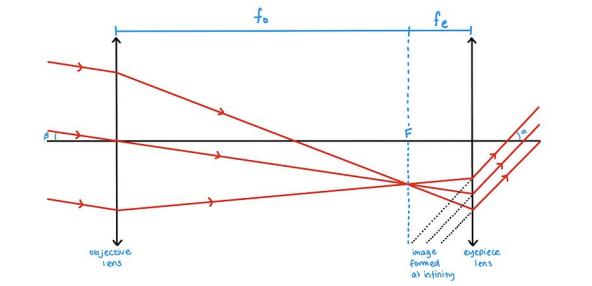
When α and β are < 10⁰, then
M = α/β = fo/fe