4.3 - Orbits and The Wider Universe
 Call Kai
 Learn
Learn Practice Test
 Spaced Repetition
 Match
Match Flashcards
 Knowt Play
1/17

There's no tags or description
Looks like no tags are added yet.
Name | Mastery | Learn | Test | Matching | Spaced | Call with Kai |
|---|
No analytics yet
Send a link to your students to track their progress
18 Terms
Kepler’s First Law of Planetary Motion
Each planet moves in an ellipse with the Sun at one focus
Kepler’s second law of planetary motion
The line joining a planet to the centre of the Sun sweeps out equal areas in equal times
Kepler’s third law of planetary motion
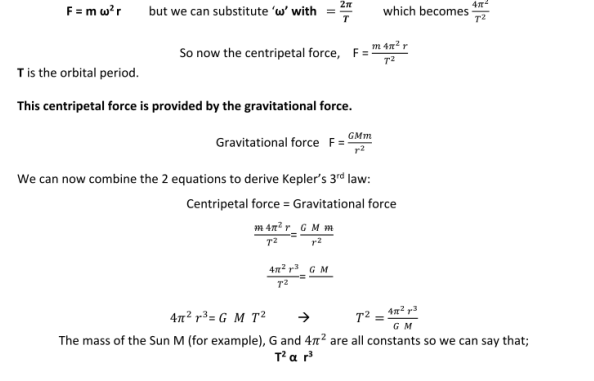
T2 , the square of the period of the planet’s motion, is proportional to r3 , in which r is the semi-major axis of its ellipse. [For orbits which are nearly circular, r may be taken as the mean distance of the planet from the Sun.]
Derivation of Kepler’s 3rd Law
Equation for location of centre of mass
r1 = (M2/M1 + M2)d
Equation for orbital period
T = 2π√(d3/G(M1+M2)
Approximation of masses in circular orbits
M1 » M2
M1 + M2 = M1
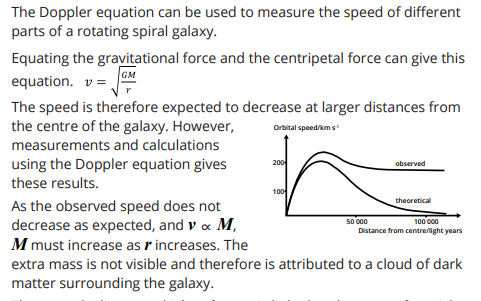
Dark matter
Matter which we can’t see, or detect by any sort of radiation, but whose existence we infer from its gravitational effects
Discovery made based on orbital speeds of objects in spiral galaxies
Implies the existence of dark matter
Explain the Doppler Effect
Observing the spectra of stars revealed that the wavelength of spectral lines changes. This due to the apparent motion of the object. The velocity of this motion can therefore be calculated using the equation; Δλ/λ = v/c
Doppler Effect equation
Δλ/λ = v/c
v = radial velocity (ms-1)
c = speed of light (3×10⁸ ms-1)
Δλ = observed (shifted) wavelength (m)
λ = emitted (unshifted) wavelength (m0
Radial velocity of a star
The component of a star’s velocity along the line joining it and an observer on the Earth
Use of the graph of velocity to determine mass
Galactic radial velocity
The mean component of a galaxy’s velocity along the line joining it and an observer on Earth
How Hubble’s constant is determine
Measurements of the radial velocity of galaxies plotted against the distance to the galaxy gave a straight line
v ∝D the gradient of the line, the proportionality constant is the Hubble’s constant
How 1/H0 approximates the age of the universe
The radial velocity has been approximately constant since the begining of the universe so that D=vT
Hence, v = H0 x vt and = 1/H0
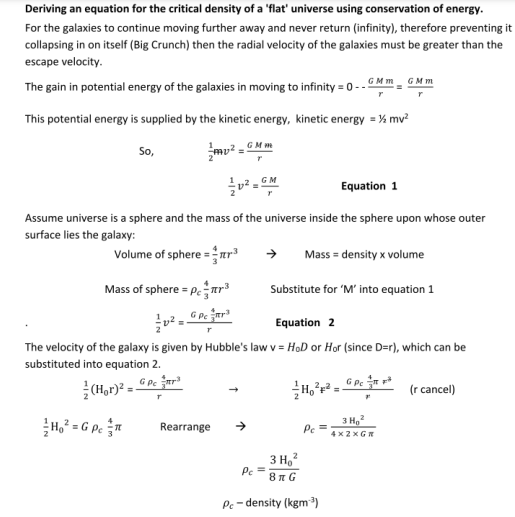
Derivation of critical density of a ‘flat’ universe