BIOL 108 Neil Harris Slides 1-3
 Call Kai
 Learn
Learn Practice Test
 Spaced Repetition
 Match
Match Flashcards
 Knowt Play
1/80

There's no tags or description
Looks like no tags are added yet.
Name | Mastery | Learn | Test | Matching | Spaced | Call with Kai | Chat |
|---|
No analytics yet
Send a link to your students to track their progress
81 Terms
What IS biological diversity
Biological Diversity refers to the VARIETY of life on Earth. In all forms (plants, animals, fungi, and microorganisms)
What is a population?
a group of individuals belonging to the same species that live in the same area and interbreed to produce fertile offspring
Genetic Diversity
Genetic Variation found within the population of a SINGLE species.
Species Diversity
refers to the variety of different species present within a particular region or habitat. Used for measuring biodiversity!
Ecosystem Diversity
refers to the variety of different habitats and ecological interactions
Provisioning Service
are the physical products that humans obtain from nature. These include food, water, medicines, and raw materials.
Regulating Services
are benefits humans receive from ecosystems that go beyond physical products. These include climate regulation, water purification, air purification, pollination, and pest control.
Supporting Services
are ecosystem services that are essential for the continued functioning and viability of the biosphere. Examples include oxygen production, CO₂ absorption, and the cycling of biomass, nutrients, and water.
Cultural Services
Cultural services are the non-material benefits people receive from nature and ecosystems. These include recreational activities, aesthetic experiences, and spiritual experiences.
Extinction
occurs when an entire species is lost and no living individuals remain anywhere on Earth.
Extant species
one that is currently living and has not gone extinct.
Extirpation
occurs when a species disappears from a specific geographic area but continues to exist somewhere else.
Endangered species
A species whose numbers are so small that the species is at risk of extinction
Threatened Species
A species that could become endangered in the near future
Habitat Loss
the greatest threat to biodiversity. Human-caused habitat destruction is estimated to endanger over 80% of species, and in almost all cases, habitat loss and fragmentation reduce biodiversity.
Introduced Species
species moved by humans to new geographic areas, either intentionally or accidentally
Invasive Species
is an introduced species that causes harm to the environment, economy, or society.
Overexploitation
Occurs when plants or animals are harvested at unsustainable rates. When organisms are removed faster than populations can recover
Taxonomy
The scientific discipline concerned with naming and classifying organisms.
Nomenclature
The system of rules used for naming things.
Carl Linnaeus
Binomial nomenclature
A two-part system used to give each species a unique scientific name.
Structure for BN?
Genus + specific epithet
Ex. Homo Sapiens
Naming Rules for BN
The genus is capitalized.
The entire scientific name is italicized.
Specific epithets can be reused in different genera.
The combination of genus + specific epithet identifies the species.
Genera
plural of genus
Hierarchical Classification
Domain
Kingdom
Phylum
Class
Order
Family
Genus
Species
Domain: Broadest major rank
Species: Most specific major rank
Taxon
(plural: taxa): A classification group at any level of the hierarchy.
Does hierarchical classification have anything to do with evolution
Hierarchical classification does NOT necessarily show true evolutionary relationships.
Bacteria
Prokaryotic (single-celled) organisms. Do not have a nucleus
Archaea
Prokaryotic organisms
Distinct from bacteria despite both being prokaryotes
Eukarya
Includes various groups of protists, many of which are single-celled.
Also includes the multicellular
SystematicsSystematics
The theory and practice of classifying organisms according to their evolutionary history (phylogeny).
Phylogeny
Evolutionary history of a species
phylogenetic tree
represents evolutionary relationships among both living and extinct organisms.
Phlyo
Tribe/Group (greek word)
Morphological Data (used to determine phylogenies)
Physical characteristics of organisms.
Molecular Data (used to determine phylogenies)
DNA sequences
RNA sequences
Protein structures/sequences
Molecular systematics
The use of molecular information to determine evolutionary relationships.
phylogeny tips
extinct or extant species
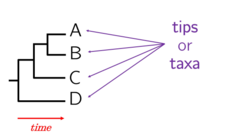
node of phylogenetic tree
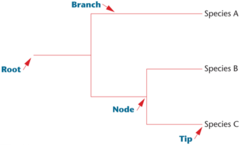
the last common ancestor shared by organisms above this point on tree

Dichotomous branching
meaning that a branch divides into two descendant lineages. These branch points represent divergence events, such as speciation
Internal branches
connect two nodes

External Branches
connect a tip and a nwhile external branches connect a node to a tip representing a descendant taxon.ode
Root (phylogeny)
common ancestor of all organisms in the tree
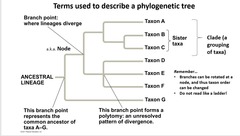
Sister Taxa
Groups of organisms that share an immediate common ancestor and hence are each other's closest relatives.

Basal Taxon
diverges early in the history of a group and originates near the common ancestor of the group

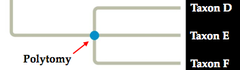
Polytomy
a branch point from which more than two descendant groups emerge, ndicate that the exact pattern of divergence has not been resolved.
Clade (phylogeny)
a group of organisms believed to have evolved from a common ancestor, according to the principles of cladistics.}
Smaller clades can be in bigger clades (this i called being nested)
A single external branch can...
sometimes represent an entire clade because the tip of a branch may represent a group of taxa rather than just one organism. For easier interpretation, large clades are sometimes shown as collapsed or pruned sections of a phylogenetic tree
Cladogram
hows evolutionary relationships based only on the branching pattern, or topology, of the tree.
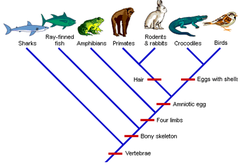
Topology (phylogeny)
refers strictly to the branching structure or shape of an evolutionary tree.
In Cladograms...
The lengths of the branches and the positions do not provide information. SO they can be rotated about.
Cladograms can..
show relative timing between nodes only when the nodes are located on the same path from the root
Phylogram
also represents evolutionary relationships, but its branch lengths contain information.
In phylograms branch length can..
can represent the number of evolutionary changes, such as morphological or genetic changes, that occurred along a lineage. The evolutionary difference between two taxa can therefore be determined by adding the branch lengths between their common ancestor and the taxa.
In phylos..
Two taxa that share a more recent common ancestor are more closely related than taxa whose most recent common ancestor lived further in the past
Second reason for polytomy
result from rapid speciation, where several speciation events occurred at approximately the same time.
Ingroup
the group of taxa whose evolutionary relationships are being studied. For example, a study could use multiple species of pigeons and doves from the genus Columba as its ingroup.
outgroup
p consists of one or more taxa that are related to the ingroup but diverged earlier.
What do outgroups do?
acts as a reference point that helps scientists determine which traits are ancestral and which are derived within the ingroup.
Character
is an anatomical, physiological, or molecular feature that can be used to compare taxa. Examples include DNA sequences, the number of flower petals, and bone structures.
Character state
is the particular variation of a character observed in an organism.
For example, eye colour is the character, while "orange" would be a character state
Homology
is similarity between organisms caused by shared ancestry.
(homologous traits)
Analogy
is similarity caused by convergent evolution.
convergent evolution
Convergent evolution occurs when unrelated organisms independently evolve similar traits because they experience similar environmental conditions and selective pressures.
NOT INHERITED FROM COMMON ANCESTORS
synapomorphy
is a trait that evolved in the MRCA of a clade and is unique to that clade compared with more distant ancestors.
symplesiomorphy
is an ancestral trait that is shared by members of a clade but was already present in ancestors that existed before the clade's MRCA.
monophyletic group
contains a common ancestor and all of its descendants, with no unrelated organisms included.
Like a Clade.
paraphyletic group
contains a common ancestor but does not include all of that ancestor's descendants.
polyphyletic group
contains organisms that are distantly related but does not contain the common ancestor of all the members.
apomorphy
derived trait
plesiomorphy
an ancestral character
Maximum parsimony
A principle that states that when considering multiple explanations for an observation, one should first investigate the simplest explanation that is consistent with the facts.
Maximum likelihood
instead considers the statistical probability of particular evolutionary changes, such as genetic mutations.
Speciation
Speciation is the process where one lineage splits into two or more separate species. It happens when populations experience a barrier to gene flow
Allopatric Speciation
The formation of new species in populations that are geographically isolated from one another.
sympatric speciation
The formation of a new species as a result of a genetic change that produces a reproductive barrier between the changed population (mutants) and the parent population. No geographic barrier is present.
Mutations
a random error in gene replication that leads to a change
Gene Flow
Gene flow occurs when individuals move between populations and reproduce in the new population.
Sexual Selection
Sexual selection occurs when traits that increase reproductive success become more common.
Selection
A trait can be advantageous, disadvantageous, or neutral. If a trait increases an organism's ability to survive and/or reproduce, it is selected for.