Developmental Psych Exam 1
 Call Kai
 Learn
Learn Practice Test
 Spaced Repetition
 Match
Match Flashcards
 Knowt Play
1/127

There's no tags or description
Looks like no tags are added yet.
Name | Mastery | Learn | Test | Matching | Spaced | Call with Kai | Chat |
|---|
No analytics yet
Send a link to your students to track their progress
128 Terms
Pre-formationism
Medieval 6th to 15th Centuries
Children treated as miniature adults
Childhood recognized as unique phase of life
John Locke
Empiricist
All things must be learned
Newborns are a tabula rasa
Latin words for “blank slate”
Jean-Jacques Rousseau
Children are born innocent, innately good
Les sauvages nobles (noble savages)
They don’t know anything about culture, but they are born with good intentions
We must nurture these tendencies
G. Stanley Hall
“Father” of Developmental Psychology
Founder of the American Psychological Association
Was fond of ORP, applied it to moral development in childhood and adolescence
Since we have only recently in our history become “moral creatures,” we should wait until late in development to begin moral education
Bad idea
Continuous vs. Discontinuity (stage) development
Continuity: development occurs steadily and gradually
Developmental change is quantitative
Discontinuity: development occurs in discrete stage
Developmental change is qualitative
Nature vs. Nurture
Nature: biological factors — i.e. genetics — are the most important determinants of developmental outcomes
Nurture: Environmental and experiential factors are the most important determinants of development — family, schools, peers, etc.
Probably not an either/or question…
One Developmental Path vs. Many
One Path: proscribed, universal pattern followed by all typical members of the species
Many Paths: start and endpoints may be defined, but multiple ways to get there
Ivan Pavlov
known for his discovery of classical conditioning through his experiments with dogs
B.F. Skinner
Behavior of Organisms (1938)
known for his discovery of operant conditioning
Albert Bandura
developed the social learning theory
famous Bodo Doll Studies
Child is taken into a room to watch a TV. either they watch the child play nicely with a bobo doll, play meanly with a bobo doll, or a control where they watched something completely unrelated
The kids who watched the violent play showed more violent behavior
The kids who watched the nice play showed less violent behavior
classical conditioning
Very basic form of learning
Always dependent on the prior existence of a reflex or automatic response
What happens after the response?
Behaviors do not occur in a vacuum
Behaviors have consequences
You can do the same thing with a child!
Ex: blow a puff of air into a child’s eyes after the sound of the bell, causing them to blink. After a while, the sound of the bell will cause the child to blink
operant conditioning
Consequences can influence the likelihood that a response will occur again
Two basic types of consequences:
reinforcement
punishment
Ex: Child has to do chores
Reinforcement: sweet treat
Punishment: grounding, time out, spanking, etc.
reinforcement
Any consequence that makes the preceding response more likely to occur again
Makes preceding behavior more likely to occur again
Positive (+) reinforcement: Presentation of a desirable stimulus following the response
Negative (-) reinforcement: Removal of an aversive or undesirable stimulus following the response
NEGATIVE REINFORCEMENT IS NOT PUNISHMENT
Ex: don’t have to do chore
punishment
Any consequence that makes the preceding responses less likely to occur again
social learning theory
Learning in the absence of reinforcement
Children can learn via simple process of
Observation
Imitation
Bandura’s famous Bodo Doll Studies
imitation
the process where a person observes and copies the actions, movements, or words of another individual
observation
the process of acquiring new behaviors and skills by watching a “model” perform them and noting the results
vicarious reinforcement
the process of learning or changing a behavior after watching another person (a model) receive a reward for that action
bobo doll study
Sigmund Freud
created the psychodynamic theories
best known for his system of therapy called psychoanalysis but worked with adults
Erik Erikson
made two major deviations from freud
Two major deviations from Freud
Turn focus away from internal, sexual urges to external, social issues
Life span theory: 8 Psychosocial stages extend into and through adulthood
Fredian Theory
Three main aspects of his theory
Structure of Personality
Id, ego, superego
Topography of Personality
Conscious/Unconscious thought
Development of Personality
Psychosexual Stages
Where does personality come from?
Freud developed this list by assigning each stage to a sector of the body that gets “pleasure” at that point
id, ego, and superego
three parts of Sigmund Freud's structural model of the human psyche that work together to shape human personality and behavior
psychosexual stages
Oral - 1st Year of Life
Anal - 1-3 Years
Phallic - 3-5 Years
Latency - 5 to Puberty
Genital - Puberty and onward
Oral
1st Year of Life
Putting anything and everything in their mouth
Attachment
To baby and his/her mother
To any caretaker/multiple care taker
anal
1-3 Years
Toilet training
According to Freud, pleasure is coming from the holding and release
phallic
3-5 Years
Sex typing
Child learns whether they are a boy or a girl and then begins to act with the cultural norms of that association
Oedipus complex - male child wants moms love but competes with dad, so he becomes more like dad
latency
5 to Puberty
Quiet period
genital
Puberty and onward
Adult personality
Erikson’s psychosocial stages
Infancy: Basic trust vs. Mistrust
Toddler: Autonomy vs. Shame and Doubt
Early Childhood: Initiative vs. Guilt
Middle Childhood: Industry vs. Inferiority
Adolescence: Identity vs. Identity Confusion
Early Adult: Intimacy vs. Isolation
Middle Adult: Generativity vs. Stagnation
Late Adult: Integrity vs. Despair
Jean Piaget
a pioneer in developmental child psychology
His theory outlines four stages of cognitive development
stages of cognitive development
Sensorimotor Stage (0-2)
Preoperational Stage (2-6)
Concrete Operations Stage (6-12)
Formal Operations Stage (12+)
Sensorimotor Stage
First two years of life
Knowledge = perception and action
A child knows about things only when they are actively involved with object/activity/etc.
Ex: thumb sucking. reflex is to suck nipple but one day finds its thumb and enjoys the sensation
Gradual movement away from this
Object permanence tasks
A not B error
Preoperational Stage
2-6
Child has symbolic representation
Child CANT operate logically on those symbols
ex: If you pour the exact same amount of juice from a short, wide cup into a tall, thin cup, a preoperational child will say the tall cup has "more juice" because it looks fuller.
Thus the preschool child’s thought is characterized by
Lack of logical problem solving
E.g. the conservation task
Egocentrism
Inability to take another’s perspective
Believe everyone shares their own point of view
Concrete Operation Stage
6-12
Child can now operate logically on mental representations
Can only do so for concrete, real, tangible problems and situations
ex: understands that flattening a ball of clay into a pancake does not change the total amount
Has problems with abstract concepts and abstract reasoning
Formal Operations Stage
12+
Fully formed adult logical abilities
Logical operations are mental structures that can be applied to any content
Scientific reasoning
Abstract reasoning
ex. trolley problem
schemes
basic unit of knowledge
assimilation
using what you already know and fitting it into the environmental demand
Fitting new information/problems/etc. into existing cognitive structures
accommodation
learning what to do with the new environmental demand
Modifying cognitive structures in response to new information/problems/etc.
equilibration
mental structures move toward a state of balance, or equilibrium
balancing old knowledge with new information
Zone of Proximal Development
One of Vygotsky’s most important concepts
Not all conflict produces change, rather there is an optimal degree of conflict
Defined as: difference in performance on a task alone and performed on the same task when assisted by a more competent other
This “zone” is where effective instruction and social interaction can occur
conflict (Vygotsky’s Sociocultural Theory)
the root of all change — social, developmental, etc.
Children are confronted with conflict during social interaction with more competent others
Culture and its “tools” are transmitted to children during social interaction
Allows for multiple developmental trajectories
Distinct paths for different skills
No strong stage claims
Places cognitive development squarely within social contexts
Charles Darwin & Konrad Lorenz
Charles Darwin laid the foundational evolutionary framework for ethology, while Konrad Lorenz helped establish it as a formal biological discipline by focusing on innate behaviors and imprinting
adaptive significance
promotion of survival and therefore reproduction
imprinting
(Lorenz)
Baby waterfowl follow their mother to the water
Adaptive
Only happens during a specific time period
critical/sensitive periods
Developmental period during which the organism is most susceptible to environmental effects (positive or negative)
imprinting
bonding/attachment
language development
ecological systems theory (bronfenbrenner)
frames human development as the product of dynamic, reciprocal interactions between an individual and five nested environmental levels. Rather than treating development as purely biological or isolated within a single setting, the model views the environment as a series of interconnected systems that influence one another.
genes
20,000 or less?
supply the raw biological potential (such as temperament predispositions, physical growth rates, and basic cognitive capacity), but they interact continuously with the environment (nutrition, caregiving, stress) to determine how a person actually develops
dominant-recessive transmission
Autosomal Dominant Alleles: Expresses even if only one of alleles is dominant
Autosomal Recessive Alleles: expressive only when BOTH alleles are recessive
x-linked traits
Traits carried on the X chromosome
Works like dominant-recessive transmission with important exceptions
Not all traits on X chromosome are carried on the Y chromosome — Y lacks genetic materials
Males express trait with only 1 recessive allele (only have 1 X chromosome)
Therefore these traits are expressed more in males
i.e. color blindness, male pattern baldness, albinism, muscular dystrophy, hemophilia
Females carry traits on X chromosomes but must have 2 recessive alleles to express it
chromosome abnormalities
Non-sex chromosomes
Down Syndrome (Trisomy 21)
Distinct physical characteristics
Mental disability
Congenital heart defect
Trisomy can occur on other chromosomes (18-Edwards Syndrom, 13-Patau Syndrome), most associated with unviable outcomes
Sex Chromosomes
XXY (Klinefelter’s Syndrome)
X0 (Turner’s Syndrome)
Fragile X — most common cause of mental disability, some association with autism
down syndrome
(Trisomy 21) — non-sex chromosomes
Distinct physical characteristics
Mental disability
Congenital heart defect
fragile x syndrome
Perhaps the most common cause of mental disability and other cognitive delays
Also associated with autism
Abnormal repetition of a particular gene sequence on the X chromosome
Expressed only when defective gene is passed from mother to child (genetic imprinting)
alleles
matched pairs of genes at identical location on chromosome pairs (autosomes)
DNA
the physical molecule that stores the hereditary instructions guiding biological, neurological, and behavioral maturation across the lifespan
Adenine, Cytosine, Guanine, Thymine
nucleotides or bases of DNA
A always paired with T, C with G
genotype
genetic makeup
phenotype
outward expression of traits
reaction range
Genotype sets lower and upper limits on expression of the phenotype
environmental factors
Physical Environment
Prenatal
Postnatal
Quality of air, water, nutrition, etc.
Social environment
Family
Peers
Schools
Community
Genotype->Environment Effects (Scarr and McCartney)
Genes and environments are NOT independent factors, they are correlated
Genetics determines to some extent what environments one experiences
Extremely radical notion at the time
1 — Passive genotype → environment effect
2 — Evocative genotype → environment effect
3 — Active genotype → environment effect
Non-shared environmental influences
Children in the same family experience different environments!!
Even Twins
Monozygotic (identical)
Dizygotic (fraternal)
Experimental Method
Independent Variable, Dependent Variable
Great control, allows for casual conclusions
Lack of ecological validity
independent variable
The cause / predictor
Manipulated or chosen by the researcher
Split into conditions or levels (e.g., experimental vs. control)
"What am I changing?"
dependent variable
The effect / outcome
Measured by the researcher (cannot be directly manipulated)
Expected to change in response to the IV
"What am I measuring?"
control group
a standard baseline in an experiment that does not receive the test treatment
correlational method
Observation, interviews, surveys, case studies
No manipulation of variables
High ecological validity
naturalistic observation
a research method where scientists monitor subjects in their real-world environments without interfering or manipulating any variables
correlation vs. causation
Correlation means two variables move together, but causation means one variable directly causes a change in the other
cross-sectional design
Testing children of different ages at the same approximate point in time
Most frequently used developmental design
Why?
Strengths
Efficient and Economical
Weaknesses
Doesn’t measure individual development
Must choose age groups very carefully
longitudinal design
Testing the same group of participants across time
Less frequently used, but becoming more common
Strengths
Measures individual development
Measure stability and change in development
Weaknesses
Expensive and time intensive
Participation Attrition
studies can take YEARS
sequential (cross-sequential) design
A longitudinal series of cross-sectional studies
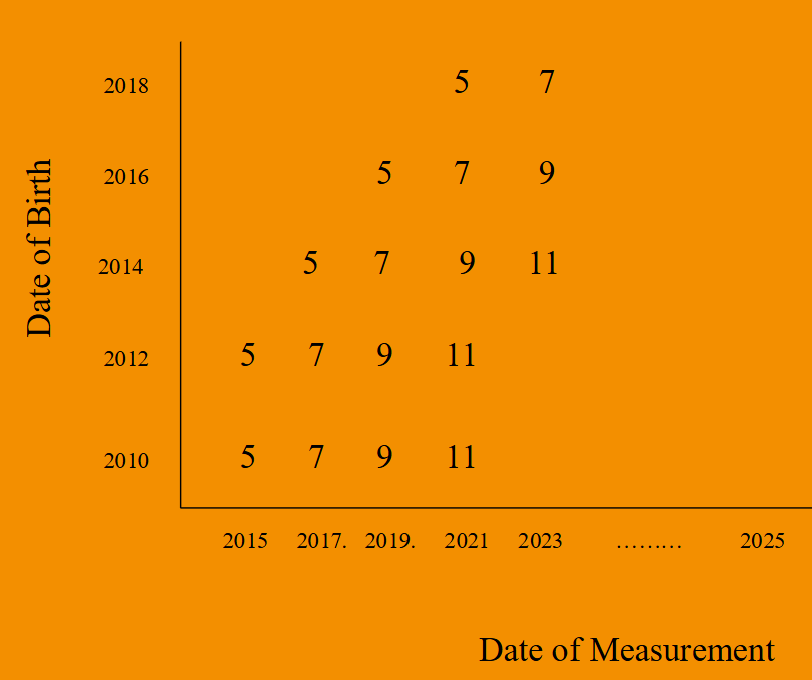
cohort effect
cohort is a group of people born at approximately the same time
an effect that is a function of date of birth (social/physical/economical conditions, etc.,)
germinal period
First two weeks post conception
Cell division, blastocyst
Little differentiation
Organism and support systems
Implantation in uterine wall by about a week after conception
embryonic period
2 to 8 weeks
Major body components and organs begin to form, including brain
Heartbeat by 4 to 5 weeks
Sexual differentiation begins around 7 weeks (though not visually distinguishable until around 12 weeks)
1.5” in length at end of this period
fetal period
From rudiments to fully formed infant
Ossification (bone development)
End of 4th month
Undeniably human form
End of 5th month
Neurogenesis “complete,” myelination begins
End of 6th month
Hemispheric cleft, production of surfactant which allow for independent breathing
7th month
Lungs capable, eyes open and close, great increase in brain fissures
8th month
Skin pigmented
Fat accumulation, especially on arms and legs
9th month
50% weight increase
zygote
single-cell eukaryotic cell formed when a female gamete (egg) and a male gamete (sperm) fuse during fertilization
implantation
the biological process where a fertilized egg attaches to the lining of the uterus to start a pregnancy
blastocyst
cell division
amnion
a thin, tough membrane that forms a fluid-filled sac around the embryo
chorion
the outermost extraembryonic membrane that surrounds the embryo or fetus
placenta
a temporary organ that grows in the uterus during pregnancy to supply oxygen and nutrients to the baby while removing waste
umbilical cord
a flexible, tube-like structure that connects a developing fetus to the placenta during pregnancy
embryo
the early developmental stage of a multicellular organism
neural tube
the embryonic structure in vertebrate development that serves as the precursor to the central nervous system
lanugo
a very soft, fine, unpigmented hair that covers a fetus during development in the uterus
vernix
creamy, white, waxy biofilm that covers the skin of a fetus during the third trimester of pregnancy
Neural proliferation and migration
foundational early phases of embryonic brain development where neural stem cells rapidly multiply in the ventricular zone and then travel to their precise final destinations to construct the central nervous system
Neural differentiation and myelination
the developmental and plastic processes where uncommitted stem or progenitor cells transform into functional neurons or glial cells
Synaptic pruning
the brain's natural process of eliminating weak or unused connections between neurons to improve overall processing efficiency
Viability
the capacity to live, grow, function properly, or succeed over time
teratogens
Any environmental substance that can cause damage during the prenatal period
its influence is a function of the following factors
Dose
Age at exposure
Heredity
Other negative influences
thalidomide
type of teratogen that can cause damage during prenatal period (like acutane)
Fetal Alcohol Spectrum Disorders
Slow growth
Facial abnormalities
Brain injury and learning/cognitive disabilities
Tobacco and Prenatal Development
approximately 15% of women in the U.S. smoke during pregnancy
LBW and VLBW
Attention and stimulus sensitivity issues
Colicky, negative temperament
Nicotine → vasoconstrictor
Oxygen deprived pre-natal environment
Drugs and Prenatal Development
Can be born addicted
Increased risk for low birth weight, birth defects, respiratory problems, prematurity, infant mortality
Disease and Prenatal Development
Rubella
Major teratogen during embryonic stage — blindness, deafness, major organs, intellectual disabilities
HIV/AIDS
Virus passed directly to fetus 20-30% of the time, extremely high risk of death
Drug treatment can reduce probability of transmission
Toxoplasmosis
Parasite found in many animals
Can cause cognitive and vision defects
Transmitted via either eating raw or undercooked meat, or animal feces (house pets)
Prenatal Screening
Regular check-ups, size estimation, ultrasounds
The embryo and fetus and its protective and support systems share the same genetic material
Amniocentesis
(14-18 weeks or after)
Very invasive, not done until second trimester
Takes a week to get results done
removes a small sample of amniotic fluid from the uterus to test for genetic conditions, birth defects, or infections
Chorionic Villus Biopsy
(9-12 weeks)
Can be less invasive
Results available more quickly
a prenatal diagnostic test that removes a small tissue sample from the placenta to check for genetic and chromosomal conditions
3 stages of labor
1st Stage: Dilation and effacement of the cervix
From tightly closed to 10 cms
2nd Stage: Birth of the child
Through the cervical opening and vaginal canal aided by contractions
3rd Stage: Birth of the Placenta
Shortly after the birth of the child