HDE 100C: Chapter 2 - terms/concepts
 Call Kai
 Learn
Learn Practice Test
 Spaced Repetition
 Match
Match Flashcards
 Knowt Play
1/74

There's no tags or description
Looks like no tags are added yet.
Name | Mastery | Learn | Test | Matching | Spaced | Call with Kai | Chat |
|---|
No analytics yet
Send a link to your students to track their progress
75 Terms
Developmental Science
a term replacing “developmental psychology” that expands the focus of life span development to include a broader variety of domains (understanding the systematic and multiple influences for developmental process)
Niche-picking (by psychologist Sandra Scarr)
the proposal that genetic and environmental factors work together to influence the direction of a child’s life
Organismic Model
proposal that heredity drives the course of development throughout life
Mechanistic Model
proposal that people’s behavior changes gradually over time, shaped by the outside forces that cause them to adapt to their environments
Interactionist Model
the view that not only do genetics and environment interact in complex ways to produce their effects on the individual but also that individuals actively shape their own development
Plasticity in Development
the course of development may be altered (is “plastic”) depending on the nature of the individual’s specific interactions in the environment. personality can alter how genes become expressed over the course of individual development.
Reciprocity in Development
a principle that people both influence and are influenced by the events in their lives (people are shaped in part by their experiences, but they also shape their experiences)
Reciprocity in Development
your choice to become involved in that activity very likely led to experiences you would not have had if you chose a different pursuit (friends w/ similar interest: they affected your life, but you would have affected theirs)
effect you have on your environment (in turn affect subsequent events in your life)
Contextual Influence on Development
forces that stem from the outside individuals to shape changes over time (emphasis on the role of the environment in development)
Ecological Perspective
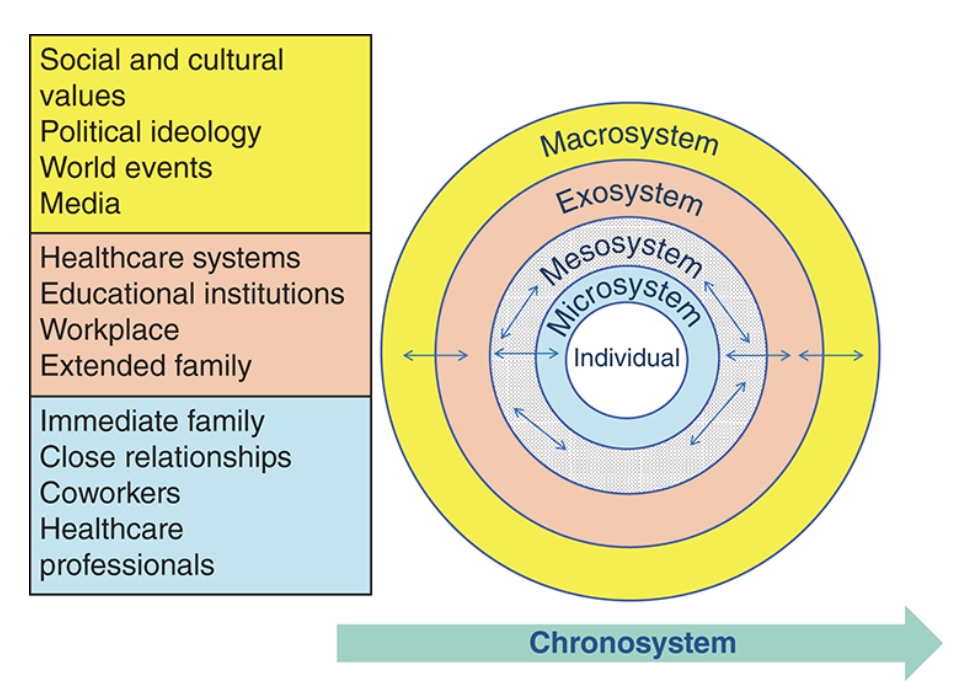
identifies multiple levels of the environment as they affect the individual’s development (bronfenbrenner’s Model of Development)
Mircrosystem = a person’s immediate environment, which includes the people they interact with on a daily basis
Mesosystem = made up of interactions that take place among the microsystems (ex. someone seeking divorce marital conflict many carry stress into interactions with co workers
Macrosystem = includes larger social institutions ranging from a country’s economy to its laws and social norms
The Zip Code Effect
disparities; large variations in life expectancy across census tracts within the US (AKA. describes how a person’s residential neighborhood strongly dictates their life expectancy, economic mobility, and overall health
Chronosystem
from the ecological perspective, changes that take place over time (ex. can include events w/in the family as well as event in the larger society that indirectly affect the individual - macrosystem)
Life Course Perspective
the norms, roles, and attitudes about age that have an impact on the shape of each person’s life (life course NOT EQUAL life span)
Life Course
refers to the course or progression of a person’s life events as shaped by social factors outside the individual’s control
Life span = biological and chronological duration from birth to death
Life Course = socially constructed sequence of roles, events, and trajectories shaped by history, culture, and society
Social Clock
the expectations for the ages at which a society associates w/ major life events
these expectations set the pace for how people think they should progress through their family and work timelines
Activity Theory
the view that older adults are most satisfied if they are able to remain involved in their social roles
Disengagement Thoery
a proposal that the normal and natural evolution of life causes older adults to purposefully loosen their social ties; this natural detachment is not only inevitable but also desirable; retirement/isolation from family members are sout out and result in higher levels of wellbeing
Continuity Theory
a proposal whether disengagement or activity is beneficial to the older adult depends on the individual’s personality
Continuity Theory of Retirement
a proposal that retired individuals maintain the ties they had to society when they were working
Ageism
a set of beliefs, attitudes, social institutions, and acts that denigrate individuals or groups based on their chronological age
Q: Why does agism exist?
A; perhaps at the root is that older adults remind younger individuals of the inevitability of mortality 9defensive mechanisms)
Terror Management Theory
proposal that people regard w/ panic and dread the thought of the finitude of their lives (death); alternative perspective is modernization hypothesis
Modernization Hypothesis
a proposal that the increasing urbanization and industrialization of Western society is what causes older adults to be devalued; (AKA older adults viewed negatively because they are no longer of use to society)
Intersectionality
the notion that multiple “isms” such as ageism, sexism, and racism do not just add up, but interact w/ one another to influence the discriminatory ways in which people reflecting more than one group are treated
Multiple Jeopardy Hypothesis
proposal that older individuals who fit more than one discriminated-against category are affected by biases against each of these categorizations
(ex. women are discriminated against by ageism, sexism, and racism)
Age-As-Leveler
proposal that as people become older, age overrides all other “isms”
Inoculation Hypothesis
the belief that older minorities and women have actually become immune to the effects of ageism through years of exposure to discrimination and stereotyping
Psychosocial Theory of Development
view proposed by Erikson that at certain points in life, a person’s biological, psychological, and social changes come together to influence his or her personality
Epigenetic Principle
in Erikson’s theory, the proposal that asserts that each phase unfolds from the previous phase according to a predestined order
Basic Trust vs. Basic Mistrust
issue in Erikson’s theory; infant’s ability to establish a sense of being able to rely on care from the environment (and caregivers)
Autonomy vs. Shame and Doubt
issue in Erikson’s theory; when young children learn ways to be able to act independently from their parents w/out feeling afraid that they will venture too far off on their own
Initiative vs, Guilt
issue in Erikson’s theory; when the child becomes able to engage in creative self-expression without fear of making a mistrake
Industry vs. Inferiority
stage in Erikson’s theory; involves the individual’s identifying w/ the world of work and developing a work ethic
Identity Achievement vs. Identity Diffusion
issue in Erikson’s theory; when individuals must decide “who” they are and what they wish to get out of life
Identity diffusion = involves a lack of direction, vagueness about life’s purposes, and an unclear sense of self
Intimacy versus Isolation
stage in Erikson’s when individuals are faced w/ making commitments to close relationships
thoeretically, isolation is more likely to develop in individuals who lack a strong identity because in a close relationship, each partner “gives up” a piece of his or her identity
Generativity vs. Stagnation
stage in Erikson’s theory; when middle-aged adults focus on the psychosocial issues of procreation, productivity, and creativity
Ego Integrity vs. Despair
issue in Erikson’s thoery; individuals face psychosocial issues related to aging and facing their mortality
Life Review
the process of looking back at the past in a way that allows the individual to accept both positive and negative experiences
Schemas
the mental structures people use to understand the world
Assimilation
a process in which people use their existing schemas in order to understand the world around them
refers to the situation in which individuals change their interpretation of reality to fit the schemas they already hold
(ex. instead of changing themselves to fit the culture, they change their perception of the culture to fit their own way of understanding it)
Accommodation
when people change their schemas in response to new information about the world
Equilibrium
when assimulation and accommodation are perfectly balanced
Identity Process Theory
proposes a framework for understanding how individuals adapt as they navigate the many new experiences that accompany their movement through life
identity continues to change in adulthood in a dynamic manner
Mutiple Threshold Model
posposes that individuals realize that they are getting older through a stepwise process as aging-related changes occur
Identity Assimilation
the process involving the interpretation of new experiences in terms of a person’s existing identity
Identity Accomodation
the process of making changes in identity in response to experiences that challenge people’s current view of themselves
Identity Balance
a process involving the dynamic equilibrium that occurs when people tend to view themselves consistently but can make changes when called for by their experiences
Selective optimization with compensation model (SOC)
a proposal that adults attempt to preserve and maximize the abilities that are of central importance and put less effort into maintaining those that are not
SOC - you cut down on the range of activities (loss) but improve your performance in those that you keep (gains)
genome
the complete set of instruction for “building” all the cells that make up an organism
gene
a functional unit of a DNA molecule carrying a particular set of instructions for producing one of those proteins
allele
one of the versions of a gene that an individual inherits from the mother and father
DNA
a molecule capable of replicating itself that encodes info needed to produce proteins
chromosomes
distinct, physically seperated units of coiled threads of DNA and associated protein molecules
Single Nucleotide Polymorphism (SNP)
a small genetic variation that can occur in a person’s DNA sequence in which one nucleotide is sub for another
Mutations
alterations in genes that lead to changes in their functions
epigenetics
changes in.a gene as a result of environmental influences
genome-wide association study (GWAS)
a method used in which researches search for specific genetic variations related to complex diseases using microarrays
genome-wide linkage study
a method used in behavior genetics in which researchers search for genetic variations related to complex diseases by scanning the entire genome
programmed aging theories
propose that aging and death are built into the hard-wiring of all organism and therefore are part of the genetic code
gompertz function
the relationship between age and death rates for a given species
replicative senescence
the loss of the ability of cells to reproduce
telomeres
repetitive DNA sequences that serve to protect the genome from becoming degraded as the DNA replicates w/ each cell division; w/ each cell division the telomeres shorten eventually leading to damage of the genome; once it can’t work anymore adjacent chromosomes fuse and the cell cycle is halted and ultimately the cell dies
FOXO genes
a group of genes that influence crucial cellular processes regulating stress resistance, metabolism, the cell cycle, and the death of cells
random error theories
assume that aging reflects unplanned changes in an organism over time
error theories
propose that it is the accumulation of mutations acquired over the organism’s lifetime that leads to malfunctioning of the body’s cells
Wear and tear theory
aging occurs as the body breaks down due to an accumulation of damage over itme
cross-linking theory
focuses on the cells of the body known as collagen
collagen
the fibrous protein that makes up about one quarter of all bodily proteins
free radical theory
regards the cause of aging as due to the formation of highly reactive unstable oxygen molecules produced when cells create energy (free radicals)
antioxidants
chemicals that prevent the formation of free radicals are thought to be able to neutralize free radicals
caloric restriction
the view that they key to prolonging life is to restrict the total number of calories that individuals consume
autoimmune theory
proposes that aging is due to faulty immune system functioning in which the immune system attacks the body’s own cells
error catastrophe theory
proposes that the error that accumulates w/ aging develop as the result of mutations in the mitochondrial DNA, so called “powerhouse” passed down from the mother
DNA methylation
the sequences of amino acids in a gene are altered by exposure to harmful conditions
exposome
measures of all exposures individuals have over life and how these relate to health