NEUR 321 Midterm 1
 Call Kai
 Learn
Learn Practice Test
 Spaced Repetition
 Match
Match Flashcards
 Knowt Play
1/36

Earn XP
Description and Tags
NEUR 321 Midterm 1 UofC
Name | Mastery | Learn | Test | Matching | Spaced | Call with Kai | Chat |
|---|
No analytics yet
Send a link to your students to track their progress
37 Terms
“*”
Study if more time/not as important to fully commit to memory
There Are Three Reasons To Study The Brain & Behaviour:
How the brain produces behaviour is a major question
The brain is the most complex organ, found in many groups of animals
Brain disorders can be treated if we increase our understanding of the brain
The Nervous System Is Divided Anatomically Into Two Parts:
Central Nervous System (CNS)
Consists of the brain and spinal cord
Peripheral Nervous System (PNS)
Consists of neurons and nerve processes outside the CNS

The Human Brain Can Be Divided Into Two Major Structures:
Cerebrum (Forebrain)
Cerebellum

Cerebrum (2)
Consists of two halves (left and right cerebral hemispheres)
The cerebrum is responsible for most of our conscious behaviours
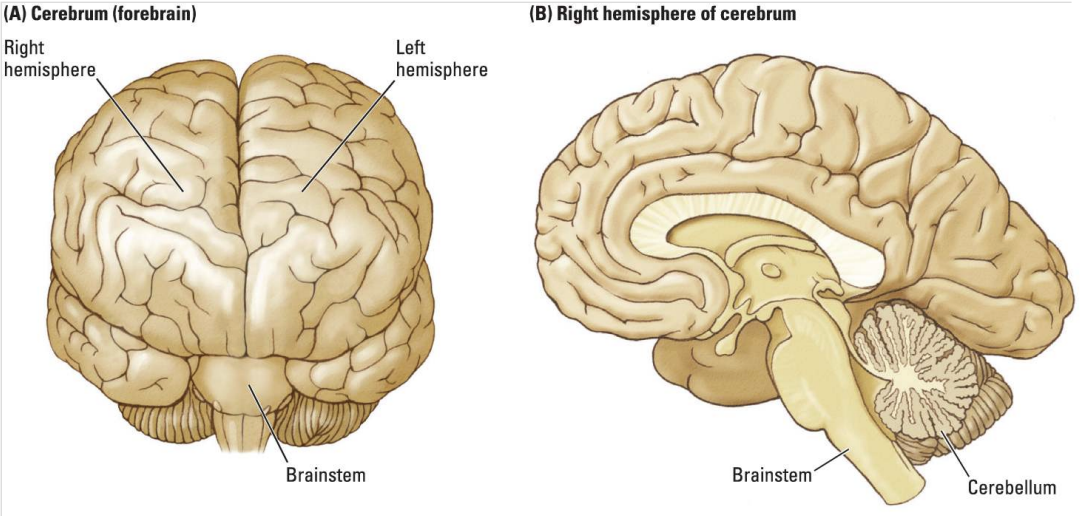
Beneath and surrounded by the cerebrum is the ___
Brainstem
Brainstem
The brainstem contains structures involved in automatic/unconscious behaviours (heart rate, breathing, sleeping, etc.,)
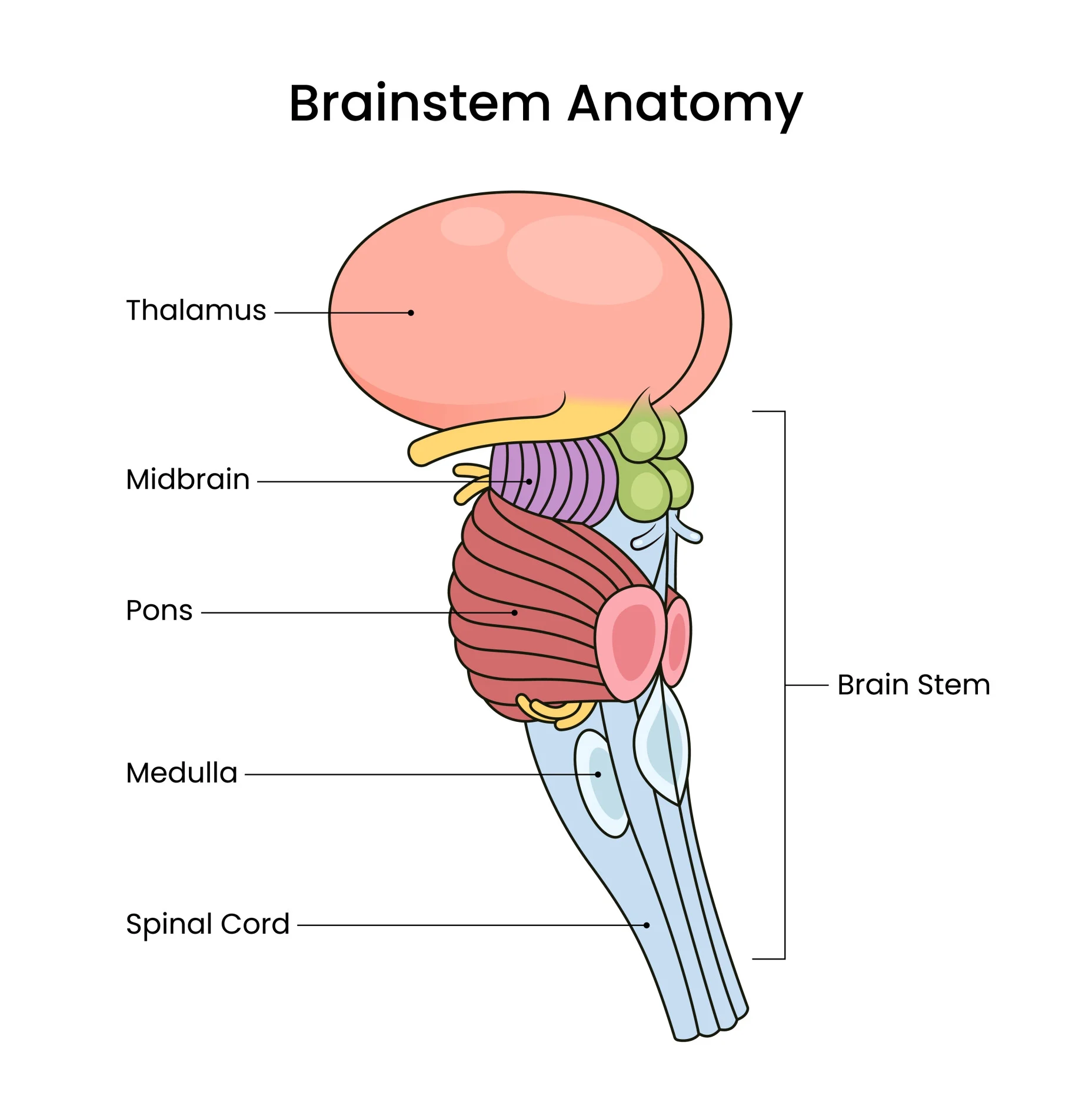
The ___ emerges from the base of the brainstem
Spinal cord
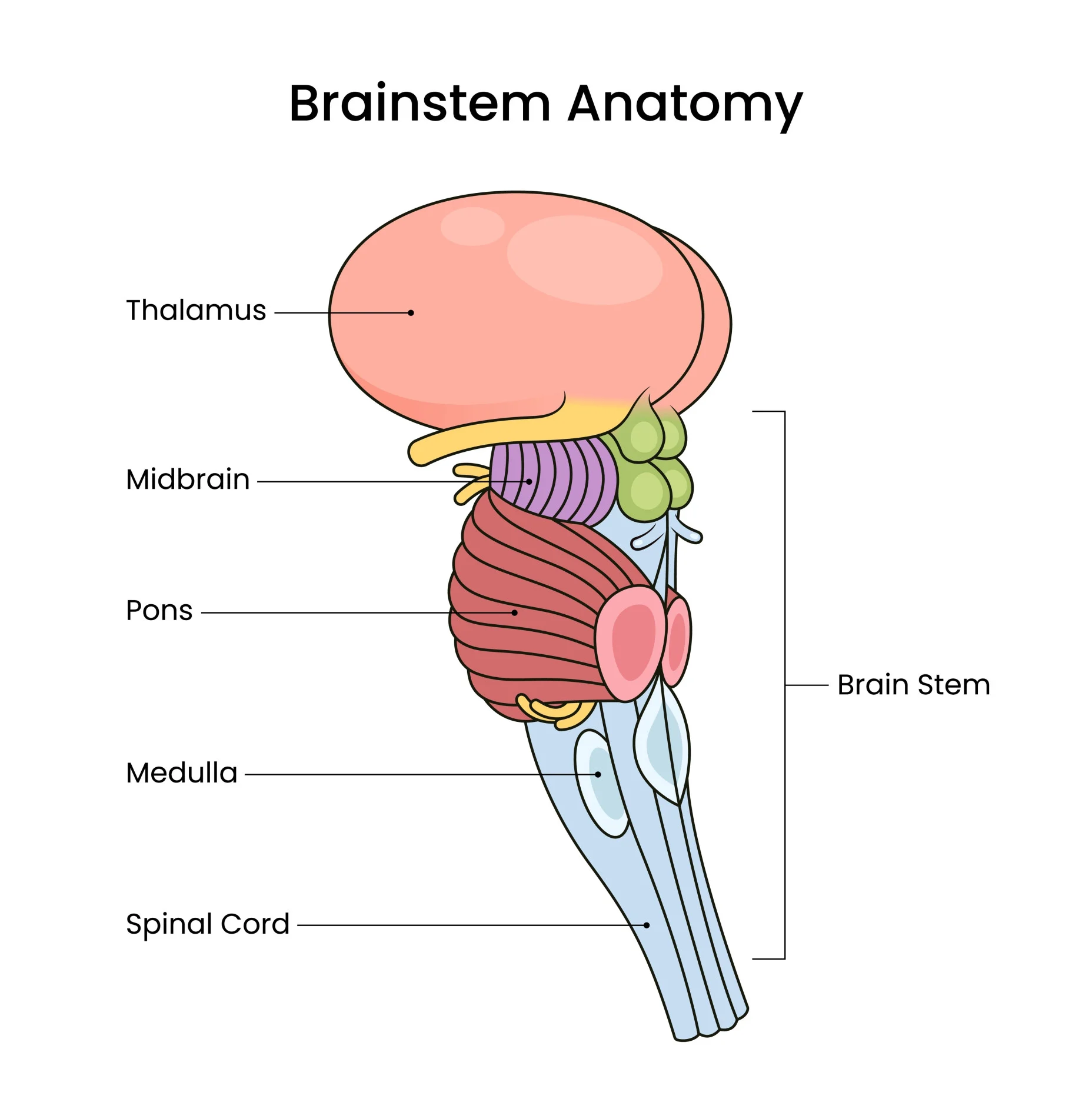
Cerebellum
The cerebellum is specialized for learning and coordinating movements
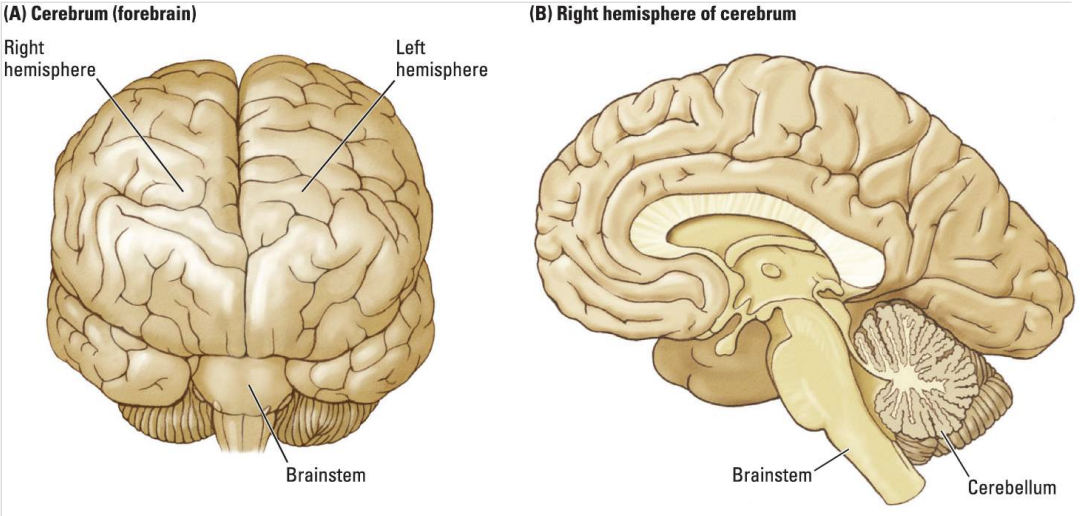
Understanding Brain Function: Treatments - Deep Brain Stimulation
DBS involves electrodes being implanted in the thalamus where they deliver continuous low-voltage electrical current (used to treat Parkinson’s and depression)
What is Behaviour: Irenäus Eibl-Eibesfeldt
Irenäus defined behaviour as “patterns in time,” meaning that behaviour consists of organized changes such as movements or vocalizations
Animal Behaviour Can Be Divided Into Two Groups:
Inherited (Innate/Fixed) Behaviours
Performed with no previous experience - brains have the requisite organization
Learned Behaviours
Require experience - depend on the brain’s plasticity
Perspectives on Brain and Behaviour: Aristotle (3)
Aristotle’s view is an example of mentalism
Aristotle believed the brain played no role in producing behaviour, and thought its function was to cool the blood
Aristotle argued that behaviour came from the psyche (mind/soul) which he viewed as a nonmaterial entity responsible for consciousness, perception, emotion, imagination, etc.,
Perspectives on Brain and Behaviour: René Descartes
René Descartes proposed dualism which gives both the nonmaterial mind and the brain roles in behaviour
René Descartes: Mind-Body Problem
Descartes proposed that the mind interacted with the body through the pineal gland, where it directs the flow of fluids through the ventricles and into the muscles to move the body

Perspectives on Brain and Behaviour: Charles Darwin
Darwin proposed materialism, the view that behaviour can be explained as a function of the nervous system, and not a separate nonmaterial mind
Darwin’s Legacy: Common Ancestor, Mechanism of Evolution, & Functionalism (3)
Darwin argued that all living organisms are related through a common ancestor (3.5 BYA)
Darwin proposed a mechanism for evolution by natural selection
Darwin’s ideas also connect to functionalism in that the purpose of a trait or behaviour was to solve a historical or adaptive problem for the organism
*Perspectives on Brain and Behaviour: Contemporary Perspectives - Eliminative Materialism (3)
Behaviour and neural function are treated as completely linked
What we call the mind is understood as a function of brain activity
Subjective terms such as consciousness, pain, belief may still be used descriptively, but researchers try to connect them to physical processes in the brain
Classification of Life: Taxonomy
Taxonomy is the branch of biology that names and classifies organisms by grouping them according to shared characteristics and evolutionary relationships
The Earth is ___ years old, and life arose around ___ years ago
4.54 BY (4540 million)
3.7 BY (3700 million)
The first nervous systems arose around ___ years ago and are only present in ___
700 million
Animals (eukaryotic and multicellular)
Evolution of Brains and Behaviour: Early Nervous Systems (2)
Early nervous systems allowed animals to detect conditions in the environment and move towards beneficial ones
These nervous systems made organized behaviour possible (animals could search for food, mates, and shelter)

___ is the group in which a true brain and spinal cord appear together
Chordates
Birds are ___
Theropod dinosaurs (hollow bones and three-toed limbs)
Evolution of Human Brains: The First Humans (2)
The brain of Australopithecus (LUCY) was about the same size as living nonhuman apes
Succeeding members of the human lineage displayed a steady increase in brain size

Evolution of Human Brains: As brain size increased, ___
Members of the genus Homo also developed increasingly sophisticated tools (association between greater brain capacity and more complex behaviour)
Evolution of Human Brains: Homo habilis and Homo erectus (2)
Homo habilis (handy human) appeared about 2 million years ago in Africa and made simple stone tools
Homo erectus (upright human) appeared about 1.6 million years ago in Europe and Asia and its larger brain allowed more sophisticated tools

The reason encephalization quotient came to be is because ___
Absolute brain size alone is not a fair way to compare species (larger animals need larger brains)
Evolution of Human Brains: Encephalization Quotient (2)
Harry Jerison developed the encephalization quotient, a quantitative measure of brain size relative to body size
An animal with a brain larger than expected for its body size has a larger EQ, whereas one with a brain smaller than expected has a lower EQ

EQ: A ___ alone does not necessarily mean greater intelligence because ___
larger brain
Behavioural ability also depends on size and organization of particular brain regions, neuron number and density, etc.,
The ___ has the largest ratio of brain weight to body weight (EQ)
Ubangi elephantfish (weakly electric fish)
The EQ of the weakly electric fish is not necessarily evidence that it is more intelligent than humans; instead ___
Much of the brain mass comes from a massive cerebellum specialized for detecting perturbations in its electric field
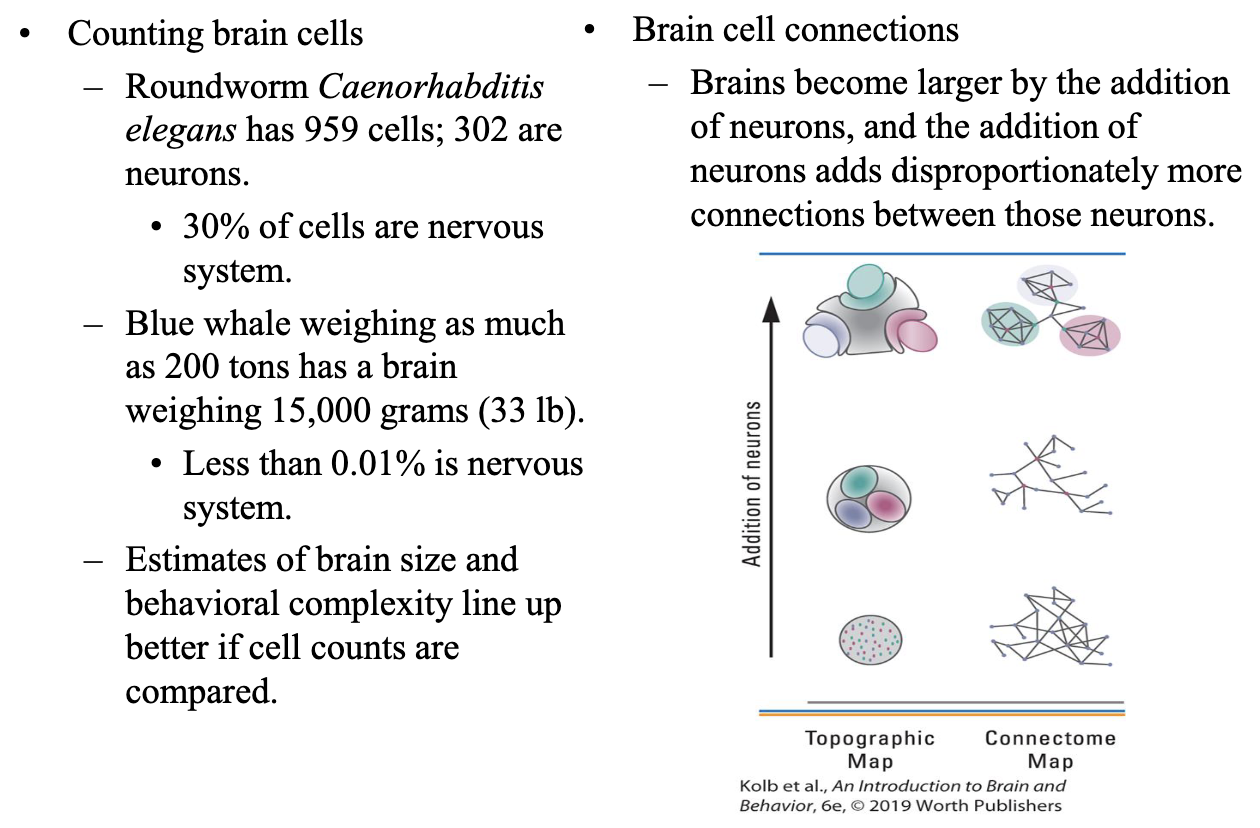
Understanding Brain Complexity: Counting Brain Cells & Brain Cell Connections (2)
Estimates of behavioural complexity often line up better when neuron counts are considered (*note blue whale vs. roundworm)
Adding neurons also creates a disproportionately larger number of possible connections, allowing complex neural networks
Evolution of Human Brains: Why The Hominid Brain Enlarged (2)
Climate change may have forced hominids to adapt to new conditions, promoting more complex behaviour (e.g. Africa’s Great Rift Valley)
Primate lifestyle, particularly demands such as living in larger social groups, food selection (fruits), and cooking (use of fire - cooking was especially important because cooked food is easier to digest and provides more usable energy, allowing hominids to support larger numbers of neurons while spending less time foraging)
Evolution of Human Brains: Changes in Hominid Physiology - Stedman (2)
Stedman proposed that cooking made food easier to chew and may have been associated with genetic changes that produced smaller facial muscles; smaller chewing muscles could then permit smaller, more delicate skull bones, and changes in diet
Changes in the skull would increase blood circulation and brain cooling, which then supports a larger brain
Evolution of Human Brains: Changes in Hominid Physiology - Altered Maturation (2)
Heterochrony refers to changes in which developmental stages begin and end and how quickly they proceed; altered heterochronicity has been proposed as one reason humans developed larger brains and other distinctive traits
Neoteny refers to juvenile characteristics of predecessors becoming adult features of descendents (e.g. small face)
Large brains are especially advantageous in ___
Long-lived, homeothermic (warm-blooded) mammals, with complex developmental, social, political, and environmental challenges