chem 1b, exam 1 ch 15 and 16
 Call Kai
 Learn
Learn Practice Test
 Spaced Repetition
 Match
Match Flashcards
 Knowt Play
1/28

Name | Mastery | Learn | Test | Matching | Spaced | Call with Kai | Chat |
|---|
No analytics yet
Send a link to your students to track their progress
29 Terms
reactants —> products
A+B —> C+D
irreversible reactions
only occur in one direction
reactants to products
reversible (spontaneous)
can occur in both directions
rxn @ equilibrium
the rate of the forward reaction is the same as the rate of the reverse reaction
*rate is how fast the reactions occurs
Equilibrium constant Keq
for aA +m bB —> cC +dD
Keq = [Cc*Dd]/[Aa*Bb]
*solids and liquids not included
Concentration @ eq
when reaction is at equilibrium the concentration (M) of reactants and products remains unchanged
Rules for Keq
if Keq > 1 product favored, goes to the right
if Keq = 1 neither side of the reaction is favored, equal amounts each side
if Keq < 1 reactant is favored, goes left
if Keq > 1010 reaction goes to completion, no more reactants, irreversible
if Keq < 10-10 reaction does not occur
Kp = Kc (RT)delta n
Kc is used when the concentration is given as the molarity (aq solution), Kp is used if the partial pressures are given (gasses)
Keq relationship
if a reaction is reversed, Keq is inverted
if a reaction is multipliers or divided the same is done to Keq
id two or more reactions are added to obtain an overall reaction, multiplu the K≤eq≤ og the individual reactions
Le chateliers principle
if a reaction at equilibrium is disrupted the reaction shifts to the side to cancel the disturbance until the equilibrium is re-established
adding heat,
for exothermic rxn, rxn will shift to the left
for endo rxn, rxn will shift right
adding pressure,
the reaction will shift to thew side with fewer number of moles
adding volume
the rxn will shift to the side with higher number of moles
reaction quotient Q
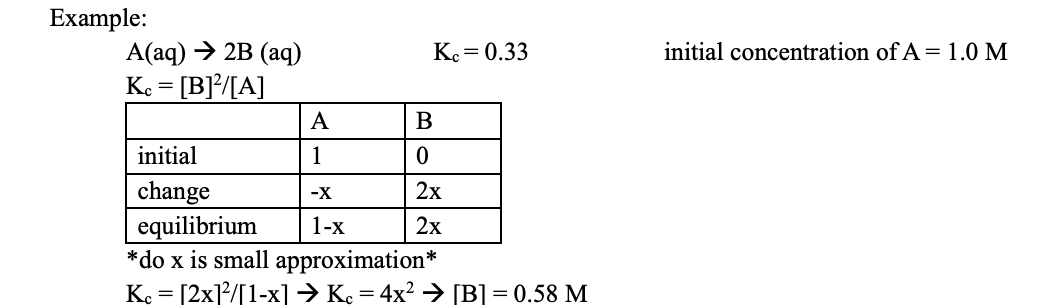
Q is calculated the same as Kc and Kp but the reaction is not at equilibrium
so: [products]/[reactants] not including solids or liquids
reaction quotient Q rules
if Q = Kc neither side is favored
if Q < Kc product favored, shift right
if Q > Kc reactant favored, shifts left
kinetics
the study of the rate of chemical reactions
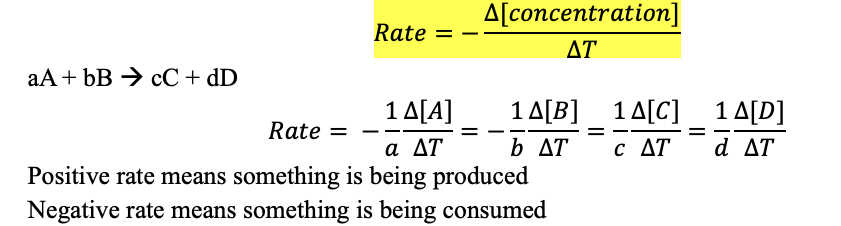
rate
change in quantity with respect to time
is how fast reactants make products
measures how the concentration of reactants change with time
positive, being produced
negative, being consumed
factors affecting the rate of a reaction
temperature, increase in temp increases rate of the reaction
pressure, increase pressure increases rate of the reaction
catalyst, catalyst increases the rate of the reaction by lowering the activation energy
concentration, increasing concentration increases the rate of a reaction (based on its rate law)
volume, increasing volume decreased the rate of a reaction due to less collisions between the particles
nature of the reactants, g > l > powdered s > rock s
surface area, increasing the surface area increases the rate of the reaction
rate law K
*depends on the concentration anbd is always determined experimentally