ANSC 325 - Midterm 1
 Studied by 0 people
 Call Kai
 Learn
Learn Practice Test
 Spaced Repetition
 Match
Match Flashcards
 Knowt Play
1/44

There's no tags or description
Looks like no tags are added yet.
Name | Mastery | Learn | Test | Matching | Spaced | Call with Kai |
|---|
No study sessions yet.
45 Terms
Perissodactyl
Horse order
Hippomorpha
Horse suborder
Equoidea
Horse super-family
Equidae
Horse family
60
Alert all the time: ___% of time is walking in a 24h (14-15 hours/day)
12
__ Generations of Selective Breeding = Domestication
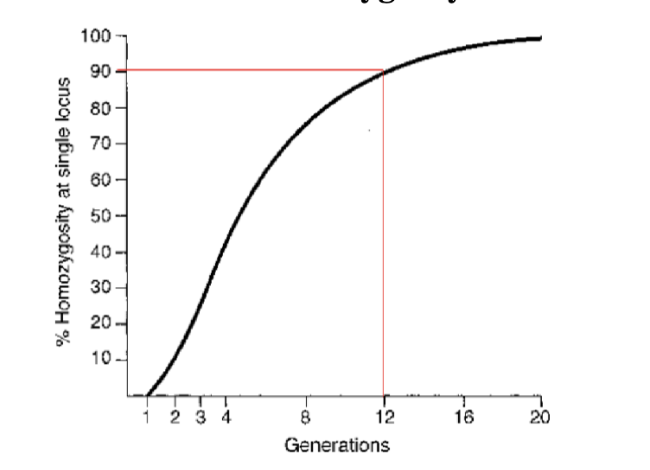
Domestication
‘The process by which a population of animals becomes adapted to man and to the captive environment by some combination of genetic changes occurring over generations and environmentally induced developmental events recurring during each generation’
involves changes- both at the genome with corresponding phenotypic changes
domestication
= 90% homozygosity / 10% heterozygosity
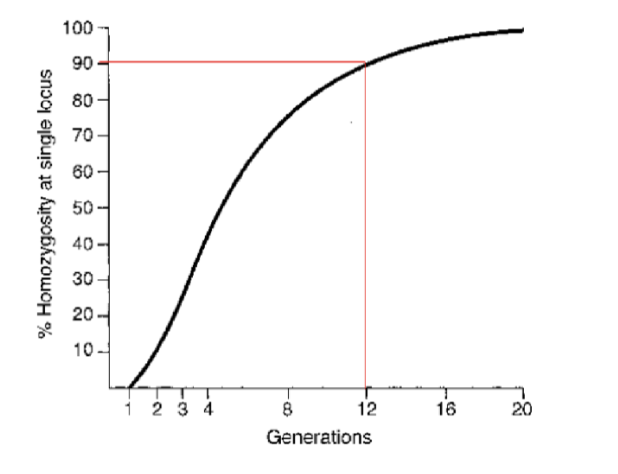
20
___ generations of selective breeding
= 100% homozygosity / 0% heterozygosity
Flexible diet
Fast growth rate
Breed in captivity
Good disposition
Mild temperament
Modifiable social hierarchy
6 qualities required for domestication
Przewalski’s horse
All wild horses are feral, descendants from domestic horses
Except the _________
Natal band
Reproductive Unit of Horses
Birth or family group, harem
Stable group of mares, offspring and 1 stallion (or more than stallions-depend on harem size-uncommon), usually adult populations in the group are stable
Bachelor group
Non-Reproductive Unit of Horses
Males that left the natal band
i) colts socializing with other colts (play)
ii) banished male juvenile and
iii) old stallions and
iv) weak stallions (failed to protect the harem or natal band)
‘lie in wait the opportunistic competitors’: capture mares +/- sneak mating’s, challenge dominant stallions and a sanctuary for transient male
Try to get back into the harem
resources, landscape, seasons (migration patterns), proximity of other herds
Group size and home range of horses depends on these 4 things
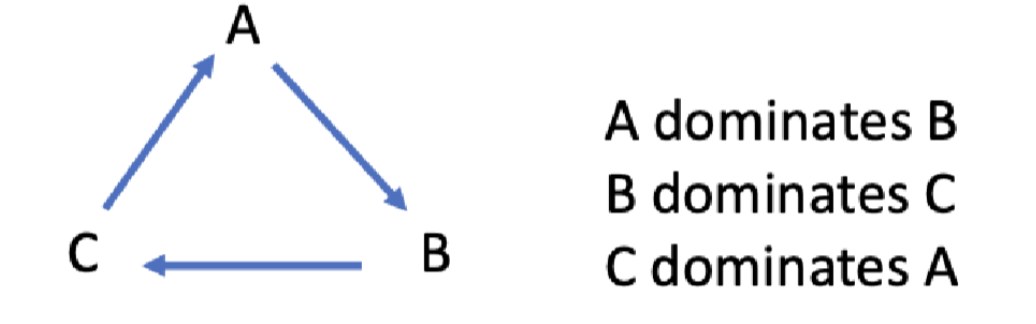
Social triangle
Individual rank not a linear process, but a __________
Height, Weight, Age
Position/hierarchical rank is variable, but depends on these 3 factors
Agnostic behaviour
Characterized as behaviours for: protest, aggression, threat appeasement, defense, avoidance
Behaviours required to have a functional herd- and daily activities
The frequencies and responses as often associated the size of the herd, complexities of the social triangle
Note: important for people to recognize behaviours in horses- if ignored or the individual is unaware of horse - dangerous
Aggression
Associated with head threats and bites
Head threat
Most common display of aggression
Defense
Associated with hindquarters, kicks
Submission
A cornerstone of maintain social stability
Often overlooked as the cues are subtle compared to aggression
Reduces to lower rank horses and also conserves resources of dominate horses (less fight- less energy usage)
Simplest form- turn their head away from aggressor
Head lowering, chewing, licking lips, back off
Ears, Head Bowing, Tail Position
3 most important body parts for communication
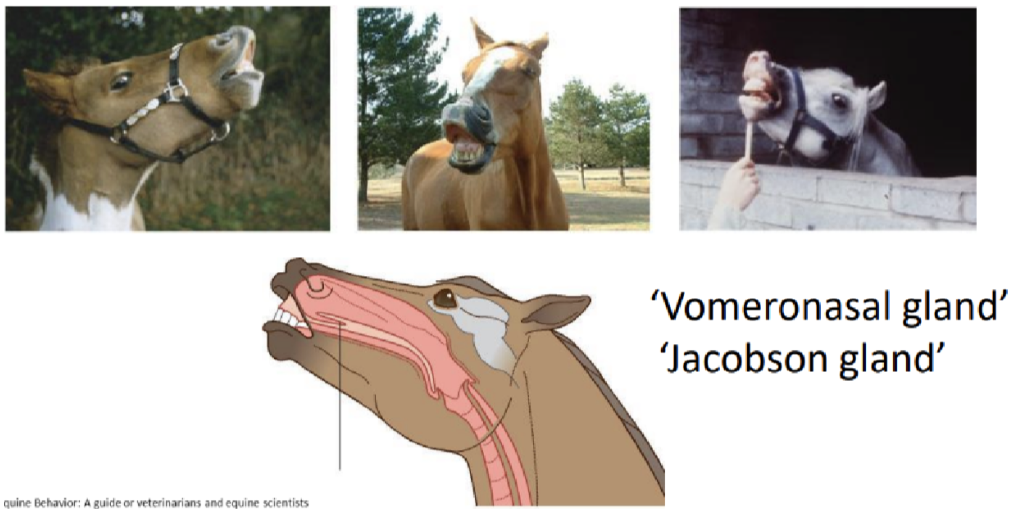
Flehmen Response
Done by horses primarily to small pheromones to find mates
Using vomeronasal gland/Jacobson’s gland
Yes
If you had 2 different equine species exposed them to the same stimuli- would they react the same?
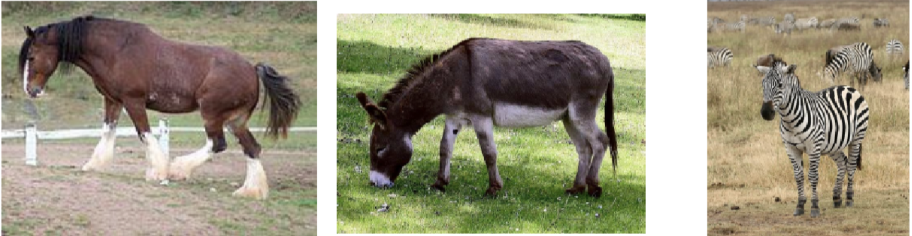
Yes and No
If you had 2 different horse breeds exposed them to the same stimuli- would they react the same?
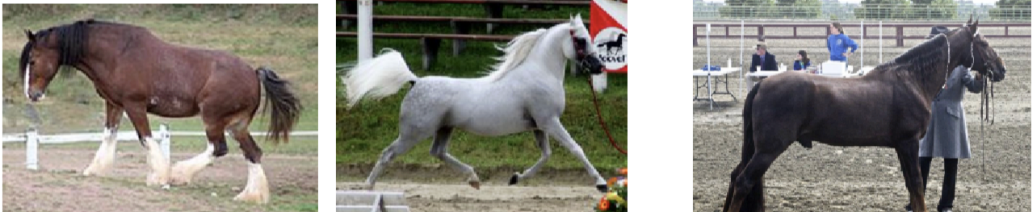
Temperament
A set of behavioural tendencies, present in early life and relatively stable across various kinds of situations over time (innate behaviour)
The innate (genetic) behaviour of the animals
Nature
Personality
the ‘behaviour’ results from the environment, such as housing, past experience (training, handling etc.) ‘effects’ on temperament
Behaviour learned from environment
Nurture
Gender, Genetics, Socialization, Environment
4 factors impacting equine personality
Genetics
Heritability Score = 1
Temperament/Personality variation due entirely to ______
Environment
Heritability Score = 0
Temperament/Personality variation due entirely to ______