IB Psychology Unit 1 Notes
 Call Kai
 Learn
Learn Practice Test
 Spaced Repetition
 Match
Match Flashcards
 Knowt Play
1/42

There's no tags or description
Looks like no tags are added yet.
Name | Mastery | Learn | Test | Matching | Spaced | Call with Kai | Chat |
|---|
No analytics yet
Send a link to your students to track their progress
43 Terms
Cognitive Psychology
Thinking can affect behavior, Cognitive Psychology typically uses the word “think”. For example, the bobo doll experiment. If one kid is exposed to normal tv, while the other is exposed to violent tv, the kid exposed to violence is more likely to act violent towards the doll.
Biological Psychology
How do hormones, our brain, or genetics influence our behavior? For example: Testosterone makes males lazy, caffeine makes it hard to sleep, whilst melatonin makes you sleep
Sociocultural Psychology
How does your culture or society impact the way you think or behave?
Physiology vs Psychology?
Physiology is changes in the body while psychology is changes in the mind
What can the mind be conceptualized as?
A set of mental processes carried out by the brain. These processes include perception, thinking, decision-making, problem solving, memory, language, and attention.
What are mental representations?
Your understanding of how the world works. It’s shaped by your experiences, which means everyone has different mental representations.
Assumption: Humans are information processors
What we know about the world is constantly updating, causing our understanding to change
What is an assumption we can make about cognitive processes?
Cognitive processes can be studied scientifically by research
Assumption: Mental representations guide behaviors
The way we process and organize our information determines how we behave. We process new information through the filter of experience and understanding. Example: If two people were at an art museum—one took an art history class while the other didn’t—The one who took the art class would have more appreciation and fun.
Assumption: Information overload is understood and expected
People argue that we often make the choice not to actively process information to save time and effort.
The Cognitive Miser Mantra
I don’t know, I don’t care, I don’t have time
What is a neutral stimulus
The item or action that had no effect before conditioning
What is an unconditioned stimulus
Something that generates a response with no former training, for example food causing salivation
What is the Unconditioned Response
After being subjected to the Unconditioned Stimulus, the UCR is the thing that happens. For example the salivating when seeing food.
What is the Conditioned Stimulus
On it’s own, it wouldn’t have caused a reaction if it weren’t for conditioning but now it creates one.
What is the Conditioned Response
The response caused after conditioning (What was the goal of the conditioning)
What is Extinction
Reversing the conditioned response, undoing the conditioning
What is operant conditioning
The argument that behavior is modified in response to a reward or punishment. Based on the Law of Effect, any behavior followed by a positive response will likely be repeated.
What is Positive Reinforcement?
Adding a stimulus, presenting a reward to encourage the continuation of a behavior.
What is Negative Reinforcement?
The removal of a stimulus to encourage continuation of a certain behavior. For example adding an annoying beep that only goes away after someone buckles their seatbelt to encourage safety.
What is positive punishment?
Adding a stimulus to discourage the continuation of a behavior. For example, fining someone for littering.
What is negative punishment?
Taking away a reward/positive stimulus to discourage the continuation of behavior. For example, parents taking away a phone to stop kids from sneaking out.
What is variable ratio schedule
A system that rewards behavior after an unpredictable number of responses. By giving random rewards, you encourage people to try again. For example, gambling.
What is Social Learning Theory?
The assumption that humans can learn by watching models then imitating their behavior. Also known as vicarious reinforcement, if you see someone do good on tests and they wear glasses, you also want glasses.
To learn behavior from a model, you need: Attention
The learner must pay attention to the model to learn a behavior. Certain factors including attractiveness, authority, or desirability may influence whether attention is paid to the model
To learn behavior from a model, you need: Retention
The observer must be able to remember the behavior that has been observed to produce that behavior immediately or after some time
To learn behavior from a model, you need: Potential
To reproduce a behavior, you must be physically and/or mentally able to carry it out. Must have a certain level of self efficacy
To learn behavior from a model, you need: Motivation
The learner must want to replicate the behavior they observed. To do this, they must understand the outcome if they repeat the behavior. This is called outcome expectancies
To learn behavior from a model, you need: Consistency
The model must act consistently throughout several occasions and situations. For example if the model is always brave, the observer would be more likely to imitate it than if the model acted differently in each situation.
To learn behavior from a model, you need to identify with the model
We tend to imitate models in the same social groups as us, such as age, gender, or interest based communities. When picking a model, learners show bias.
To learn behavior from a model, you need to like the model
Warm and friendly models are more likely to be imitated than cold and uncaring models.
To learn behavior from a model, you need: Rewarded behavior
If the model is rewarded because of their behavior, the learner wants to imitate the model to gain the same reward.
What is schema?
Schema is a mental framework formed by past experiences. When you learn new information, you try to fit it into preexisting schema. For example, when learning a name similar to a familiar one, you pronounce it like the name you’re familiar with.
What is a script?
Scripts are schema about events rather than for objects. For example, you have a mental script about how a dinner date is supposed to go and when the date doesn’t follow your script, it can be frustrating.
What is accommodation?
When an existing schema gets replaced, for example if a child grew up with a dog, when they see a cat (four legged, furry, ears, tails) they call it a dog. Eventually they learn it’s a cat and replace their old schema with a new one
What is assimilation
When information is added to schema. For example, you know how a shower works but you go to a hotel with a differently working shower. You assimilate that knowledge into your understanding of showers.
What is reconstructive memory?
The idea that memory is reconstructive based on schema. Memory isn’t fully reliable or true
What is a cognitive model?
A model that simplifies complex concepts into visual or verbal representations
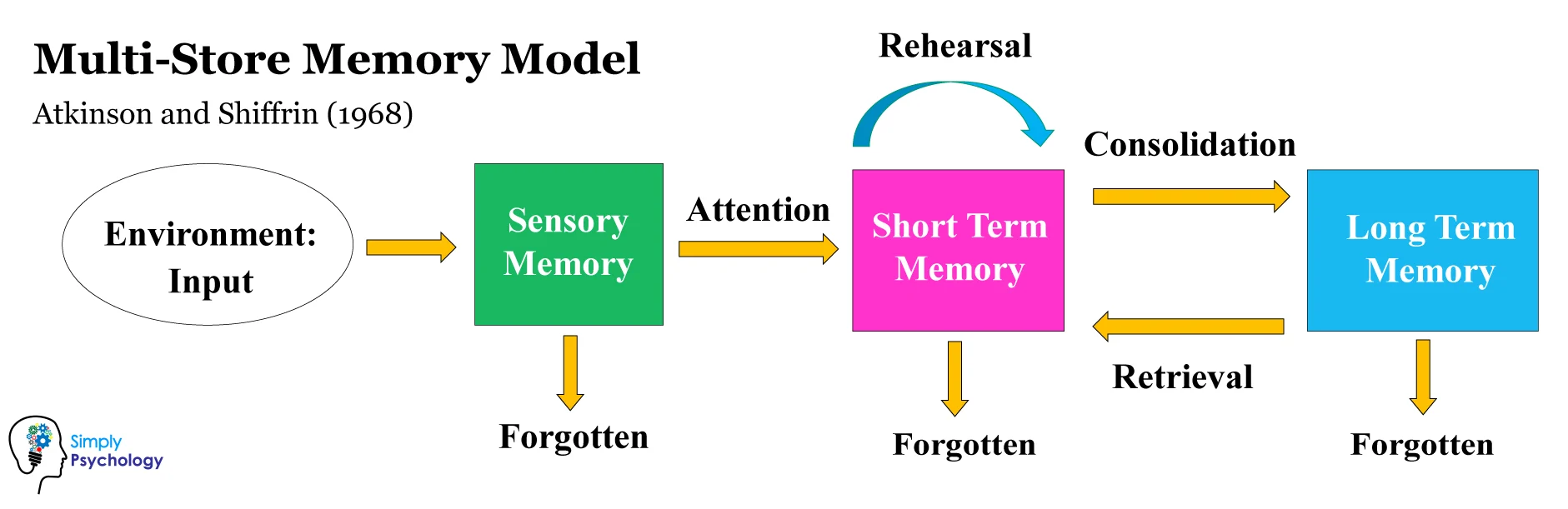
What is Sensory Store?
Something must first trigger our senses to be committed to memory
What is Short Term Memory
If we pay attention to the sensory trigger, it goes into STM along with ~4-6 other things, most of which get forgotten
What is Long Term Memory
If the trigger gets rehearsed repeatedly, it could end up in limitless LTM
What is Rehearsal
Practicing something recently learned, leading to LTM
What is Retrieval
Pulling something back out of LTM