APK4125 Lab 7: Air Plethysmography Body Composition Analysis (BodPod)
 Studied by 0 people
 Call Kai
 Learn
Learn Practice Test
 Spaced Repetition
 Match
Match Flashcards
 Knowt Play
1/55

There's no tags or description
Looks like no tags are added yet.
Name | Mastery | Learn | Test | Matching | Spaced |
|---|
No study sessions yet.
56 Terms
Plethysmography is simply a measure in the ?, meaning air plethysmography is an assessment of the ?
-change of volume
-change in volume of air
The ? is the ? name of a device that measures air plethysmography
-BODPOD
-brand
The BODPOD is a large egg-shaped ? chamber that is capable of measuring ?
-fiberglass
-pressure changes
The BODPOD was created by ? and ? in 1990 and released by ? as the BODPOD in 1995
-Susan Aitkens and Phil Dempster
-Cosmed
BODPOD is an accurate method of ? measurement that is ?, requires minimal client ?, and minimal ? skill
-body composition
-fast
-compliance
-technician
The general premise of BODPOD is simple and works the same as ?
hydrostatic weighing
After volume is measured in the BODPOD, a ? model is used to estimate their body fat and is therefore an ? method
-2-compartment
-indirect method
The BODPOD has two chambers: ?
reference chamber and measurement chamber
Reference chamber has a volume of ?L
Measurement chamber has a volume of ?L
-300L
-450L
There is a ? located between the two chambers of the BODPOD
diaphragm
During a measurement, the diaphragm ? back and forth to create ? volume changes (of roughly ? mL) that are equal in ? but opposite in ?
-oscillates
-sinusodial
-(of roughly 350mL)
-magnitude
-sign
Volume changes lead to ? and ? pressure changes in the two chambers
small and complementary
The BODPOD computer uses the changes of ? and ? between the reference chamber and the testing chamber to calculate ?
-volume and pressure
-volume
The known volume inside the testing chamber is ?L
450L
Depending on the conditions of ?, the relationship between ?, ? and ? changes
-the environment
-pressure, volume, and temperature
**major problem in measuring volume changes of air in a closed system
Density= ?
mass/volume
Isothermal conditions
the temperature of the system stays constant because there is a transfer of heat between the system and the surroundings
When air is in isothermal conditions, the relationship between pressure and volume of a ? can be explained by ?
-gas
-Boyle's Law
Boyle's Law
(P1/P2)=(V2/V1)
Adiabatic conditions
the temperature of the system is not constant and there is no transfer of heat between the system and the surroundings
When air is in adiabatic conditions, the relationships of the pressure and volume of ? can be explained by ?
-gas
-Poisson's equation
Poisson's equation
(P1/P2) =(V2/V1 )^γ
γ is the ratio of ? of the gas
specific heat
When air is inside the BODPOD chamber, it does not act ?
uniformly
Air near the body surface in clothing and hair reacts like ? conditions, air away from the body surface reacts like ? conditions
-isothermal
-adiabatic
Air whose volume is compressed under ? conditions changes its pressure ?% less ? than would occur under ? conditions
-isothermal
-40%
-less compressible
-adiabatic
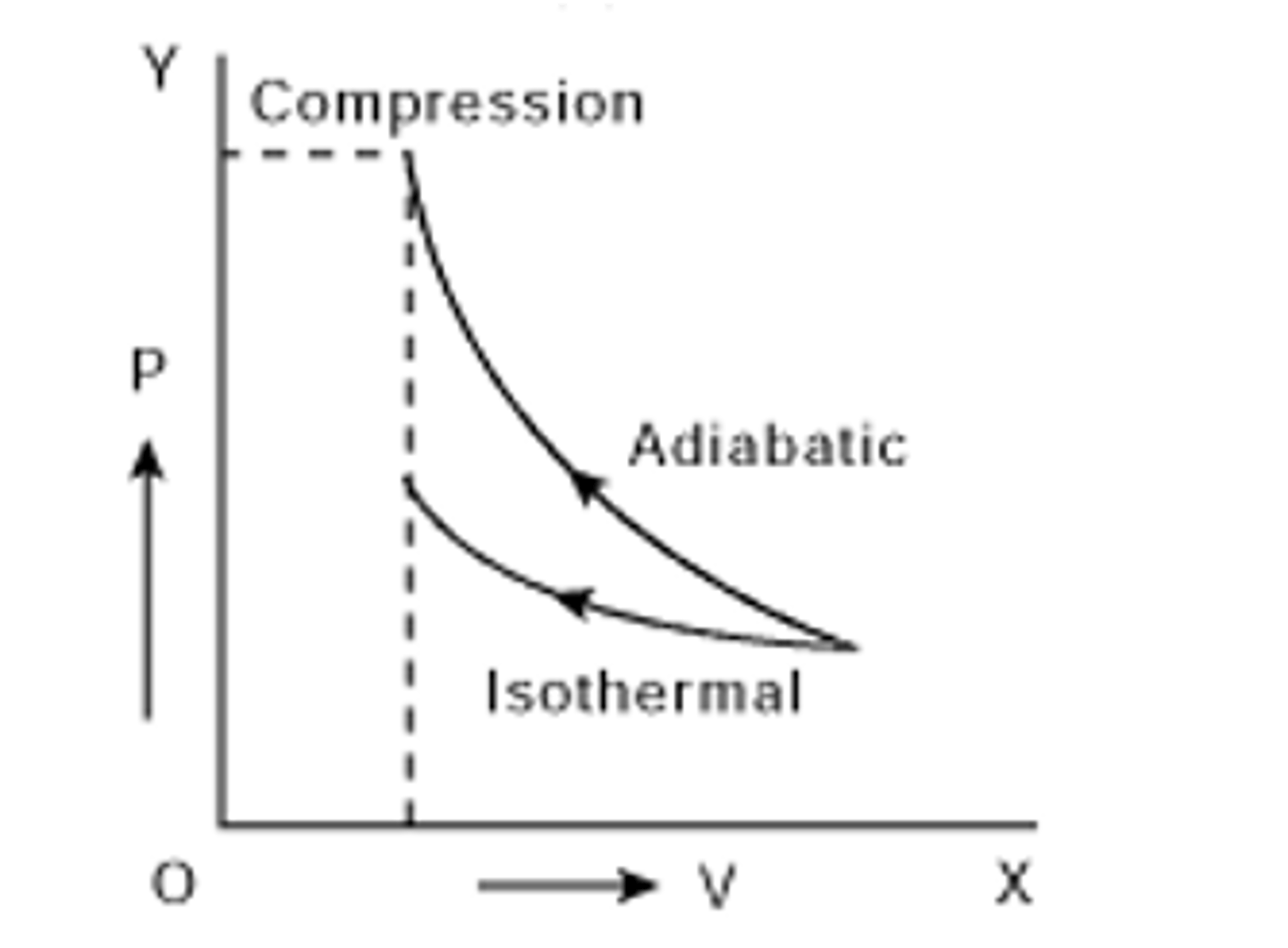
Throughout the measurement in a BODPOD, it is assumed that the air is acting under ? conditions; for this several things must be ? and ultimately ?
-adiabatic
-controlled
-assumed
There must be a constant ?; for this to be true there must be the same ? of air in the reference chamber that is in the testing chamber
-γ (ratio of specific heat of the gas)
-composition of air
To achieve consistent equal gas composition, an ? is used to mix the air between ? throughout measurement
-air circulation system
-between the two chambers
Since the majority of air in the system is acting under ? conditions, the ? will be calculated assuming these conditions; means that anything that increases air under ? conditions must be eliminated
-adiabatic
-volume
-isothermal
Regardless of how many items are eliminated, air that is in contact with the ? is going to act under ? conditions and this must be considered
-skin
-isothermal conditions
The body surface area is estimated by Dubois formula: ?
BSA (cm²)=71.48Weight(kg)^0.425Height(cm)^0.725
BSA is multiplied by ? to yield surface area ? which is automatically computed and used to correct the ? air that cannot be ?
-constant k
-artifact
-isothermal
-eliminated
The average ? volume (?) needs to be considered (can be measured or predicted)
thoracic gas volume (Vtg)
The BODPOD predicts Vtg based on ? and ? of the participant
height and weight
The range for total thoracic volume is ?L to ?L
3L-4.5L
Individuals with higher average Vtg (>?L) will be ? by the BODPOD
Individuals with lower average Vtg (
-(>4.5L) overpredicted
-(<3.0L) underpredicted
Ultimately, the BODPOD takes a measure of ? change inside the measurement chamber by comparison of the reference chamber with air under ? conditions and then factors in the ? and ?
-volume
-adiabatic
-surface area artifact and Vtg
Final Body Volume=?
Body Volume(raw) - Surface Area Artifact + 40%Vtg
The reason Vtg is multiplied by ?% is because lung volume appears this much ? than it is because the air in the lungs is acting under ? conditions
-40%
-larger
-isothermal
Since ? is used to estimate body composition, the estimations of ? model are still assumed:
FFM:
FM:
-density
-2-compartment
-FFM: 1.100g/cm3
-FM:0.900g/cm3
? ?kg weights are used for calibration beside the scale
2 10kg
Testing chamber can accommodate up to ?lbs clients and ?' tall clients
-550lbs
-7'
The volume calibration cylinder has a value of ?L
50.118L (overall volume varies around 50L)
When the client sits back, it changes the ? of the diaphragm when then creates the changes in ? and ? that allow for precise measurement
-surface area
-pressure and volume
Clothing requirements for women and men
Women: form fitting, spandex-type swimwear or single layer compression shorts (no padding) and single layer (not padded) sports bra; remove all jewelry
Men: form fitting spandex-type swimwear or single layer compression shorts (no padding) and no shirt; remove all jewelry
Both: a swim cap will be reqired to be worn during testing
Compliance conditions prior to testing:
-no exercise for at least ? hrs prior to testing
-do not eat/drink liquids for at least ? hrs prior to testing
-avoid ? or ? supplements prior to testing
-void ? before testing
-do not apply ? or ? to the skin the day of
-if you shave any part of the body, do so ?
-no exercise for at least 2 hrs prior to testing
-do not eat/drink liquids for at least 2 hrs prior to testing
-avoid caffeine or thermogenic supplements prior to testing
-void bladder before testing
-do not apply skin creams or lotion to the skin the day of
-if you shave any part of the body, do so the day of the test
Minimal amount of "essential fat" is ?-?% for men, and ?-?% for women
-3-5% for men
-12-15% for women
Risky (high) body fat rating
Men: >30%
Women: >40%
Excess fat rating
Men: 21-30%
Women: 31-40%
Moderately lean body fat rating
Men: 13-20%
Women: 23-30%
Lean body fat rating
Men: 9-12%
Women: 19-22%
Ultra lean body fat rating
Men: 5-8%
Women: 15-18%
Risky (low) body fat rating
Men: <5%
Women: <15%
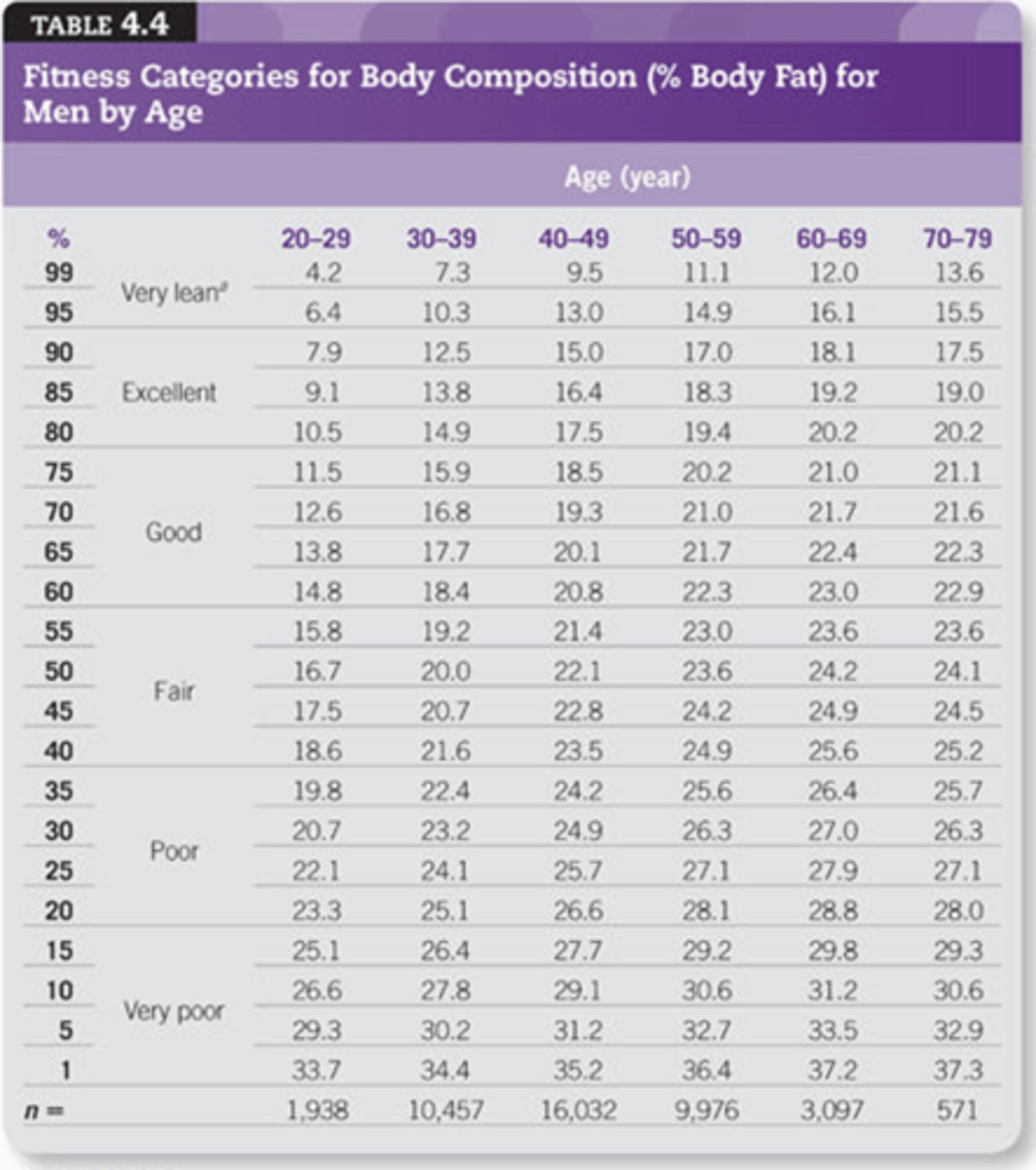
Body composition normative data (men)
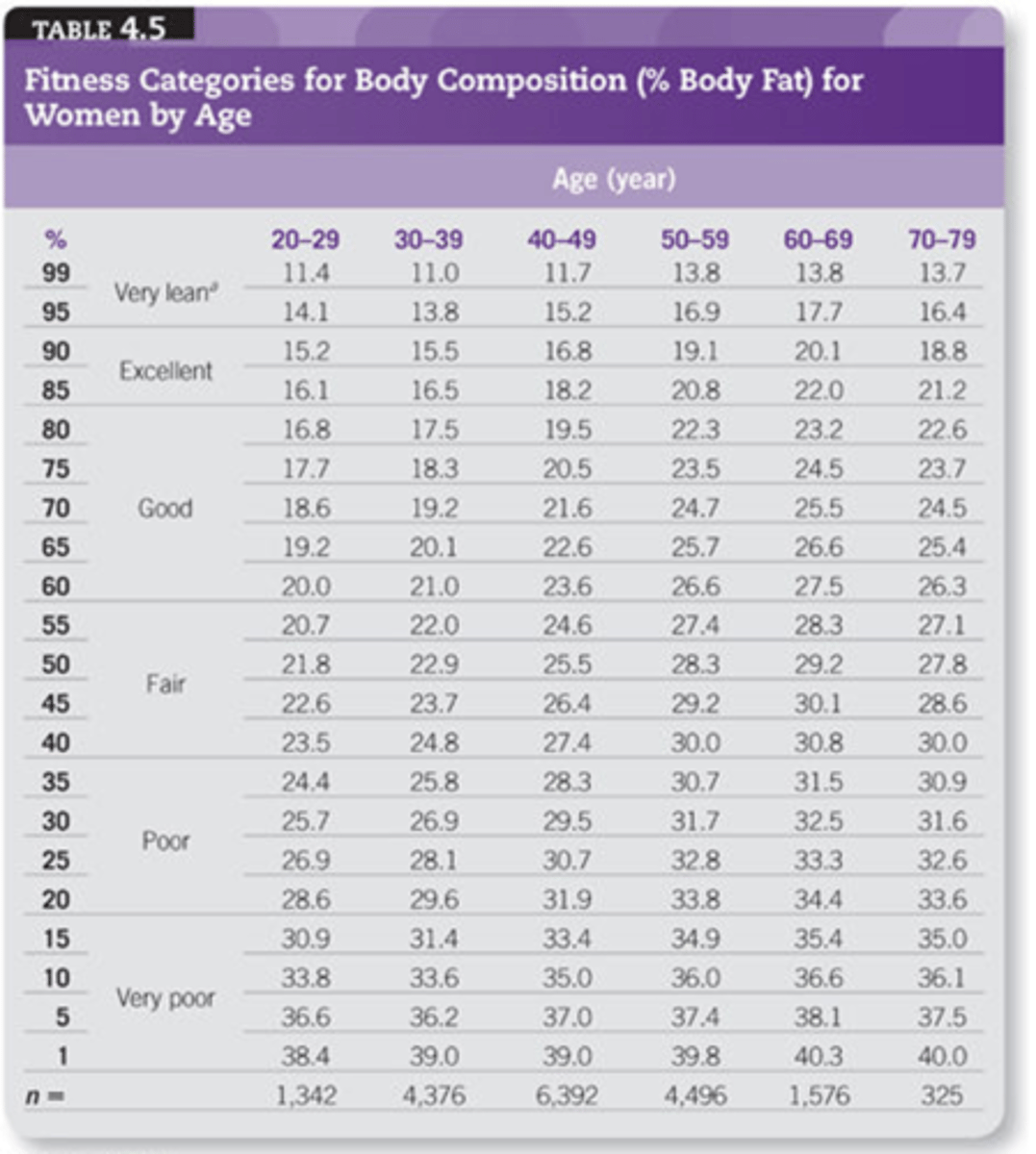
Body composition normative data (women)