CH. 13 Biomechanics & Ergonomics
 Call Kai
 Learn
Learn Practice Test
 Spaced Repetition
 Match
Match Flashcards
 Knowt Play
1/18

There's no tags or description
Looks like no tags are added yet.
Name | Mastery | Learn | Test | Matching | Spaced | Call with Kai | Chat |
|---|
No analytics yet
Send a link to your students to track their progress
19 Terms
Biomechanics
A component of physics, the law of Newtonian mechanics, applied to living bodies at rest and in motion
Base of Support
Foundation on which a body rests or stands. The area between feet in standing position
Center of Gravity
A hypothetical area of the body where the mass of the body is concentrated; the gravity works from this area.
Mobility Muscles
Muscles found in the 4 extremities (arms and legs)
Stability Muscles
Muscles that support the torso and are designed to provide posture stability
Orthostatic Hypotension
A sudden drop in blood pressure in the brain when a person stands up quickly from sitting or supine position, causing the oxygen in the brain to drop and the person to become dizzy and prone to falling.
Signs/Symptoms of Orthostatic Hypotension
Dizzy
Fainting
Blurred Vision
Slurred Speech
Proper Lifting
Bending & Straightening the knees
Back Straight
Inform Patient
Patient’s w/ AMS may overestimate abilites
Standby Assist
Transfer from wheelchair to table on their own
Provide movement instructions to patient
Assisted Standing Pivot
Wheelchair to table
Use transfer belt to hold patient. If No Belt: Put your arm under theirs’ and hold the back of their pants.
Patient sits at the end of the wheelchair
Patient pushes down on wheelchair arms and bends knees to stand up
Patient pivots towards chair
Then holds onto the table and sits down
Two-Person Lift
1st Person asks patient to cross their arms over chest
Person making transfer stands behind patient and reaches under patient’s armpit and grasp onto their forearm
2nd person squats and grabs patient’s thigh with one hand and calves with the other
At the 1st persons’ go: the patient is lifted and moved to desired place
Hydraulic Lift
Used when patient is too heavy to lift
If patient is transferred without lift (transfer) sling, call the nursing floor and return patient back to floor
Call Transfer with Slider Board
Roll patient away from table
Position board under patient and draw sheet
Roll patient back and ensure they’re on the board
Gently pull draw sheet and patient onto the table
Cart Transfer with Draw Sheet
Roll up draw sheet on both sides of the patient
Patient crosses arms over chest
Assistant pushes patient to the table while you pull in your direction
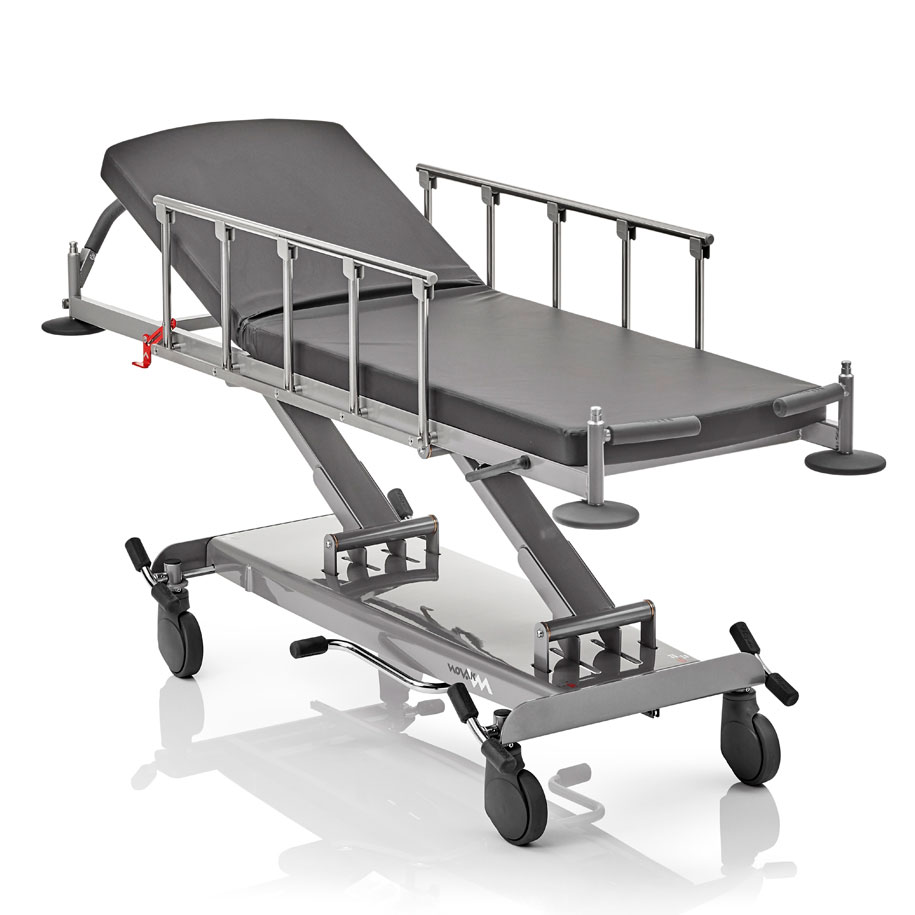
When moving a patient to or from a stretcher
lock the stretcher securely against examination table
Supine vs Prone
Supine - face up
Prone - face down
Lateral vs Sims
Lateral - lying on left or right side
Sims - lying on left side with leg flexed up to chest
Fowlers
Lying on back with the head of the bed elevated
Recumbent
Lying down horizontally