L9 - Beta Blockers (Part C)
 Call Kai
 Learn
Learn Practice Test
 Spaced Repetition
 Match
Match Flashcards
 Knowt Play
1/57

There's no tags or description
Looks like no tags are added yet.
Name | Mastery | Learn | Test | Matching | Spaced | Call with Kai | Chat |
|---|
No analytics yet
Send a link to your students to track their progress
58 Terms
What is first-pass metabolism?
Metabolism of an absorbed drug in the liver before it reaches systemic circulation.
How do orally absorbed drugs reach the liver before systemic circulation?
They enter the liver through the portal vein.
Does propranolol undergo significant first-pass metabolism?
Yes; propranolol undergoes extensive first-pass metabolism.
Approximately what percentage of propranolol reaches systemic circulation?
About 25%.
What is the main purpose of Phase I metabolism?
To introduce or expose polar functional groups on a drug.

What are the 3 major categories of Phase I reactions?
Oxidation, reduction, and hydrolysis.
What types of bonds are commonly hydrolyzed during Phase I metabolism?
Esters and amides.
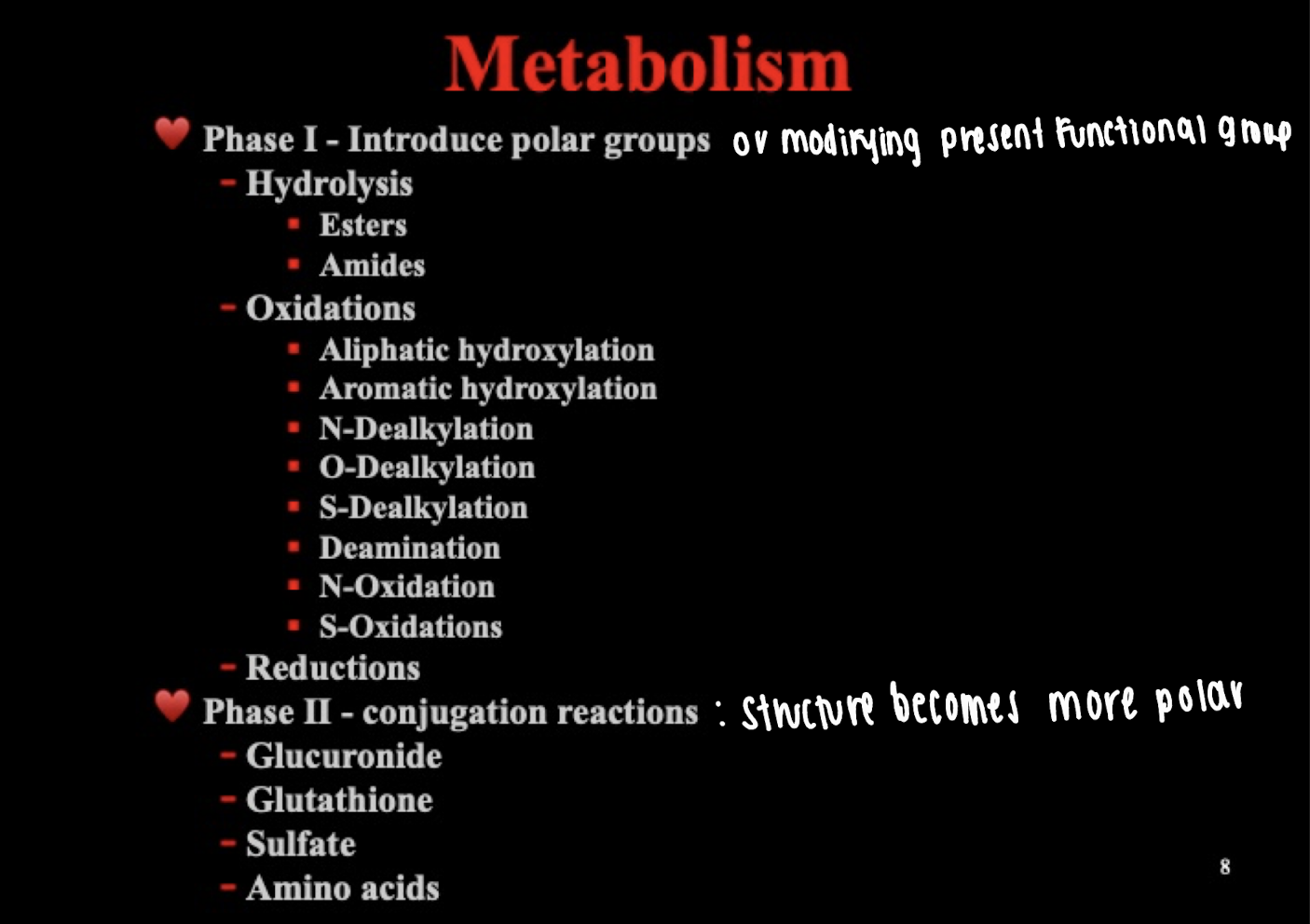
What are important Phase I oxidation reactions?
Aliphatic hydroxylation, aromatic hydroxylation, N-dealkylation, O-dealkylation, S-dealkylation, deamination, N-oxidation, and S-oxidation.
What is the main purpose of Phase II metabolism?
Conjugation of the drug or Phase I metabolite with a polar group.
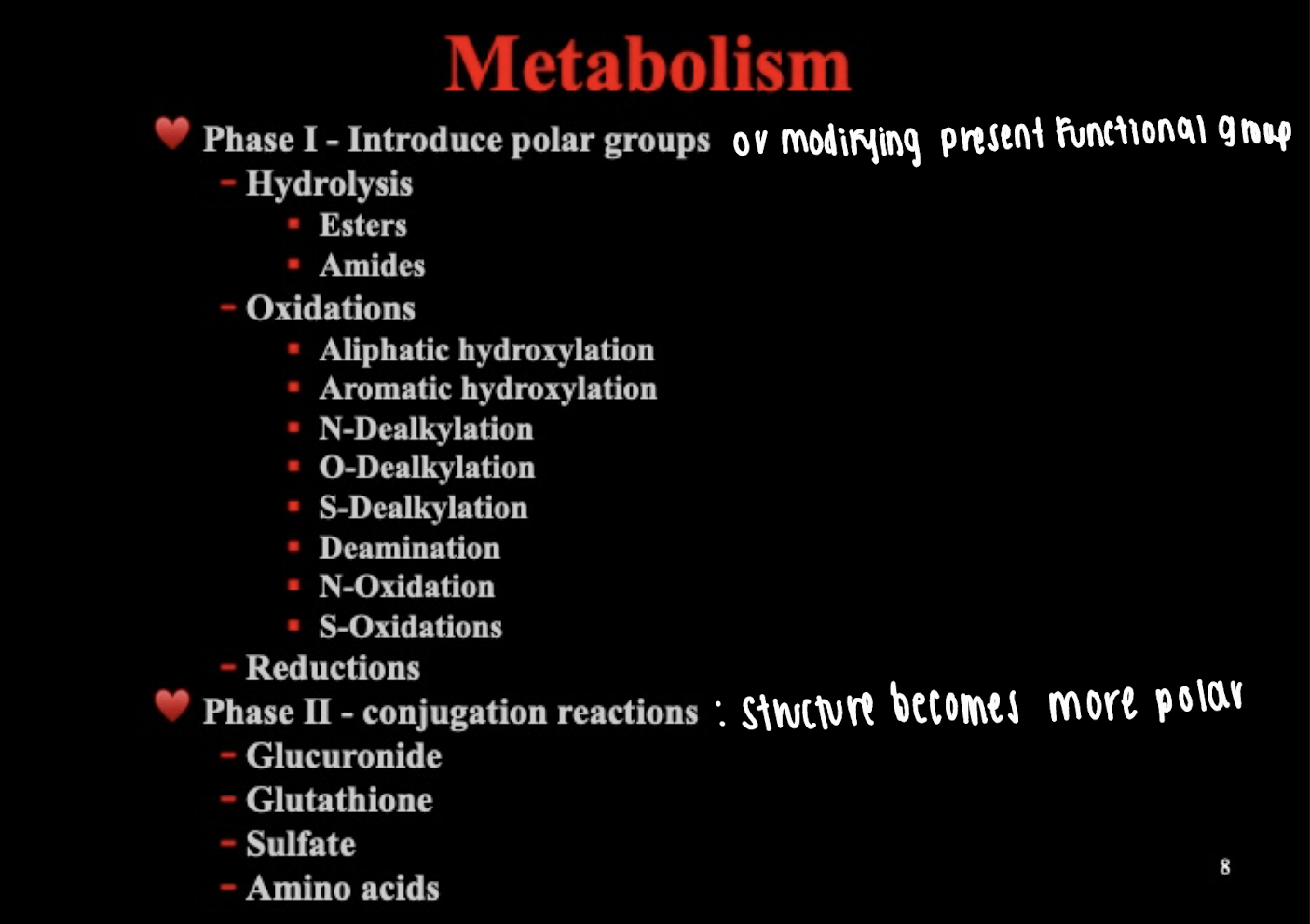
What are the Phase II conjugation reactions listed in this lecture?
Glucuronide, glutathione, sulfate, and amino acid conjugation.
Phase I vs. Phase II metabolism
Phase I introduces/exposes polar groups through oxidation, reduction, or hydrolysis; Phase II performs conjugation reactions.
What Phase I metabolic pathways does propranolol undergo?
Oxidative deamination, N-dealkylation, and aromatic hydroxylation.
What Phase II metabolic pathway is emphasized for propranolol?
Glucuronide conjugation.
What enzyme system is responsible for many drug oxidation reactions?
Cytochrome P450 (CYP450).
What type of mechanism is involved in CYP450 hydroxylation?
A free-radical mechanism.
What is the overall CYP450 hydroxylation reaction?
Drug-H → Drug-OH using CYP450, O₂, and NADPH.
Which CYP family makes up the largest percentage of total liver P450 in the lecture?
CYP3A (~63%).
Which CYP family metabolizes the largest percentage of drugs in the lecture?
CYP3A (~44%).
Why is CYP2D notable despite making up only ~2% of total liver P450?
It metabolizes about 30% of drugs.
What must happen first during propranolol oxidative deamination?
Aliphatic hydroxylation occurs on the carbon adjacent to the nitrogen, forming a hemiaminal (carbinolamine) intermediate.
What intermediate is formed during oxidative deamination of propranolol?
A hemiaminal (carbinolamine) intermediate.
How does the hemiaminal intermediate rearrange during propranolol oxidative deamination?
The secondary amine is protonated, followed by rearrangement of the OH group with simultaneous loss of the isopropyl secondary amine.
What products result from oxidative deamination of propranolol?
An aldehyde-containing metabolite plus isopropylamine.
What can happen to the aldehyde produced by oxidative deamination?
It can be reduced to an alcohol or oxidized to a carboxylic acid.
Why are aldehyde metabolites rapidly transformed in the body?
Aldehydes are relatively unstable and react rapidly under physiological conditions.
How does propranolol undergo N-dealkylation?
CYP-mediated hydroxylation produces a hemiaminal intermediate that rearranges and removes an alkyl group from nitrogen.
What is the key difference between oxidative deamination and N-dealkylation of propranolol?
Oxidative deamination removes the amine from the side chain, whereas N-dealkylation removes an alkyl substituent from the nitrogen while leaving the amine attached to the drug.
What type of intermediate forms during aromatic hydroxylation?
An arene oxide.
What happens after formation of an arene oxide during aromatic hydroxylation?
The arene oxide rearranges through resonance-stabilized intermediates and a 1,2-H shift to produce a phenol.
Why does carbocation stability matter during aromatic hydroxylation?
A positive charge develops in resonance-stabilized intermediates, so pathways producing the more stable carbocation are favored.
What aromatic ring system does propranolol contain?
A naphthalene ring system.
How does the ether oxygen affect electron density in propranolol's naphthalene system by induction?
The electronegative oxygen pulls electron density away from the aromatic carbon through the C-O bond.
How does the ether oxygen affect electron density in propranolol's naphthalene system by resonance?
An oxygen lone pair donates electron density into the π system of the naphthalene ring.
Why can one aromatic ring of a multi-aromatic drug be hydroxylated preferentially?
Substituents alter electron density and the stability of carbocation-like intermediates, making one ring more favorable for CYP450 aromatic hydroxylation.
Which position of propranolol is preferentially hydroxylated?
The 4-position, producing 4-hydroxypropranolol.
Why is the 4-position of propranolol preferentially hydroxylated?
The pathway leading to 4-hydroxylation forms the more stable resonance-stabilized carbocation intermediate.
What happens to 4-hydroxypropranolol after Phase I metabolism?
It can undergo Phase II glucuronide conjugation.
Why does aromatic hydroxylation facilitate Phase II metabolism?
It introduces an OH group that can undergo conjugation, such as glucuronidation.
Can the original alcohol of propranolol undergo glucuronidation?
Yes; the lecture shows glucuronide formation involving an OH group of propranolol as well as the phenolic OH of 4-hydroxypropranolol.
How would you predict whether a β-blocker can undergo aromatic hydroxylation?
Look for an aromatic ring with a position available for CYP450 hydroxylation and consider electronic effects that stabilize the reaction intermediate.
How would you predict whether a β-blocker can undergo N-dealkylation?
Look for an N-alkyl group with a carbon adjacent to the nitrogen that can undergo CYP-mediated hydroxylation.
How would you predict whether a drug can undergo oxidative deamination?
Look for an amine with an adjacent carbon that can be hydroxylated to form a hemiaminal intermediate that can rearrange and eliminate the amine.
How would you predict whether a drug can undergo glucuronidation?
Look for a conjugatable functional group such as an OH group; Phase I metabolism may also introduce an OH group first.
What major functional groups/ring systems are present in propranolol?
Naphthalene aromatic ring system, aryl ether, secondary alcohol, and secondary amine.
What type of amine is present in propranolol?
A secondary amine.
What type of alcohol is present in propranolol?
A secondary alcohol.
What type of ether is present in propranolol?
An aryl ether connecting the naphthalene ring system to the side chain.
What is the aromatic ring system in propranolol?
Naphthalene: two fused aromatic rings.
If a drug undergoes hydroxylation, is that Phase I or Phase II?
Phase I.
If a drug undergoes N-dealkylation, is that Phase I or Phase II?
Phase I.
If a drug undergoes oxidative deamination, is that Phase I or Phase II?
Phase I.
If a drug undergoes hydrolysis, is that Phase I or Phase II?
Phase I.
If a drug undergoes glucuronidation, is that Phase I or Phase II?
Phase II.
If a drug undergoes sulfate conjugation, is that Phase I or Phase II?
Phase II.
If a drug undergoes glutathione conjugation, is that Phase I or Phase II?
Phase II.
If a drug undergoes amino acid conjugation, is that Phase I or Phase II?
Phase II.
What is the overall metabolism sequence for aromatic hydroxylation of propranolol?
Propranolol → CYP450 aromatic hydroxylation → 4-hydroxypropranolol → Phase II glucuronidation.
What is the overall metabolism sequence for oxidative deamination of propranolol?
Propranolol → aliphatic hydroxylation → hemiaminal intermediate → protonation/rearrangement → aldehyde metabolite + isopropylamine → aldehyde may be oxidized or reduced.