CHEM 1312 Chapter 12: Chemical Equilibrium
 Call Kai
 Learn
Learn Practice Test
 Spaced Repetition
 Match
Match Flashcards
 Knowt Play
1/31

There's no tags or description
Looks like no tags are added yet.
Name | Mastery | Learn | Test | Matching | Spaced | Call with Kai |
|---|
No analytics yet
Send a link to your students to track their progress
32 Terms
equilibrium
dynamic state where forward and reverse reaction rates are equal
dynamic equilibrium
both forward and reverse reactions continue at the molecular level, even though concentrations appear constant
law of mass action
products over reactants, coefficients become exponents (basis for writing K expressions)
equilibrium constant (Kc)
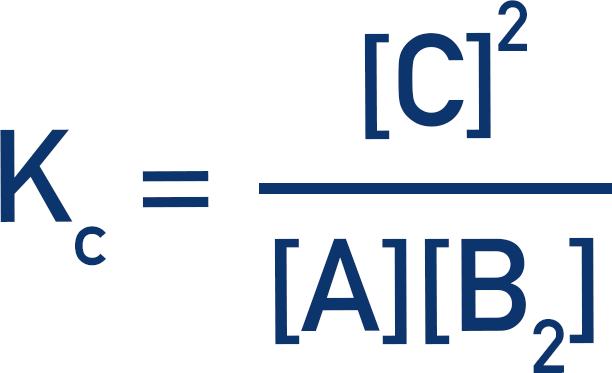
Large K (»1)
equilibrium favors products
Small K («1)
equilibrium favors reactants
K vs. rate law exponents
K’s exponents come directly from balances equation coefficients; rate law exponents must be found experimentally
Kp
equilibrium constant expressed using partial pressures instead of concentrations
Kp/Kc relationship
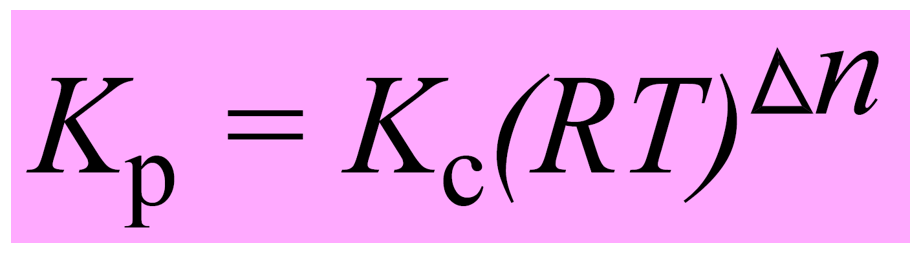
Δn
moles of gas (products) - moles of gas (reactants), from balanced equation coefficients
heterogeneous equilibrium
equilibrium involving species in more than one phase
pure solids/liquids in K expressions
omitted entirely; their “concentration” (density) is constant and gets absorbed into K
effect of adding/removing solid/liquid
no effect on equilibrium position of K
reaction quotient (Q)
same expression as K, but using concentrations at any given moment (not necessarily equilibrium)
Q<K
reaction shifts forward (toward products)
Q>K
reaction shifts reverse (toward reactants)
Q=K
system is at equilibrium, no shift
ICE table
Initial, Change, Equilibrium - organizes stoichiometry-based equilibrium calculations
Change row (ICE)
uses stoichiometric coefficients as the ratio for how much each species changes (-ax, +cx, etc.)
approximation (small x)
when K is very small, [A]0 - x ≈ [A]0, simplifying the algebra
5% rule
validity check for the approximation
Le Châtelier's principle
a system at equilibrium shifts to partially counteract an applied disturbance
effect of adding reactant
shifts forward
effect of adding product
shifts reverse
effect of decreasing volume (increasing pressure)
shifts toward fewer moles of gas
effect of increasing volume (decreasing pressure)
shifts toward more moles of gas
effect of increasing T (exothermic reaction)
shifts reverse; K increases
Effects of increasing T (endothermic reaction)
shifts forward; K decreases
Only disturbance that changes K
temperature
reversing a reaction
K becomes 1/K (reciprocal)
multiplying all coefficients by n
K becomes Kn
Adding two reactions together
multiply their K values