FUCK BIO 324
 Call Kai
 Learn
Learn Practice Test
 Spaced Repetition
 Match
Match Flashcards
 Knowt Play
1/306

Earn XP
Description and Tags
Lecture 2- Lecture 6
Name | Mastery | Learn | Test | Matching | Spaced | Call with Kai | Chat |
|---|
No analytics yet
Send a link to your students to track their progress
307 Terms
What are the two tests to answer developmental questions?
Correlative tests
Functional tests
What are correlative tests?
A test to find the correlation between two observations
What are examples of correlative tests?
• Observation by eye or microscope
• Label and follow cells
• Protein localization (immunostain)
• mRNA localization (in situ hybridization)
• RNA seq
• qRT-PCR
• Microarray
• Transgene reporter
What are the three outcomes correlation could be?
• cause of the observation
• consequence of the observation
• unrelated to the observation
What kind of test could be the cause of the observation, the consequences of the observation, or unrelated to the observation?
The correlation test
What did Edwin Conklin observe?
The correlation between yellow pigment and muscle fate
(tunicate blastomeres inheriting yellow pigment
went on to form muscle cells)
What best describes the relationship between the yellow pigment and muscle cell development?
consequence— yellow pigment is activated in cells destined to becoming muscle
Conklin was using sort of the natural pigmentation of the tunic kits.
This was an early form of what?
Dye labeling
What does dye labeling do?
it follows the fate of cells in the embryo
What is a functional test?
A test that physically interferes with a system;
“What happens if we reduce or eliminate a gene/protein”
or
“Manipulate the embryo - how does it impact development?”
What are examples of a function test (lose-it approach)?
Reduce mRNA or translation of mRNA
(example: Morpholino injection)
• Delete gene (homologous recombination
or Crispr Cas9)
• Inactivate protein (inactivating antibody,
protease, or chemical)
• Express dominant negative proteins
What are the three outcomes functional tests could be (lose-it approach)?
• Direct result of manipulation
• Secondary consequence of manipulation
• Non-specific effects of manipulation
What are examples of a function test (move-it approach)?
• Move or transplant cells
• Remove parts of embryo
• Treat with drugs/chemicals
• Move mRNA/protein to a new region
(microinjection or transgene)
What are the three outcomes functional tests could be (move-it approach)?
• direct result of manipulation
• direct result but mimics the real signal
• secondary consequence of manipulation
Correlative tests + functional tests =
coherence
What is coherence?
when experimental outcomes from a variety of
scientific approaches agree, this supports a hypothesis!
What general principles make it valid to study the development of other organisms to infer molecular mechanisms that regulate human development?
genetics, evolution, etc…
What is embryogensis?
Stages of development between
fertilization and birth/hatching
What is the pathway of human embryogenesis (simple)
preembryonic ——> emrbyonic period ——→ fetal period
What is the preembryonic stage (weeks 1 & 2) of the human embryogenesis process?
fertilization to
gastrulation
What is the embryonic stage (weeks 3-8) of the human embryogenesis process?
gastrulation to early organogenesis
What is the fetal period (weeks 9-38) of the human embryogenesis process?
organ maturation development continues after birth – brain,
stem cells.....
What is the fertilization process?
when two haploid gametes (a sperm and an egg) fuse to create a diploid
When fertilization occurs, mechanisms are activated to prevent polyspermy.
What is polyspermy, and why is it prevented?
It is when multiple sperm penetrate an egg, and it is prevented because it usually results in failed fertilization.
After fertilization, cleavage occurs.
What is cleavage?
Mitotic cell division without cell growth (total
embryo volume stays same.
After fertilization, cleavage occurs.
What does cleavage result in ?
blastomeres
In xenopus, blastomeres form a hollow ball called what?
blastula
In early embryonic cell divisions, each time a cell divides, what happens?
the cell becomes half as big
What is cell cycle in somatic cells?
mitosis → gap phase 1 —> DNA synthesis —> gap 2 —> mitosis
What is cell cycle in early embryonic cells?
mitosis—> DNA synthesis —> mitosis
What is the difference between the cell cycle in early embryonic cells and somatic cells?
early embryonic cells DO NOT have gap phase 1 and gap phase 2
After cleavage, gastrulation happens.
What is gastrulation?
Major reorganization of cells (morphogenesis)
What is formed in gastrulation?
Three germ layers
(and the germline is set aside).
What are the three germ layers of gastrulation?
ectoderm (outer layer)
mesoderm (middle layer)
endoderm (inner layer)
The embryonic tissues of gastrulation interact to establish the axes.
What are the axes?
anterior/posterior
dorsal/ventral
left/right

What are the three types of the ectoderm?
outer surface
central nervous system
neural crest
What are the outer surface cells (ectoderm)?
epidermal cells of skin
What are the central nervous system cells (ectoderm)?
neurons of the brain
What are the neural crest cells (ectoderm)?
pigment cell (melanocyte)
What are the five types of the mesoderm?
dorsal
paraxial
intermediate
lateral
head
What is an example of a dorsal cell? (mesoderm)
notochord
What is an example of a paraxial cell? (mesoderm)
bone tissue muscle
What is an example of an intermediate cell? (mesoderm)
tubule cell of the kidney
What is an example of a lateral cell? (mesoderm)
red blood cells
What is an example of a head cell? (mesoderm)
facial muscle
What are the three types of the endoderm?
digestive tube
pharynx
respiratory tube
(also gallbladder, pancreas, liver)
What is an example of a digestive tube cell? (endoderm)
stomach cell
What is an example of a pharyngeal cell? (endoderm)
thyroid cell
What is an example of a respiratory cell? (endoderm)
lung cell (alveolar cell)
After gastrulation, organogenesis (and organ maturation) occurs.
What is organogenesis?
Organs are derived primarily from one germ layer
What does organogenesis (and organ maturation) often require?
signals from neighboring tissues
In terms of organogenesis, what is generally conserved across many species?
the tissue origin of organs
In adults, gametogenesis occurs.
What is gametogenesis?
Bipotential diploid germ cell precursors of
gametes are reserved during gastrulation
• Diploid germ cells migrate to the
developing gonads
• Postnatal differentiation of the haploid
male and female gametes
What is the phylotypic stage?
period in development when the embryos within
a phylum have the highest level of shared
appearance.
In the phylotypic stage, the evolutionarily oldest genes share what?
similar temporal expression pattern
What are Karl Ernst Baer’s principles?
Features shared by many animals appear
earlier in development compared to specialized features found in a small group of animalsSpecialized characteristics develop from
shared generalized structuresAn embryo of one species does not pass
through the adult stage of a lower speciesAn early embryo of a higher animal is only
similar to the embryo of a lower animal, not to the adult
According to Karl Ernst von Baer (principle one),
The shared features of a group of animals appear earlier in development
The specialized features characteristic of a smaller group develop later.
What is a good example?
Human embryo & Mouse embryo

According to Karl Ernst von Baer (principle two),
Specialized characteristics develop from the more general structures.
What is an example?
Limb bud becomes human arms/hand and legs/feet or mouse legs/paws
According to Karl Ernst von Baer (principle three),
the embryo of a given species DOES NOT pass through the adult stages of lower animals.
The early embryos are similar and gradually become different.
What is a good example?

According to Karl Ernst von Baer (principle four),
the early embryos of higher animals are similar to the early embryos of the lower animals (phylotypic stage).
What is a good example?
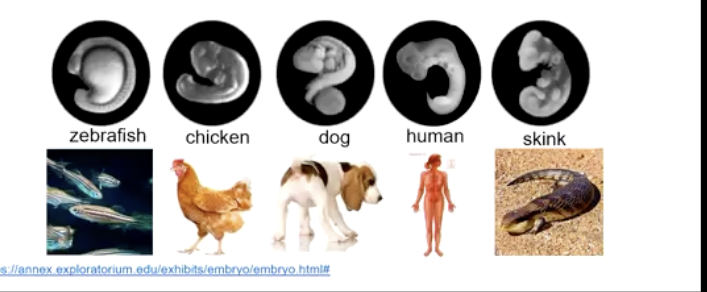
What are the characteristics focused on when choosing a model organism to study?
• Size
• Generation Time
• Embryo Accessibility
• Feasibility of genomic interrogation
• Organism type and phylogenetic position
• Ease of experimental manipulation
• Relevance to the question being studied
What is a commitment?
a transition state between uncommitted and differentiated cells
In the earlier stages of commitment, the fate of cells is more what?
flexible; (the fate can switch)
specified
In the later stages of commitment, the fate of cells is more what?
inflexible; (the fate CANNOT switch)
determined
Commitment choices of the cell are influenced by what?
Factors in the cell
environment that the cell encounters
chance
What are the two types of specification?
autonomous specification
conditional specification
What is autonomous specification?
Factors localized within a cell or on
the cell surface
What are the two ways the factors in the cell can be inherited/ activated?
(specification)
Maternal (inherited from egg)
Zygotic (produced by the embryo)
What is conditional specification?
Factors EXTERNAL to the cell/tissue influence the commitment choice
During early embryonic development, researchers isolate a group of cells from a developing embryo and culture them in a dish without the neighboring tissues that normally surround them. The isolated cells, nevertheless, differentiate into the same cell type they would have produced in their original location.
Which conclusion is best supported by this experiment?
The cells were automatically specified before isolation and therefore retain the information necessary to follow their developmental fate.
What is a good example of autonomous specification?
Despite being isolated in an experiment, presumptive trophoblast cells (progenitors) still become normal trophoblast cells
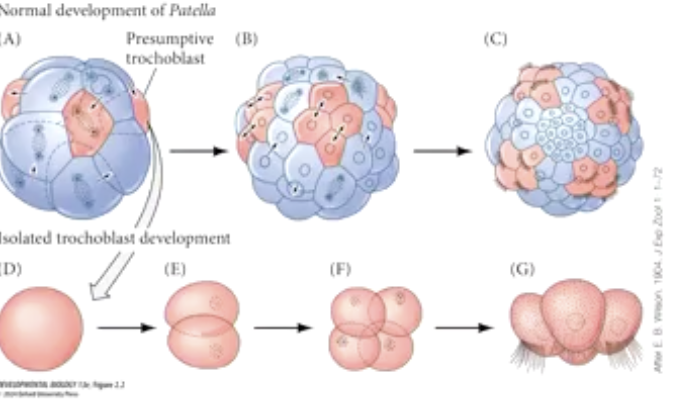
What is an example of conditional specification?
A sea urchin embryo (at the 4 cell stage0 was separated into 4 individual cells.
Each was grown separately.
Each cell made a whole embryo with ALL cell types (the embryos were smaller than normal)
What does specification lead to?
Heritable changes in chromatin/gene expression patterns (epigenetic)
What will the changes caused by specification lead to?
restriction of the potential of a stem cell
triggering of differentiation
Through the commitment process genes will transition through active, poised, or repressed states (or the reverse!)
What are the characteristics of the active stage?
Permissive histone
modifications
• Open chromatin
(euchromatin)
• RNA polymerase and
transcription factors
have access to gene
Through the commitment process genes will transition through active, poised, or repressed states (or the reverse!)
What are the characteristics of the poised stage?
• Histone modifications
prepare for RNAPII
for TF access
Through the commitment process, genes will transition through active, poised, or repressed states (or the reverse!)
What are the characteristics of the repressed (inactive & harder to reverse) stage?
Repressive histone
modification
• Genes inaccessible to
RNA PII or TFs
Through the commitment process, genes will transition through active, poised, or repressed states (or the reverse!)
What are the characteristics of the repressed (inactive & reversible) stage?
• Repressive DNA or
histone modifications
prevent RNA PII for
TF access
These frog blastomeres appear identical, how can you
experimentally determine if they are committed?
1. Label the cells and follow their fate (fate map)
2. Remove cells and see what they become in
culture or when transplanted to new location
(commitment test).
3. Remove cells and see how it affects
development of the embryo (can remaining cells
compensate?)

Fate maps combine results from many labeling experiments; summarizes the level of cell commitment at the time of labeling
What happens to the cells that are uncommitted?
Descendants of the labeled cell will be
found in ALL tissues
Fate maps combine results from many labeling experiments; summarizes the level of cell commitment at the time of labeling
What happens to the cells that are committed?
Descendants of the labeled cell will be found
in a SUBSET of tissues
What is the fate of committed cells are found in the surface ectoderm?
Surface ectoderm -> epidermis

What is the fate of committed cells are found in the neural ectoderm?
Neural ectoderm -> CNS
What is the fate of committed cells found in the mesoderm?
Mesoderm -> Muscle
What is the fate of committed cells found in the endoderm?
Endoderm -> Digestive system
If you remove a cell from an early embryo that would normally become a neuron, but when you culture it in a dish, it becomes a muscle cell, what type of specification does this suggest?
conditional
What two tests determine whether a specification is conditional or autonomous?
cell transportation
extirpation
(functional tests)
What is cell transplantation?
cells are removed from a region fated to become one cell type and moved to a region fated to be a different cell type (conditional)
What happens in cell transplantation?
Host embryos are grown, and donor cell
type is determined
What is extirpation?
Cells are removed from a region fated to
become one cell type
What happens in extirpation?
Embryo is grown and
analyzed for a deficit
of any cell type
**if it is missing, this is AUTONOMOUS
What is a functional test?
The isolation of cells and
place in a neutral
environment to see if they differentiate
according to the fate map

What is the procedure for a functional test of the level of commitment?
Change the environment surrounding a specified cell to see if the cell changes fate.
For a functional test of the level of commitment, if the committed cell is specified, what could happen?
It can alter its fate in response to the new environment
In a functional test (of the level of commitment), what happens if a committed cell is specified?
It can alter its fate in response to the new environment
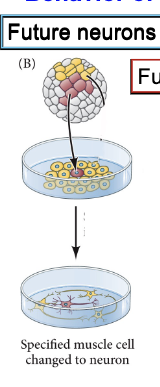
In a functional test (of the level of commitment), what happens if a committed cell is determined?
It is unable to alter its fate in response to the new environment.
What is a modern approach to understanding cell specification?
single cell RNA-seq
What is the procedure of single cell RNA-seq?
Embryos are dissociated into single cells → RNA is isolated from individual cells and used to make cDNA with unique barcodes→ Sequencing is performed, and data is annotated based on known cell-type gene expression
Single cell RNA-seq data is visualized as tSNE or UMAP plots.
What are tSNE or UMAP plots?
dimensionality reductions algorithms
Allows visualization of high-dimensional data in 2D or 3D
(transcriptomes are color coded—indicating what type of cell)
Data from multiple stages can be compared to follow the
trajectory of cells as they are specified with each color representing a different embryonic stage.
With this particular tree, how can lineages be followed?
based on spatial relationships of individual cell transcriptomes
