Dementia, CCD, Aphasia and PPA
 Call Kai
 Learn
Learn Practice Test
 Spaced Repetition
 Match
Match Flashcards
 Knowt Play
1/34

Earn XP
Description and Tags
Name | Mastery | Learn | Test | Matching | Spaced | Call with Kai | Chat |
|---|
No analytics yet
Send a link to your students to track their progress
35 Terms
What characterises the PPA Logopenic subtype (PPA-L)?
Problems with:
Word-finding difficulties
What characterises the PPA Semantic subtype (PPA-S)?
Problems with
Recognising and naming familiar objects, people or places
What characterises the Agrammatic/non-fluent PPA (PPA-G)?
Problems with:
Grammar
Motor speech difficulties
What are 3 factors that can influence recovery from CCD?
PTA
Years of education that a person has had
Aphasia
What 3 measures can you use to assess the initial severity of TBI?
Loss of consciousness (LOS)
Glasgow Coma Scale (GSC)
Post-Traumatic Amnesia (PTA)
What are the 4 components of Grice's Maxims?
Relevance
Quantity
Quality
Manner
What are the 3 subtypes of CCD?
Confused
Impoverished
Verbose
What is the FAVRES Assessment?
Reflective of functioning in the real world -> involves cognitive/executive functioning tasks
Getting facts
Eliminating irrelevant information
Weight facts
Being flexible when new info arises
Generate alternatives
Predict consequences
Provide rationales
What self-rating scale can you give to a person with PPA?
Communication Confidence Rating Scale for Aphasia (CCRSA)
What is an alternative to the LaTrobe Questionnaire for self-awareness?
Self-Awareness of Deficits Interview (SADI)
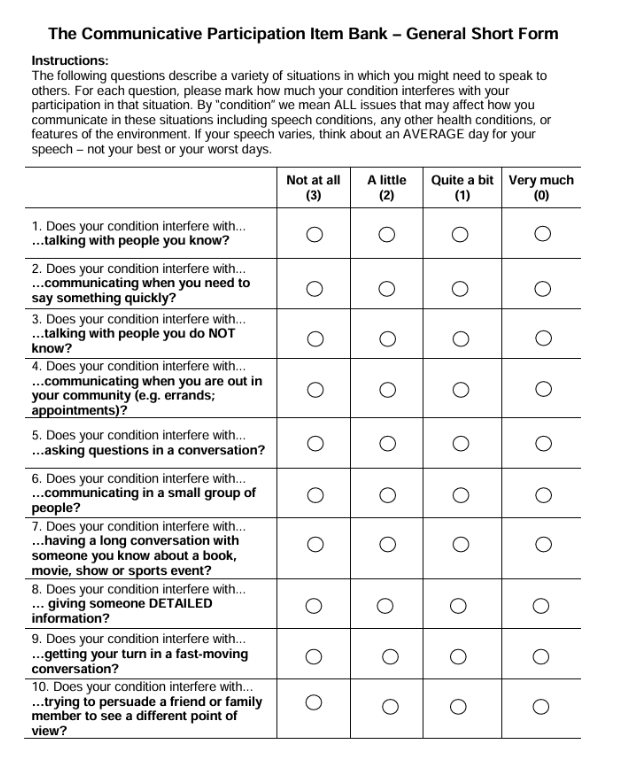
What is the Communication Participation Item Bank (CPIB)?
- Looking at whether the condition interferes communication
- Alternative to La Trobe Communication Questionnaire for RHD
What is the Progressive Aphasia Severity Scale (PASS)?
Outcome measure for tracking progression of PPA symptoms
How many items are in the short version of the BNT? (Graviotto et al., 2022)
12 -> suitable for PPA
What is the Assessment for Living with Aphasia (ALA)
QoL screener for people with aphasia
What is the Communication Activities of Daily Living (CADL-3)?
Assesses functional communication skills of adults with neurogenic communication disorders
What is the Mini-Mental State Examination (MMSE)?
Cognition screener -> memory, attention, orientation, language
What is the Montreal Cognitive Assessment (MOCA)
An assessment to detect mild cognitive impairment (good for detecting early stages of dementia, if concerned about PPA)
What is the SYDBAT?
Assessment battery for PPA
Differentiates PPA variants
Assessing naming, repetition, comprehension, semantic knowledge
What is the RICE (RIC Evaluation in RHD) assessment?
Assesses pragmatics, visual scanning, writing, metaphorical language
What is the RHD Bank Protocol monologue tasks?
Cookie theft picture
Cat in a tree story
Cinderella recount
Cheese & vegemite sandwich
Unfamiliar object task
What is the CLQT (Cognitive Linguistic Quick Test)?
Assesses:
Screens cognitive and linguistic strengths and weaknesses
Severity of neglect
Includes clock drawing
What are the Adapted Kagan Scales?
Rates conversation skills when conversing with a communication partner, post-TBI
What is the SCATBI (Scales of Cognitive Ability for Traumatic Brain Injury)?
Assesses cognitive-linguistic skills including:
Orientation
Ability to organise information
Short-term memory
Reasoning
Visual & auditory processing
What is the Western Aphasia Battery Revised (WAB-R)
Assessment battery for people with acquired neurological disorders (more suitable for diagnosis aphasia in STROKE victims!)
Includes:
Spontaneous speech
Auditory comprehension
Repetition, naming
Reading, writing
What is the TBIBank Protocol?
Includes:
Monologic discourse tasks
10 min conversation
Additional sample with conversational partners
What is The Awareness of Social Inference Test (TASIT)
Assesses
Theory of mind
Social cognition
Emotional perception
by asking the person to make inferences based off videos of everyday conversations of actors
Comes in short form too!
What is the PCAD (Profiling the Communication Abilities of People with Dementia)?
Assesses:
Communication of people with dementia
Provides strategies for communication partners
What is the FLCI-2 (Functional Linguistic Communication Inventory)?
Suitable for evaluating functional communication of people with dementia
What is the Traumatic Brain Injury Quality of Life (TBI-QOL)
Assesses
QoL
Symptom interference
What is the QOLIBRI (Quality of Life in Brain Injury)?
10 minute scale for people after having brain injury, inspects:
Cognition
Daily living
Autonomy
Social relationships
Emotional & physical wellbeing
What is the MCLA (Measure of Cognitive-Linguistic Abilities)?
Provides comprehensive battery, links between cognitive deficits and communication
What is the LCQ (LaTrobe Communication Questionnaire)?
Gives perceived communication ability (conversational effectiveness, social communication, verbal and non-verbal communication, and pragmatic difficulties)
Also provides communication partner perspective
What is the Measure of Cognitive-Linguistic Abilities - Communication Functioning Intake (MCLA-CFI)?
Assesses:
Communication functioning
Medical/social background
Current concerns
Functional impact
Informs goal-setting, good for case history