Quiz 2- Ch 17&18 (alcohols, ethers, epoxides, thiols, sulfides)
 Call Kai
 Learn
Learn Practice Test
 Spaced Repetition
 Match
Match Flashcards
 Knowt Play
1/44

There's no tags or description
Looks like no tags are added yet.
Name | Mastery | Learn | Test | Matching | Spaced | Call with Kai | Chat |
|---|
No analytics yet
Send a link to your students to track their progress
45 Terms
Williamson Ether Synthesis

R’ must be primary or methyl to favor substitution over elimination
Alkoxymercuration-Demercuration

Acidic Cleavage of an Ether
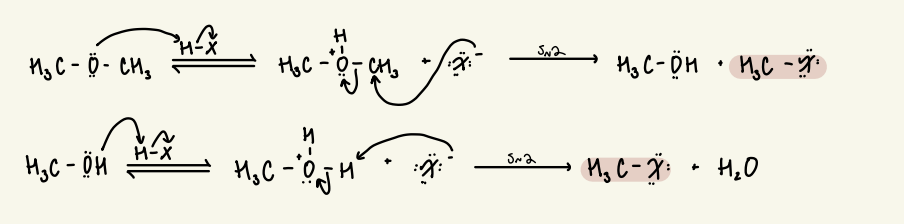
*in 2nd step, the alkyl carbon on the protonated alcohol undergoes Sn2 by X-
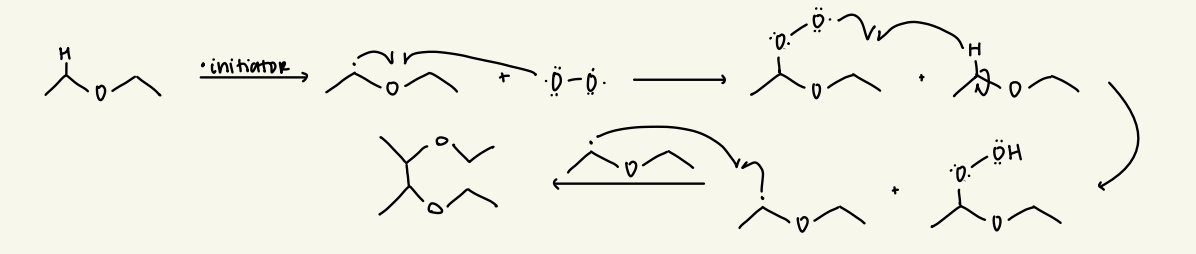
Autooxidation of Ethers
Epoxide formation from halohydrins
halohydrin is treated with a base, the -OH is deprotonated to give an alkoxide. The alkoxide undergoes a kind of intramolecular Sn2, where the O- attacks the carbon bonded to the halogen group, forming an epoxide
Epoxide Ring Opening using a nucleophile under basic conditions
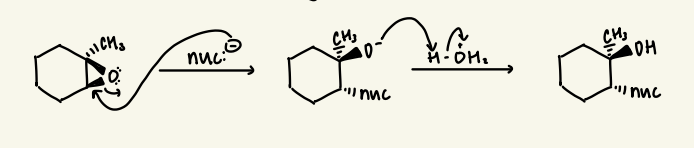
the nucleophile always adds to the less substituted carbon
Epoxide Ring Opening using a nucleophile under acidic conditions

the nucleophile adds to the more substitution carbon if the substrate is a tertiary carbon, it adds to the less substituted carbon if the substrate is a primary or secondary carbon.
Oxidation of Thiols

Sulfide formation from Thiols

Epoxide formation from an alkene
Reagent: RCO3H (like mCPBA)
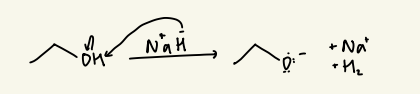
De-protonation of alcohols
Reagents: NaH, NaNH2, Na or K
De-protonation of phenols to form anisole
reagent: 1. NaOh / 2. CH3I

Preparation of Alcohols: Acid Catalyzed Hydration
reagents: H2SO4 or H3PO4

Preparation of Alcohols: Oxymercuration-Demercutation
reagents: 1. Hg(OAc)2, H2O / 2. NaBH4

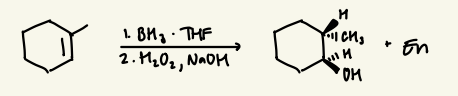
Preparation of Alcohols: Hydroboration-Oxidation
reagents: 1. BH3, THF / 2. H2O2, NaOH
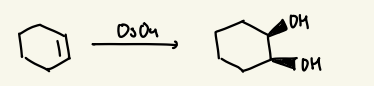
Preparation of Diols: Syn Dihydroxylation
reagents: OsO4
Preparation of Diols: Anti Dihydroxylation
reagents: RCO3H (mcPBA)

Aldehydes, Carboxylic Acids, and Esters reduce to…
primary alcohols
Ketones reduce to…
secondary alcohols
reduction of a ketone using 1. NaBH4 / 2. H3O+

reduction of a ketone using 1. LiAlH4 / 2. H3O+
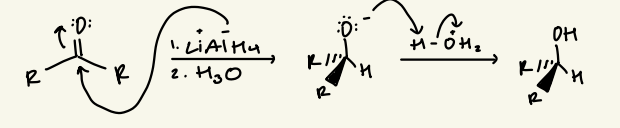
reduction of a Carboxylic Acid
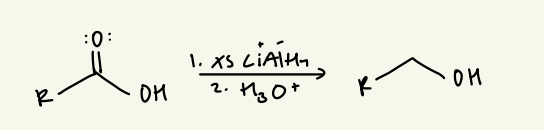
reduction of an ester to an alcohol

Grignard reagent formation

Grignard Reactions with a ketone

Grignard reactions with an ester

Grignard reactions with an epoxide

Grignard reactions with CO2

Reactions of alcohols: tertiary alcohols undergo…
SN1
Reactions of alcohols: secondary and primary alcohols undergo…
SN2
Alcohol + H-X

Alcohol + SOCl2 / pyridine

Alcohol + PBr3

Protection of Alcohols using Tosylate

Net Retention of a Chiral Center:
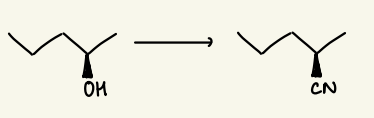

Net Inversion of a Chiral Center:

Acid Catalyzed Dehydration
reagents: H2SO4

Oxidation of Alcohols: reagents
CrO3 / H2SO4, H2CrO4, Na2Cr2O7, or K2Cr2O7
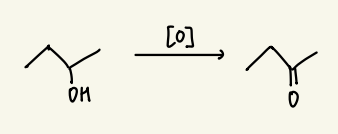
Secondary alcohols oxidize to form….
ketones
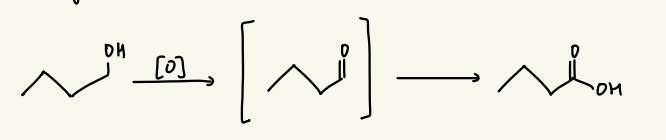
Primary alcohols oxidize to form…
carboxylic acids
Tertiary alcohols oxidize to form…
tertiary alcohols do not react
Oxidation of a secondary alcohol
Oxidation of a primary alcohol
Oxidation of a primary alcohol to an aldehyde
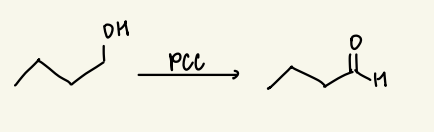
PCC or Dess-Martin/ CH2CH3
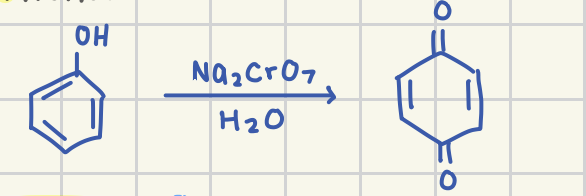
Quinone formation
phenol + Na2CrO7 / H2O