Monday Exams
 Call Kai
 Learn
Learn Practice Test
 Spaced Repetition
 Match
Match Flashcards
 Knowt Play
1/57

There's no tags or description
Looks like no tags are added yet.
Name | Mastery | Learn | Test | Matching | Spaced | Call with Kai | Chat |
|---|
No analytics yet
Send a link to your students to track their progress
58 Terms
While early modern audiences expected men to outwardly defend their honour through physical violence,
the greatest psychological terror in Renaissance drama often came from Machiavellian villains who bypassed the blade entirely to manipulate the minds of others.
In Othello, these traits are manifested exactly through Iago,
a character whose entire strategy relies on his constructed reputation as a plain-speaking, honest soldier
By recognising the significance of reputation in Renaissance society, Iago hides behind a falsified persona for his own personal gain
Through Othello's trust in Iago's constructed reputation, Shakespeare explores how prioritising reputation over reality can enable manipulation and lead to catastrophic consequences.
Paragraph 1 - Iago establishes a false identity
I am not what I am
We cannot all be masters, nor all masters
I am
Not what I am
We cannot all be masters
Nor all masters
Paragraph 2 - Othello trusts Iago
I know, Iago. Thy honest and love doth mince this matter
My Lord, you know I love you - I think thou dost
I know, Iago.
Thy honest and love doth mince this matter
My Lord, you know I love you
I think thou dost
Paragraph 3 - Collapse of Iago's reputation exposes the consequences
Honest, honest Iago
You told an odious, damned lie
Why hath he ensnared my soul and body?
Honest,
honest Iago
You told an odious,
damned lie
Why hath he ensnared
My soul and my body
While Shakespeare presents the interracial love between Othello and Desdemona as a transformative bond
capable of defying Venetian social conventions, it is ultimately subverted by internalised insecurities and oppressive societal barriers.
This breakdown reveals how easily private intimacy can be
poisoned when individuals adopt the prejudices of their environment.
Paragraph 1 - Love breaks the interracial and social barriers
She loved me for the dangers I had passed, and I loved her that she did pity them.
I did love the Moor to live with him…to his honours and his valiant parts / Did I my soul and fortunes consecrate.
Your son-in-law is far more fair than black.
She loved me for the dangers I had passed,
and I loved her that she did pity them.
I did love the Moor to live with him…to his
honours and his valiant parts / Did I my soul and fortunes consecrate.
Your son-in-law is
far more fair than black.
Paragraph 2 - The infiltration of insecurity
Haply, for I am black / And have not those soft parts of conversation / That chamberers have…
She did deceive her father, marrying you; / And when she seem'd to shake and fear your looks, / She lov'd them most.
Her name, that was as fresh / As Dian's visage, is now begrimed and black / As mine own face.
Haply, for I am black / And have not those
oft parts of conversation / That chamberers have…
She did deceive her father, marrying you; / And when she
seem'd to shake and fear your looks, / She lov'd them most.
Her name, that was as fresh / As Dian's visage,
is now begrimed and black / As mine own face.
Paragraph 3 - Breakdown of Love
Yet she must die, else she'll betray more men.
O curse of marriage!
O, the more angel she, / And you the blacker devil!
Yet she must die,
else she'll betray more men.
O curse
of marriage!
O, the more angel she,
/ And you the blacker devil!
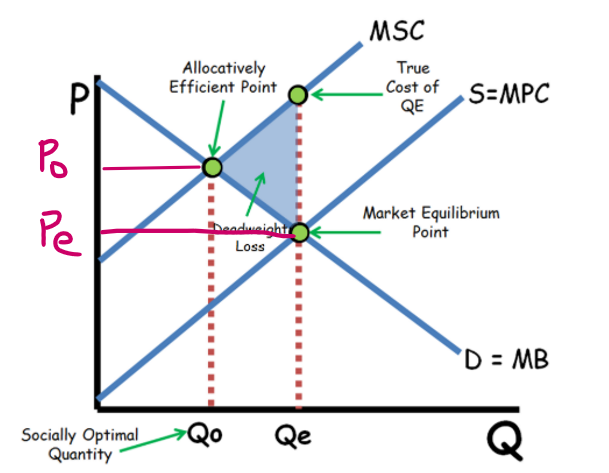
What externality is this?
Negative, Production

What externality is this?
Negative, Consumption
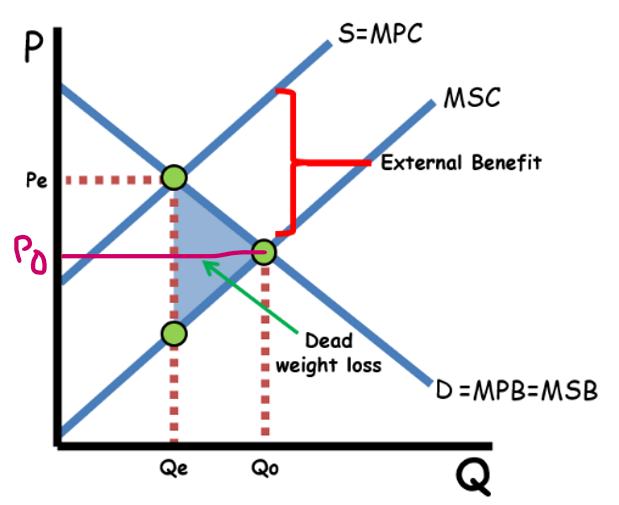
What externality is this?
Positive, Production
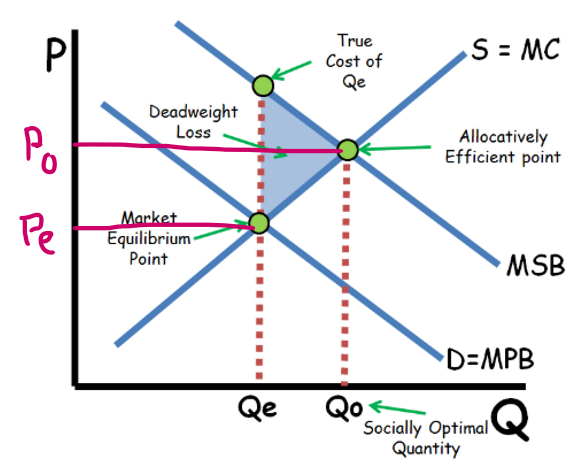
What externality is this?
Positive, Consumption
What is the MPC?
Marginal Private cost, Cost of supply
What is the MSC?
Marginal Social Cost, true cost to society
What is the MPB?
Marginal Private Benefit, where consumption is economically optimal
What is the MSB?
Marginal Social Benefit, where consumption is socially optimal
Is the MSC inward or outward from the MPC
Inward in neg production, Outward pos production
Is the MSB inward or outward from the MPB
Inward in neg consumption, Outward pos consumption
What is irrational behaviour in markets
Where consumers do not prioritise somethings utility, and producers do not seek optimal efficiency
What are the 4 things that make a market optimally efficient
Productive, Technical, Allocative, Dynamic
What is productive/technical efficiency
Maximised outputs from given inputs
What is allocative efficiency
Making products that meet consumer demand
What is dynamic efficiency
Innovation to meet changing needs
What is the law of diminishing returns?
Once the most efficient production level has been reached, adding extra may cause a smaller output increase
What is a Pigouvian tax?
A tax charged on goods that impact a third party (Negative externalities)
What is a subsidy
Financial support given by the Government to encourage a good thing (Positive externalities)
What is inequality?
The unequal distribution of income among a population
What is a Lorenz Curve
The cumulative distribution of income in a population, used to visualise inequality
What does a Gini coefficient of ~3.2% mean
Small proportion of low-income earners, small proportion of high-income earners
What does a Gini coefficient of >5% mean
Very few high income earners that hold most income
What is complete market failure?
Where a market is not productively/technically, allocatively, and dynamically efficient
What are price ceilings
Limiting how high the price of something can be (E.G Rent)
What are price floors
Setting a minimum price something can be (E.G Minimum wage laws)
What’s on the y axis of a Lorenz Curve
% of Income
What’s on the x axis of a Lorenz Curve
% of Population
What curve on externality graphs points right
Cost
What curve on externality graphs points left
Benefit
What way does the deadweight loss point on Negative graphs
To the left
What way does the deadweight loss point on Positive graphs
To the right