RAD 101 Unit 3 Abdomen Anatomy
 Call Kai
 Learn
Learn Practice Test
 Spaced Repetition
 Match
Match Flashcards
 Knowt Play
1/16

There's no tags or description
Looks like no tags are added yet.
Name | Mastery | Learn | Test | Matching | Spaced | Call with Kai | Chat |
|---|
No analytics yet
Send a link to your students to track their progress
17 Terms
AP Abdomen (KUB) demonstrates
-borders of psoas major muscles
-diaphragm
-symph
KUB Anatomy to be visualized on a radiograph
1. Diaphragm
2. Psoas muscles
3. Symph

Digestive Tract
oral cavity,
pharynx,
esophagus,
stomach,
small intestine,
large intestine
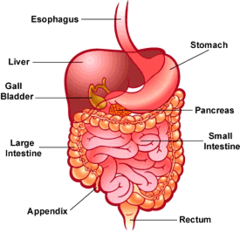
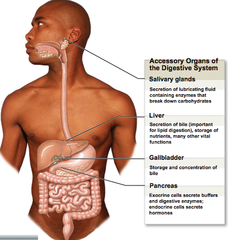
Digestive Tract Accessory Organs
-Liver
-Gallbladder
-Pancreas
-Spleen
Stomach
large muscular sac that continues the mechanical and chemical digestion of food

small intestine
Duodenum (shortest and widest)
Jejunum (2/5 of small intestine)
Ileum (3/5 of small intestine)

Large Intestine
Anus
Appendix (vermiform)
Ascending colon
Cecum
Descending colon
Ileocecal valve
Left colic (splenic) flexure
Rectum
Right colic (hepatic) flexure
Sigmoid colon
Transverse colon

Urinary system
kidneys, ureters, urinary bladder, urethra

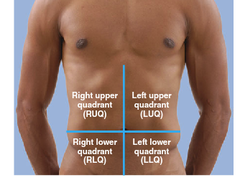
Four abdominal quadrants
Right upper quadrant (RUQ)
Left upper quadrant (LUQ)
Right lower quadrant (RLQ)
Left lower quadrant (LLQ)
Nine Abdominal Regions
1. Right hypochondriac
2. Epigastric
3. Left hypochondriac
4. Right lateral (lumbar)
5. Umbilical
6. Left lateral (lumbar)
7. Right inguinal (iliac)
8. Pubic (hypogastric)
9. Left inguinal (iliac)

Bony landmark palpation, upper/mid abdomen: Xiphoid process (T9-T10)
Superior margin of the abdomen
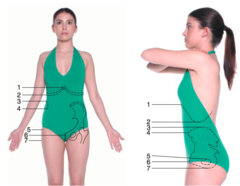
Bony landmark palpation, upper/mid abdomen: Inferior costal margin (L2-L3)
For use when locating stomach and gallbladder
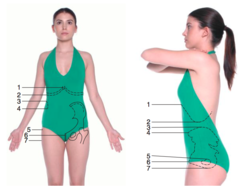
Bony landmark palpation, upper/mid abdomen: Iliac crest (L4-L5)
At approximate level of the umbilicus (belly button). Mid abdomen

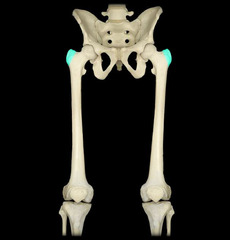
Bony Landmark palpation lower abdomen/pelvis: ASIS

Bony Landmark palpation lower abdomen/pelvis: Greater trochanter
Can be difficult to palpate. A level of upper border of symph
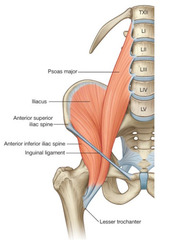
Bony Landmark palpation lower abdomen/pelvis: Symphysis pubis
Inferior margin of abdomen
Bony Landmark palpation lower abdomen/pelvis: Ischial tuberosity
Lower margin of abdomen when patient is prone. Slightly distal to symph
