AP Human Geography: Unit 2 Population & Migration Terms
 AP Practice
 Call Kai
1/67

Earn XP
Description and Tags
Combination of Mcquaid's Quizlet sets for this unit. Also, this will NOT count towards the extra credit, so do her sets before this.
Name | Mastery | Learn | Test | Matching | Spaced | Call with Kai | Chat |
|---|
No analytics yet
Send a link to your students to track their progress
68 Terms
Overpopulation
a situation in which the number of people in an area exceeds the capacity of the environment to support life at a decent standard of living
Census
the official count of a population
Nonparticipation (census)
the situation in which homeless people, ethnic minorities, and/or people without proper immigration documents don't fill out census forms
Sampling
a statistical technique used to attempt to get a more accurate census count - the US Supreme Court ruled this cannot be used to determine Congressional district boundaries
Ecumene
permanently inhabited areas of the Earth's surface
Arithmetic Density
the total number of people divided by the total land area
Physiological Density
the number of people per unit of area of arable land (land suitable for agriculture)
Agricultural Density
the number of farmers per unit area of farmland
Developed Country (MDC)
a country that has progressed relatively far along a continuum of development
Developing Country (LDC)
a country that is at a relatively early stage in the process of economic development
Natural Increase Rate (NIR)
the percentage growth of a population in a year (the crude birth rate minus the crude death rate)
Doubling Time
the time required for a population to double in size
Crude Birth Rate
the total number of live births in a year for every 1,000 people alive in the society
Crude Death Rate
the total number of deaths in a year for every 1,000 people alive in the society
Total Fertility Rate (TFR)
the average number of children born to a woman during her childbearing years (AKA "children per woman")
Replacement Rate
the total fertility rate needed for a population to replace itself (2.1 for MDCs, 2.4 for LDCs)
Demography
study of population characteristics
Demographic Momentum
the tendency for growing population to continue growing for a time after a fertility decline because it takes time for already born people to reach child-bearing age
Demographic Transition Model (DTM)
a process of change in a society's population from a condition of high crude birth and death rates and low rate of natural increase to a condition of low crude birth and death rates with a low rate of natural increase
Medical Revolution
the leap of medical knowledge in stage 2 of the demographic transition
Zero Population Growth (ZPG)
a decline of the total fertility rate to the point where the natural increase rate equals zero
Sex Ratio
the ratio of males to females in a population
Population Pyramid/Age-Sex Structure
A bar graph that represents the distribution of population by age and sex
Dependency Ratio
the number of people who are too young or too old to work, compared to the number of people in the labor force
Elderly Support Ratio
the number of working-age people (15-64) divided by the number of persons 65 and older
Infant Mortality Rate
the total number of deaths in a year among infants under one year old for every 1,000 live births in a society
Epidemiology
the branch of medicine that deals with the incidence, distribution, and possible control of diseases and other factors relating to health
Epidemiologic Transition Model (ETM)
this focuses on identifying and explaining the causes of death in each stage of the Demographic Transition Model
Pandemic
an epidemic that is geographically widespread
John Snow
he mapped the occurrence of cholera in London
Thomas Malthus/ Malthusian Theory
he argued the world's population was increasing faster than the food supplies need to sustain it and reasoned that food supplies grow linearly (arithmetically), whereas population grows exponentially (geometrically)
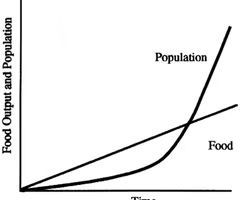
Carrying Capacity
the largest population that an environment can support at any given time
Antinatalist Policy
a government plan to decrease the birth rate

Pronatalist Policy
a government plan to increase the birth rate

Migration
a type of relocation diffusion that is a permanent move to a new location
Mobility
movement from one place to another
Circulation
short-term repetitive, cyclical and periodic movements. Ex: college students, farm workers, or even going to work/school daily
Emigration
migration from a location (out)
Immigration
migration to a location (in)
Net Migration
the difference between the level of immigration and the level of emigration
International migration
the permanent move from one country to another
Migration transition
consists of changes in a society comparable to those in the demographic transition (i.e. as societies develop migration patterns change)
Voluntary Migration
movement in which people relocate in response to perceived opportunity; often economic, sometimes environmental
Forced Migration
movement in which people have been compelled to relocate; often cultural, political or environmental factors
Internal migration
movement within the same country
Interregional migration
movement from one region of a country to another; often rural to urban
Intraregional migration
movement within one region; often within urban areas
Counterurbanization
net migration from urban to rural areas in more developed countries
Ravenstein ("laws of migration")
an explanation of the reasons why migrants move, the characteristics of migrants, and the distance migrants typically move
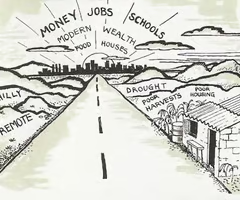
Push factor
a negative reason that induces people to leave their present location
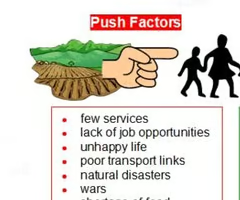
Pull factor
a positive reason that induces people to move to a new location
Refugee
a person who has been forced to flee his or her country because of persecution, war, or violence
Internally Displaced Person (IDP)
a person who has been forced from their home but remains in their own country
Asylum Seeker
a person who has left their country of origin and formally applied for sanctuary in another country but whose application has not yet been concluded
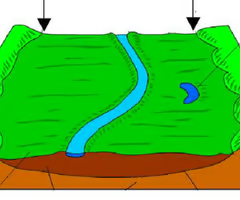
Floodplain
an area subject to flooding based on historical trends
Desertification
the gradual transformation of habitable land into desert
Intervening obstacle
an environmental or cultural feature that hinders migration
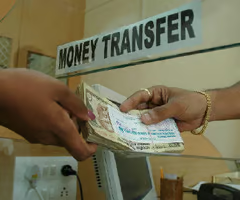
Remittance
the transfer of money by workers to people in the country from which they emigrated
Unauthorized Immigrant
an academic observer's term for a person who enters a country without proper documents to do so
Undocumented Immigrant
a term preferred by advocate groups for a person who enters a country without proper documents to do so
Illegal Alien
a term used by groups who favor tough immigration restrictions for a person who enters a country without proper documents to do so
Quotas
in reference to migration, laws that place maximum limits on the number of people who can immigrate to that country each year
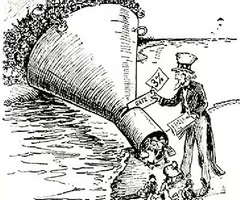
Brain Drain
the loss of highly educated and skilled workers to other countries

Chain Migration
migration of people to a specific location because relatives or members of the same nationality previously migrated there
Guest Worker
a foreign laborer living and working temporarily in another country
Circular Migration
the temporary movement of a migrant worker between home and host countries to seek employment
Step Migration
a migration in which an eventual long-distance relocation is undertaken in stages
Transnational Migration
a form of population movement in which a person moves between two or more countries