BU111 Social Factors Finals Prep
 Studied by 0 people
 Call Kai
 Learn
Learn Practice Test
 Spaced Repetition
 Match
Match Flashcards
 Knowt Play
1/78

There's no tags or description
Looks like no tags are added yet.
Name | Mastery | Learn | Test | Matching | Spaced | Call with Kai |
|---|
No study sessions yet.
79 Terms
What are Elements of Social Factors?
Customs, Habits, Values/Attributes, Demographic Characteristics
An example of Demographic Characteristics is women having to think twice about taking an Uber and how to get home from the bar.
True
Social Factors consider:
How you spend your time
How you spend your free time
How you spend your money
True
What are Demographics?
The study of human populations and cohorts
What are cohorts?
Homogeneous groups within the larger population
Why are Demographics Important?
They are a powerful predictor of behaviour, trends, and preferences, providing certainty and simplicity through age data, and helping predict supply and demand for environmental and human resource decisions.
What does studying demographics show?
How to achieve success in the future, trying to determine what people want
What are things to look like in demographics? (Consider the “four pillars”)
Cohort size, Cohort characteristics, Cohort participation, Future and Trends
A bigger cohort is _________, but can be _______ too.
more attractive, negative
Factors that can affect the size of cohorts are the fertility rate
False
Factors that can affect the size of cohorts are the fertility rate and the death rate
True
What does the size of cohort mean?
Number of people in each age group
What happens when the Baby Boomers leave the workforce?
Crisis of Leadership because they are leaving the important leadership roles within their field.
Which years correspond to the WWI Generation, also called the Lost Generation?
1883 – 1900
Which years correspond to the Greatest Generation, or the “Roaring Twenties”
1901 – 1927
Which years correspond to the Silent Generation, or the “Depression Babies”
1928 – 1945
Which years correspond to the Baby Boomer generation?
1946 – 1964
Which years correspond to Generation X?
1965 – 1980
Which years correspond to Millennials, also called Generation Y?
1981 – 1996
Which years correspond to Generation Z?
1997 – 2012
Which years correspond to Generation Alpha, also know as Gen X?
2013 – 2025
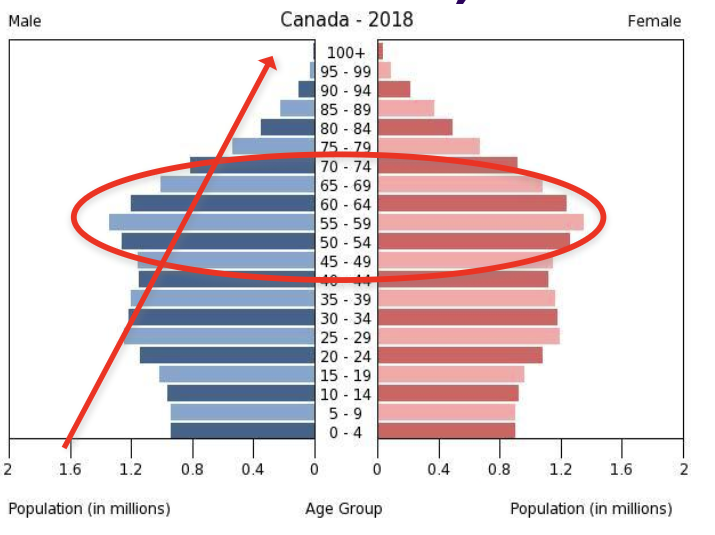
What does the bulge represent?
The Baby Boomers
What is the Sandwich Generation?
When the middle generation is caring for both their parents and children at the same time
What are Implications of the Baby Boomers?
An increase in the care that is needed, and an increase in the number of vulnerable seniors
What implications does the Sandwich Generation face?
Financial, emotional, time pressures, and burnout
What are factors that determine characteristics?
Economics, Technology, World Events/News, and Parenting
What are characteristics that determine the factor Economics?
Values ad Priorities
What are characteristics that determine the factor Technology?
Lifestyle
What are characteristics that determine the factor World Events/News?
Habits (digital and other)
What are characteristics that determine the factor Parenting?
Mindset
What are implications to consider with economics?
How to attract, retain, retain, and motivate
What are implications to consider with technology?
What makes a product appealing
What are implications to consider with world events/news?
How to attract consumers
What are implications to consider with parenting
How much they spend and what they spend on
What does economics consider?
How much to spend, how we acquire stuff, and how much we spend on stuff
Why do people who experienced the depression hoard?
Because they have already lost so much, they want to hold onto what they can
Why’s is technology important?
Because of its availability, all that it can do, and the access that it provides people
How has technology impacted students life in residence?
Now, when you want to see someone, you just text them to meet up
How has technology affected childhood?
Kids used to play outside together, now they play together on video games
How has a world event, like covid 19 had impacts on a cohort like Gen Z?
It made them uncomfortable with face-to-face interactions and increased anxiety due to the unpredictable nature of not knowing what will happen
How did Covid-19 impact communication?
It increased reliance on digital communication methods like texting, video calls, and social media
Did 9/11 impact communication or world view?
Only world view was affected-it influenced worldview by increasing awareness of security, global politics, and safety concerns
How has parenting involved in relation to children’s education?
Parents are trying to be much more involved with communication with children’s professors now than they used to be
What is the problem with “Helicopter” or “Bulldozer” parents?
Kids never learn to figure things our for themselves
How has parenting evolved over the past few generations?
Parents used to be must more hands off “go figure it out yourself”, and now there are many more helicopter parents.
How has attracting consumers changed across generations?
Other generations watch tv with commercials and read the paper, current generations focus on streaming and social media
What should be considered when you are trying to attract employees?
Factors such as values, priorities, lifestyle, habits, mindset, and the technological and economic environment of the target cohort
What motivates the current generation of employees?
Recognition for what they have accomplished
When retaining employees, they want to be _________. Current generations ________ mind numbing jobs for lots of money.
challenged, don’t want
Current generations want to be challenged, but previous generations wanted________>
to just have a job
Current generations are more ___________.
Environmentally Conscious
Why are Social Factors important?
Customers come from society, and their wants and needs impact the market
What is an example of Social Factors?
In some countries they shop in bulk to last for weeks/months, but in others they visit a market almost daily for their goods
The way managers run their business varies based on their ________.
Social Experience
Gen Z _______.
Is digitally savvy
Gen Z values ________.
uniqueness
Gen Z wants ________.
a brand that means something
Gen Z is likely to _______.
have several careers
Gen Y/millenials ___________.
are digitally savvy
Gen Y/millenials prefer __________.
Quality>Brand
Gen Y/millenials want __________.
authenticity
Gen Y/millenials __________.
will change jobs
Gen X _______.
prefers to do research online but buy in person
Gen X ________.
is brand loyal
Gen X wants ________.
Flexible Work
Gen X wants ________.
a perfect career
Baby Boomers ________.
prefer in person transactions
Baby Boomers prefer ________.
Long hours in office
Baby Boomers _________.
Want one career at one company
At work, Gen Z wants ___________.
Feedback and recognition
At work, Gen Z wants ___________.
Civic Minded tasks
At work, Gen Z wants ___________.
Competitive wages and benefits
At work, Gen Z wants ___________.
Work-life balance
What should be considered when understanding cohorts and customer segments?
What they can afford, Where you can sell, Messaging design, Feasability of Tech design
Pain Points, Priorities, When/How/Why they will use the product, Product design, Marketing design
What is an implication of the aging Baby Boomer population?
Increasing strain on pension and healthcare, as well as potential for labour shortages
What are implications of the growing ethnic composition?
Many consumers having difficulty interacting with marketplace
Why are immigrants younger and more likely to live in the city than the average Canadian
Because younger individuals are more likely to migrate for education, work, and career opportunities, and cities provide more economic, social, and cultural resources, making them attractive places for new immigrants to settle.
What are implications of single-family households?
Lost economies of scale in living and shopping