Earth's Atmosphere: Composition, Layers, and Ozone Depletion
 Call Kai
 Learn
Learn Practice Test
 Spaced Repetition
 Match
Match Flashcards
 Knowt Play
1/22

There's no tags or description
Looks like no tags are added yet.
Name | Mastery | Learn | Test | Matching | Spaced | Call with Kai | Chat |
|---|
No analytics yet
Send a link to your students to track their progress
23 Terms
What is the atmosphere?
An envelope of gases surrounding Earth that protects and provides materials necessary to support all forms of life.
Name the four regions of the atmosphere based on temperature.
Troposphere, Stratosphere, Mesosphere, Thermosphere.
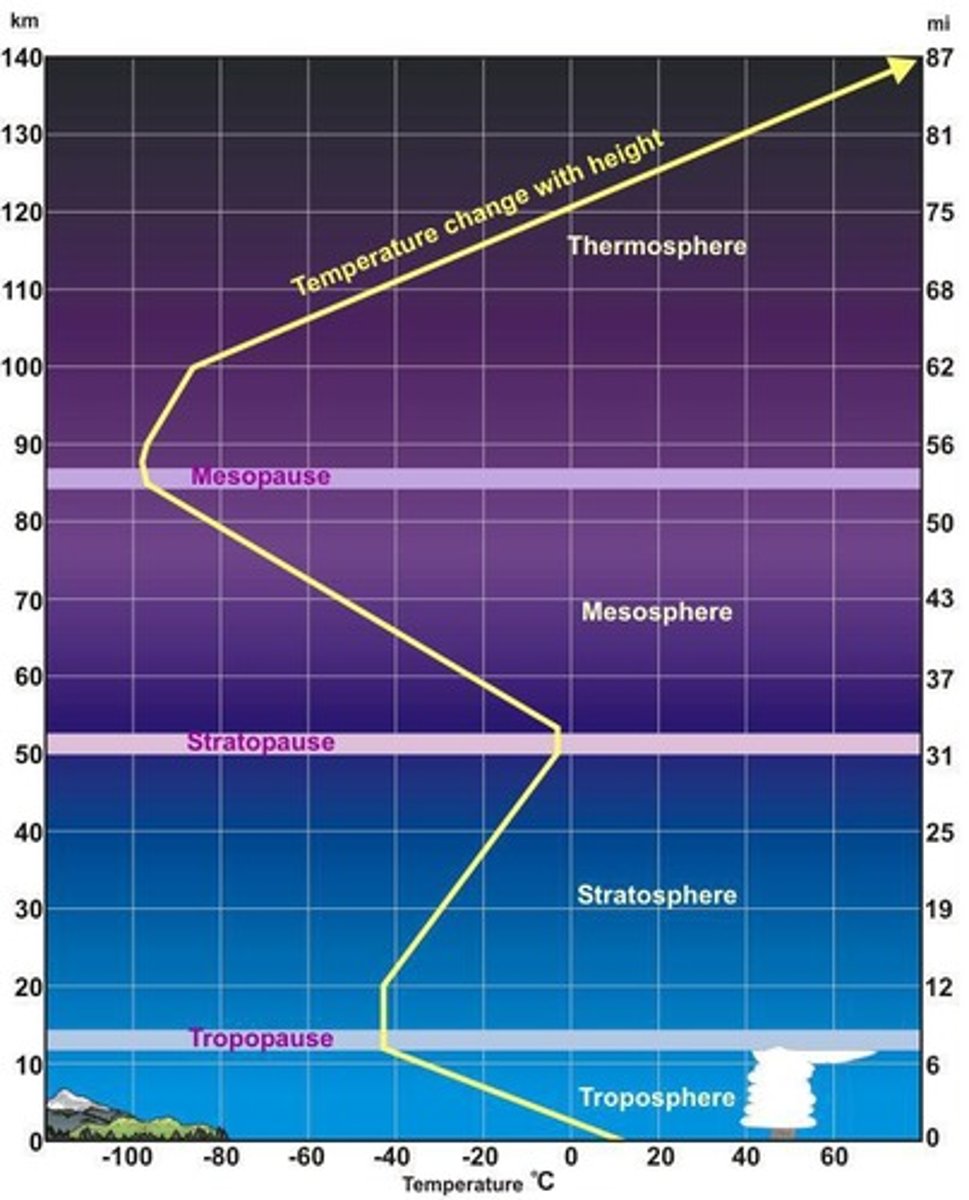
What is the altitude range of the Troposphere?
0-12 km.
How does temperature change with altitude in the Troposphere?
Temperature decreases with altitude.
What is the upper limit of the Troposphere called?
Tropopause.
What is the altitude range of the Stratosphere?
12-50 km.
How does temperature change with altitude in the Stratosphere?
Temperature increases with altitude.
What is the upper limit of the Stratosphere called?
Stratopause.
What is the altitude range of the Mesosphere?
50-85 km.
How does temperature change with altitude in the Mesosphere?
Temperature decreases with altitude.
What is the upper limit of the Mesosphere called?
Mesopause.
What is the altitude range of the Thermosphere?
85-500 km.
How does pressure change with increasing elevation?
Pressure decreases in a regular way.
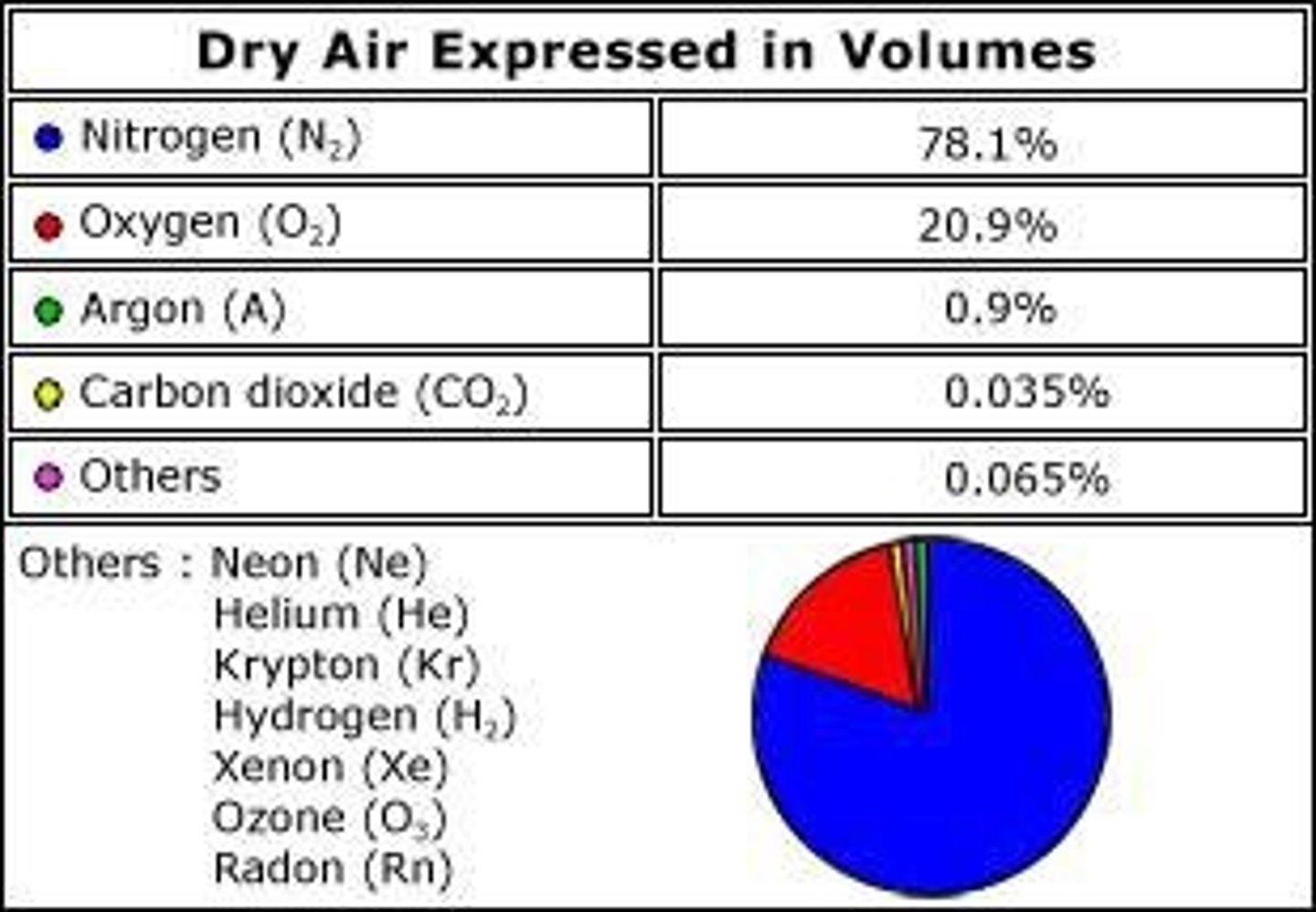
What gases make up 99% of the Earth's atmosphere?
Nitrogen (N2) and Oxygen (O2).
What is the bond type of N2 compared to O2?
N2 has a triple bond, while O2 has a double bond.
What is photodissociation?
The rupture of a chemical bond resulting from the absorption of a photon by a molecule.
What happens during photoionization?
A molecule absorbs radiation and ejects an electron, becoming a positively charged ion.
What is the role of O3 in the upper atmosphere?
O3 is a key absorber of photons in the UV range (240-310 nm).
What is the net result of the cyclic process involving O3?
Solar energy converts to thermal energy.
What was the impact of CFCs on the ozone layer in the 1970s?
CFCs were depleting ozone in the stratosphere.
What international agreement aimed to limit the use of CFCs?
The 1987 Montreal Protocol on Substances that Deplete the Ozone Layer.
What are hydrofluorocarbons (HFCs)?
They are replacements for CFCs, with a C-H bond instead of a C-Cl bond.
What natural sources contribute to chlorine and bromine in the atmosphere?
Natural sources include methyl chloride (CH3Cl) and methyl bromide (CH3Br).