Lecture 24 & 25: Infectious Diseases & Disorders of Equine Nervous System
 Call Kai
 Learn
Learn Practice Test
 Spaced Repetition
 Match
Match Flashcards
 Knowt Play
1/56

There's no tags or description
Looks like no tags are added yet.
Name | Mastery | Learn | Test | Matching | Spaced | Call with Kai | Chat |
|---|
No analytics yet
Send a link to your students to track their progress
57 Terms
What is the most frequent protozoal disease affecting the equine nervous system?
sarcocystis neurona
What are the 3 hosts of sarcocystis neurona?
definitive host = source of transmission (possums)
intermediate hosts = cats, raccoons, armadillos, skunks
aberrant hosts = horses
What is the speculated neospora hughesi life cycle?

What is the pathogenesis of EPM?
• Inflammation, neuronal necrosis
• Lack of clearance from CNS
MACROSCOPIC
• Multifocal areas of hemorrhage
• Foci of malacia & areas of discoloration
• Spinal cord and brain stem
• Gray & white matter
MICROSCOPIC
• Confirm parasite and/or typical lesions
• Diffuse nonsuppurative inflammation &
necrosis
• Perivascular infiltration - mononuclear cells
What are the clinical signs of EPM?
any neurologic sign - acute or chronic, focal or multifocal
brain, brainstem, spinal cord - white/grey matter
AAA = ataxia, asymmetry, atrophy
behavioral changes
cranial nerves
weakness, ataxia, atrophy → recumbency
What are the two etiologic agents of equine protozoal myelocephalitis?
Sarcocystis neurona
Neospora hughesi
How is EPM diagnosed?
ANTEMORTEM – not definitive
1. Consistent Clinical signs
2. Positive serum/CSF ratio (intrathecal Ab)
3. Rule out other diseases
POSTMORTEM – definitive
But…harder in chronic cases
What are the 3 FDA approved EPM treatments?
Sulfadiazine/Pyrimethamine (ReBalance)
Ponazuril
Diclazuril
What are the potential adverse reactions to sulfadizaine (ReBalance)?
anorexia, intestinal issue, bone marrow suppression
What are the unofficial, off-label, and illegal drugs used to treat EPM?
• Sulfadiazine/pyrimethamine - compounded: illegal
• Diclazuril sodium salt or IV formulation: illegal
• Toltrazuril: (Baycox ®, Bayer): not approved in US, Compounded Toltrazuril ± pyrimethamine: illegal
• Decoquinate with Levamisole: (Orogin ®, Pathogenes) – NOT FDA approved, Not allowed in performance horses
What supportive treatments are used in an EPM treatment plan?
anti-inflammatories: NSAIDs, steroids if danger of recumbency
anti-oxidants: DMSO, vitamin E
supportive care: nutrition, preventative care
What is the prognosis of EPM?
• 60% improve (1 grade or negative test)
• 10% relapse in 1-3 years
How is EPM prevented?
• No vaccine available
• Avoid stress
• Reduce exposure to opossum feces: Feed off ground, Separate fresh water source
• No wildlife access to pastures or stalls
• Intermittent anti-protozoals?
What are the different equine herpes viruses?

What is the emerging, worldwide neurologic disease affecting 80-100% of horses?
EHV-1 (dsDNA): 3 genotypes
• D752: “neuropathogenic”
• N752: “non-neuropathogenic”
• H752: “new”
• All can cause neuro disease
What are the risk factors of EHV?
• Shedding horse(s) close to susceptible horses
• Stress
• Season
• Crowding, mingling – shared air space
• Adult horses of tall breeds
How is EHV transmitted?
• Incubation 4-7 days
• Direct contact: Respiratory (often before clinical signs), Aborted materials
• Indirect: Tack, equipment, People
What is the pathogenesis of EHV?
Phase 1: respiratory epithelium, local lymph nodes, PBMC
Phase 2: PBMC associated viremia
Phase 3: endothelial cells, vasculitis, hemorrhage, thrombosis, ischemia
Neurologic disease, abortion
What are the clinical signs of EHV?
biphasic fever: most consistent initial sign
acute (ascending) ataxia & paresis: posterior ataxia, anterior ataxia, recumbency
cauda equina signs: urinary & fecal incontinence, loss of anal tone, loss of sensation perineum
stabilizes in 24-48 hours
How is EHV diagnosed?
• Reportable & actionable (e.g. TN, VA, KY)
• Samples to collect: Nasal swab (viral transport medium), EDTA blood
• PCR: gB-based test = recommended, D752 vs N752 marker (may miss new strain)
• CSF: xanthochromia (high protein & normal cells)
• Seroconversion
• Virus isolation
How is EHV treated?
Isolation & quarantine - No specific treatment
NSAIDs, steroids, antioxidants, antimicrobials (secondary infection), virustatic drugs (expensive), CRI detomidine in severe cases
Nursing care:
• Keep standing, sternal with props, repositioning
• Comfortable support
• Easy access to food and water
• Protection from trauma
• Hydration
• Evacuation of bladder and rectum if necessary
• !!! Attention neurologic horse = DANGER !!!
What is the prognosis of EHV?
• If stays standing: good
• If recumbent > 24 h: reserved
What are the outbreak management steps of EHV?
1. Quarantine of premise
2. Biosecurity (individual PPE &equipment, barriers)
3. Confirm diagnosis: 1. PCR - febrile and EHM horses 2. Complete postmortem 3. Freeze serum
4. Monitor rectal temperature 2x/day on all horses
5. Release premise (28 d or 21 d)
How is EHV prevented?
• Biosecurity & good monitoring
• Management
• EHV-1 vaccines do not protect against EHM
What 4 viruses are covered by the 5 AAEP core vaccines?
Rabies
West Nile
Eastern Equine Encephalomyelitis
Western Equine Encephalomyelitis
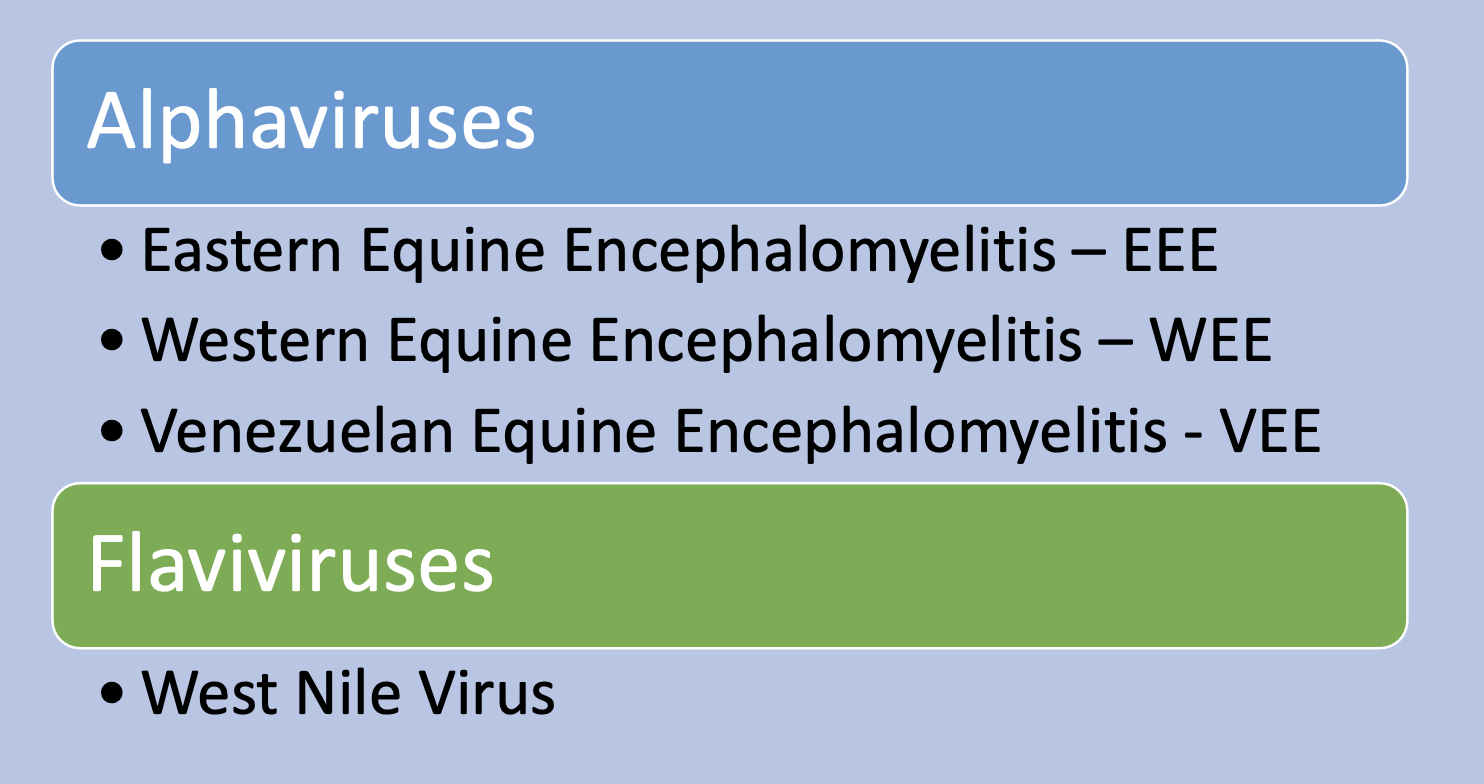
What are the equine mosquito-borne infections and where are they found?

What are the risk factors of the equine mosquito born diseases?
Horse:
• Any breed or sex
• Age (usually not in foals)
• Vaccination history (unvaccinated)
Environment:
• Region
• Season, weather, landscape
• NE: vector season, SE: year round
Young horse recently moved to endemic area and with incomplete vaccination
What are the amplifying hosts of equine mosquito borne diseases?
birds
What are the clinical signs of EEE?

How are equine mosquito born diseases (EEE) diagnosed?
History & clinical signs
Rule out: CBC, serum biochemistry, blood ammonia, Radiographs (rule out CVM), CSF tap, Nasal swab & EDTA blood (rule out EHM)
Serology: IgM-capture ELISA
CSF: cytology, PCR and virus isolation
PCR
Post-mortem exam
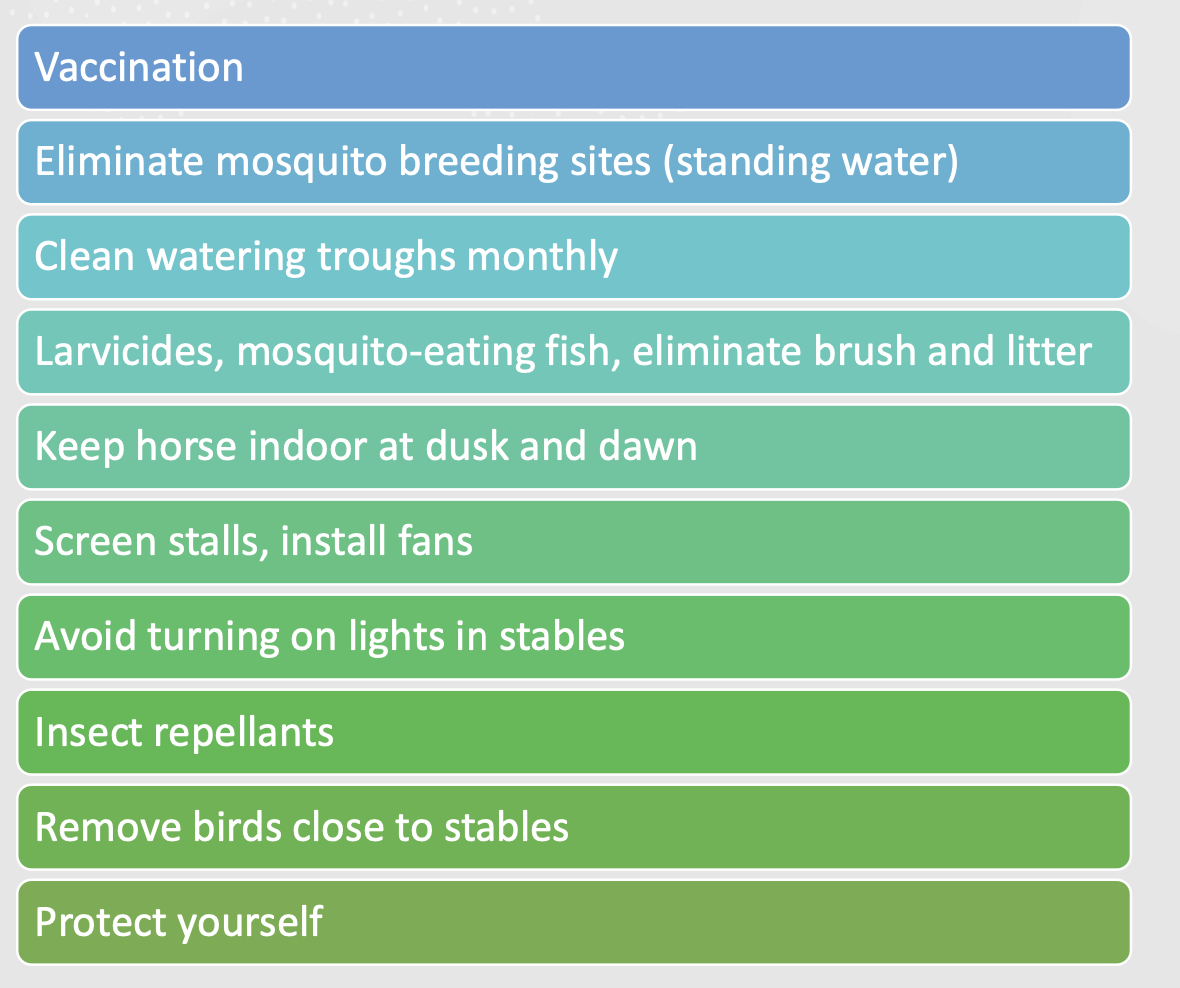
How are equine mosquito born diseases (EEE) prevented?
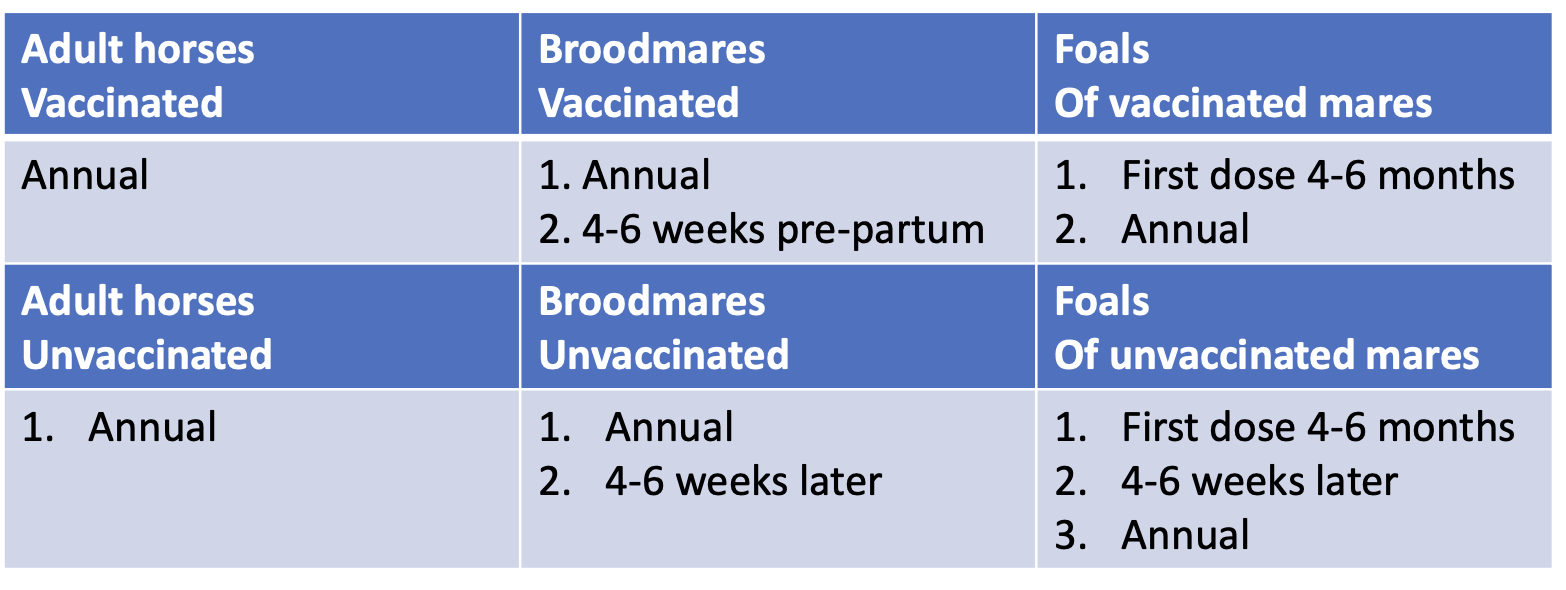
What is the EEE vaccination plan for adult unvaccinated and vaccinated horses?
vaccinated: annual before season, adapt to region
unvaccinated: 1. first dose 2. 4-6 weeks later 3. annual
What is the EEE vaccination plan for adult unvaccinated and vaccinated broodmares?
vaccinated: 1. annual 2. 4-6 weeks pre-partum
unvaccinated: 1. first dose 2. 4-6 weeks later 3. 4-6 weeks pre-partum 4. annual
What is the EEE vaccination plan for foals of unvaccinated and vaccinated mares?
foals of vaccinated mares: 1. first dose 4-6 months 2. 4-6 weeks later 3. annual
foals of unvaccinated mares: 1. first dose 4-6 months 2. 4-6 weeks later 3. annual
What are the 3 contagious neurological diseases of horses?
Rabies
Borna
Hendra and Nipah
What are the reservoir hosts of rabies (lyssa virus)?
• Racoon
• Skunk
• Fox, Coyote
• Bat
What are the risk factors of rabies?
• No sex or breed predilection
• Younger horses more curious
• Vaccination history
• 100% pasture
• Endemic area
How does rabies spread through the body?
bite infection (contact: mucous membranes, skin lesions) → retrograde/centripetal axonal transport → replication in spinal cord → brain → anterograde/centrifugal axonal transport → salivary gland
What are the clinical signs of rabies?
• Can look like any neuro disease or colic
• Long incubation time
• Rapidly progressive or diffuse neurologic signs
• 3 Forms
• Bite wound often NOT seen
• Non-specific: colic, lameness, fever, depression
What are the clinical signs of rabies based on CNS location?

How is equine rabies diagnosed?
NO ANTEMORTEM CONFIRMATION
• History and clinical signs
• CBC, biochemistry: normal
• CSF
POSTMORTEM
• ½ brain in 10% formaldehyde for histology
• ½ brain frozen for direct IFAT, etc
• Mild non suppurative encephalomyelitis
• Negri bodies
How is rabies prevented?
Vaccination = core vaccine
Contact tracing, zoonosis!!!
Exposed horse
Vaccinated (by licensed DVM with USDA approved vaccine) → Immediate revaccination, Observation as directed by state public health official
Unvaccinated → Contact public health state official
How often should horses be vaccinate for rabies?
Describe the etiologic agent of botulism.
• Gram +, anaerobic
• Spore-forming
• Ubiquitous
• 8 neurotoxins: A, B, Ca, Cb, D, E, F, G
• Rapidly progressive neurologic disease
• High mortality
What are the 3 forms of equine botulism?
Forage poisoning
• Toxin pre-formed
• Origin: food or water with decaying vegetable matter, carcass
Wound contamination
• Origin: contaminated wound
• Spores germinate
• Toxin produced
Toxiinfectious (Shaker foal)
• Origin: food with spores or bacteria
• Spores germinate in necrotic hypoxic condition (eg ulcers)
• Toxin produced
What is the MOA of botulism?
1. Binding and internalization
2. Translocation
3. Inhibition neurotransmitter release
Pre-synaptical action at peripheral cholinergic neuromuscular junction
Inhibition of neurotransmitter (Ach)
Neuroparalysis
What are the clinical signs of botulism?
• Generalized (symmetric) weakness with normal mentation
• Decreased tail, anal, eyelid, tongue tone
• Trembling worsened with exertion
• Recumbency
• Dysphagia (eating slow, unable to swallow, drooling)
• Mydriasis, sluggish pupillary light reflex
• Hypoventilation, respiratory arrest
• Colic, decreased GI motility
• Sudden death
How is botulism diagnosed?
tongue stress test and grain test
History and clinical signs
CBC, biochemistry, monitor blood gas
Identify toxin: Feces, Stomach or intestinal content, Dead animal, feed or water, soil, Mouse toxin assay
How is botulism treated?
Neutralize circulating toxin - antitoxin
supportive care
no stress, stall confinement
nutrition: remove food, tube feeding, fluids
positioning (sling), respiratory support
pain medication, sedation
antimicrobials: avoid aminoglycosides, PPG, tetracyclines; use ceftiofur or TMS
What is the prognosis of equine botulism?
Foals: depends
• Antitoxin & standing: good
• Respiratory distress: poor
Adults
• 3-5 days of weakness but standing: fair-good
• Recumbent or peracute signs: poor
How is botulism prevented?
• Feed and water management
• Vaccination in endemic areas (risk-based) – type B

What are the equine tetanus risk factors?
• Unvaccinated horse
• Wound: deep contaminated puncture wound (lower leg)
• Soft tissue: surgical, post-partum, injection site…
What is the MOA of tetanus?
1. Germination of spores
2. Exotoxin formation, spread
3. Retrograde transport by alpha-motoneuron
4. CNS: binds irreversibly to presynaptic inhibitory interneurons
What are the clinical signs of tetanus?
• Colic, vague stiffness
• Trembling, spasm, paralysis
• Protruding 3rd eyelid (upon stimulation), grimace
• Eyelid retraction, flared nostrils…locked jaw
• Sawhorse stance, stiff spastic gait, erect tail
• Rigid recumbency
• Stimuli may cause panic
How is tetanus diagnosed?
• History & clinical signs
• No diagnostic tests
• Anaerobic culture MAY be attempted
• DD: Severe neck pain, Hypocalcemia, Myopathy, EMND, Stiff horse syndrome, Shiver, Encephalitis
How is tetanus treated?
1. Environment
• Quiet, good footing, deep bedding
• Dark stall, cotton in ears
2. Muscle relaxation/tranquilization
• Acepromazine or Phenobarbital
• Diazepam and Methocarbamol
3. Remove source of infection
• Debride
• Local PPG, systemic K-Pen
4. Neutralize unbound toxin
• Antitoxin IV or IM
• Intrathecal
5. Maintain hydration & nutrition
6. Vaccinate
What is the prognosis of tetanus?
• Fair to poor (grave if recumbent)
• Depends on severity of clinical signs and horse