Intro to Astronomy - Prof. Duffin - Midterm II Review
0.0(0)
Studied by 1 person Call Kai
 Learn
Learn Practice Test
 Spaced Repetition
 Match
Match Flashcards
 Knowt Play
Card Sorting
1/41

Earn XP
Description and Tags
Last updated 6:07 PM on 11/14/22
Name | Mastery | Learn | Test | Matching | Spaced | Call with Kai | Chat |
|---|
No analytics yet
Send a link to your students to track their progress
42 Terms
1
New cards
What could happen after a low mass star becomes a white dwarf?
1. can simply fizzle out and get cooler
2. "nova, nova, nova": material gets sucked from the red giant and infills into the accretion disk resulting in a small carbon detonation
3. can become a Type I supernova with a close and massive neighbor
2. "nova, nova, nova": material gets sucked from the red giant and infills into the accretion disk resulting in a small carbon detonation
3. can become a Type I supernova with a close and massive neighbor
2
New cards
Type 1 Supernova
a fast, massive transfer of material from a red giant leading to carbon detonation and explosions
3
New cards
Why does a sun-like star stop expanding?
Because when the core reaches 100 million K a helium flash occurs, helium to carbon fusion begins, and the star only shrinks after
4
New cards
What wavelength of hydrogen is used to see sunspots?
H-alpha (the strongest wavelength)
5
New cards
What is the spectral class of the sun?
G2
6
New cards
solar constant
1.4 kw/m^2 or 1400 J/s/m^2
7
New cards
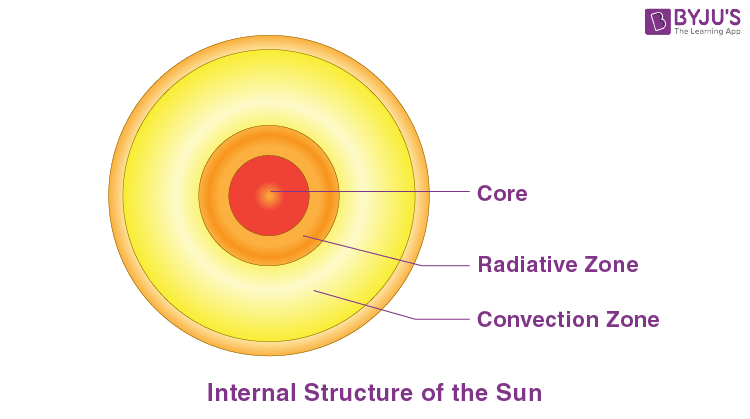
Dimensions of the Sun
Core: r = 200 million km
Radiation Zone: r = 300 million km
Convection Zone: r = 200 million km
Photosphere: n/a
Corona: n/a
Radiation Zone: r = 300 million km
Convection Zone: r = 200 million km
Photosphere: n/a
Corona: n/a
8
New cards
Temperatures of the Sun
Core: T = 15 million K
Radiation Zone: n/a
Convection Zone: n/a
Photosphere: T = 6,000 K
Corona: T = 1-2 million K
Radiation Zone: n/a
Convection Zone: n/a
Photosphere: T = 6,000 K
Corona: T = 1-2 million K
9
New cards
solar cycle
the 11 year period where the regions of magnetic polarity get a different charge; creates the butterfly pattern
10
New cards
butterfly pattern
the pattern created when sunspot pairs move towards the equator while their polarity regions do the same; over time more pairs are created and each pair lasts 3 cycles
11
New cards
solar maximum
the month and year where the sun has the most amount of sun spots during a solar cycle
12
New cards
solar minimum
the month and year where the sun has the least amount of sun spots during a solar cycle
13
New cards
Helium to Hydrogen Fusion
Input: 4 hydrogen
Output: 1 helium, 2 neutrinos, 1 gamma ray
Output: 1 helium, 2 neutrinos, 1 gamma ray
14
New cards
How to Tell Where a Sunspot Event Occurs
split the sun into degrees (counter-clockwise: O° at N, 90° at E, 180° at S, 360° at W) and use Universal Standard Time (UT/UST) and radius; ex: "event happened at 90° and .45 solar radii at 05:00 UT"
15
New cards
How long does the sun take to rotate?
26 days
16
New cards
How many times does the sun rotate in one Earth year?
12 times
17
New cards
granulation
when small sells push (convect) plasma, and therefore heat, out of and back into the sun's photosphere from the convection zone
18
New cards
coronal holes
the source of solar wind through open field lines; winds are 400 km/s at the equator and 800 km/s at the poles
19
New cards
coronograph
a regular camera with a dark disk in front so that the disk of the sun is blocked and you can see sun's corona (atmosphere)
20
New cards
sunspots
seen in H-alpha wavelengths; they are the footprints of coronal loops
21
New cards
coronal loop
a thick bundle of magnetic field lines that is in a ring-like shape and goes from the convection zone up through the photosphere; we see plasma running up and down through field lines; can become a coronal mass ejection (CME)
22
New cards
coronal mass ejection (CME)
when a coronal loop accelerates out from the sun's interior making the tension too strong when at a point the plasma cuts off
23
New cards
Two Main Solar Events
1. from the whole disk: Solare Flares
2. from the limb: Coronal Mass Ejections (CME)
2. from the limb: Coronal Mass Ejections (CME)
24
New cards
solar flare
when radiation is emitted from the sun in large quantities; higher mass particles are damaging to humans and electronics
25
New cards
hydrostatic equilibrium
when a star's radiation pressure is equal to the pressure of its gravity
26
New cards
parallax
an measure to help find the distance of a star from earth or from the sun; D(in parsecs) = 1 / parallax angle (in arc seconds)
27
New cards
parallax example
parallax angle = 0.05° --> 1 / 0.05° = 20 parsecs
28
New cards
absolute luminosity
luminosity at 10 parsecs as shown on the HR diagram
29
New cards
apparent luminosity
luminosity measured from Earth
30
New cards
Distance of 1 Parsec
1 parsec = 3.26 light years
31
New cards
What is the nearest star to us?
Proxima Centauri, at 1.3 parsecs away (4.2 light years)
32
New cards
blackbody curve
shows how much of each wavelength of light an object produces
33
New cards
Inverse Square Law
I(N) = I(1)/N^2
34
New cards
Inverse Square Law Example
"intensity at 10 parsecs is 100 solar luminosities, what is the intensity at 50 parsecs?"
I(1) = 100, N = 5 (50 is 5x more than 10) --> I = 100 / 5^2 = 4 solar lum.
I(1) = 100, N = 5 (50 is 5x more than 10) --> I = 100 / 5^2 = 4 solar lum.
35
New cards
spectroscopic parallax
method of finding the distance to a star
1. look at absorption spectra to determine spectral class and luminosity class; the elemental content determines spectral class and the thickness of lines determines luminosity class (big line = little star and vice versa)
2. look at place on HR diagram and read off absolute luminosity
3. measure apparent luminosity from Earth
4. use inverse square law to determine distance
1. look at absorption spectra to determine spectral class and luminosity class; the elemental content determines spectral class and the thickness of lines determines luminosity class (big line = little star and vice versa)
2. look at place on HR diagram and read off absolute luminosity
3. measure apparent luminosity from Earth
4. use inverse square law to determine distance
36
New cards
Star Evolution Process
MS to RG: helium ash compacts as the hydrogen shell burns and
H-->He fusion begins. The temperature increases to 100 million K so the star expands to release heat and He-->C fusion begins after a helium flash
RG to HB: the star shrinks until radiation pressure is equal to gravity and the temperature of the core is 250 million K
HB to SRG: carbon ash compacts as density, T(core), and R(star) increase while the R(core) decreases
SRG to PN: the He and H shell burns and when R(star) = 500 solar radii the star's atmosphere moves away
PN to WD: the core becomes C and O while T(surface) increases and L(star) decreases, becoming a white dwarf
H-->He fusion begins. The temperature increases to 100 million K so the star expands to release heat and He-->C fusion begins after a helium flash
RG to HB: the star shrinks until radiation pressure is equal to gravity and the temperature of the core is 250 million K
HB to SRG: carbon ash compacts as density, T(core), and R(star) increase while the R(core) decreases
SRG to PN: the He and H shell burns and when R(star) = 500 solar radii the star's atmosphere moves away
PN to WD: the core becomes C and O while T(surface) increases and L(star) decreases, becoming a white dwarf
37
New cards
Is the mass of the average star smaller than that of our sun?
Yes
38
New cards
open cluster
a cluster of younger, blue and white colored stars formed in the spiral arm of galaxies with many other smaller, unseen stars in the cluster
39
New cards
globular cluster
a cluster of mostly older, mostly red and white stars located in random orbits in the halo of a galaxy (ex: Pleides)
40
New cards
dark cloud
the dark cloud of gas and dust where star formation occurs
41
New cards
emissions nebula
appear red/orange in color; found near stars emitting lines of hydrogen (i.e. strong radiation) in the dust lanes (regions of more dust where stars form); key: red = hydrogen and star formation
42
New cards
reflections nebula
appear blue/white in color; close-by starlight reflects off the dark cloud; key: blue = helium and light reflection